A Place at Supper
by Z. Marlow
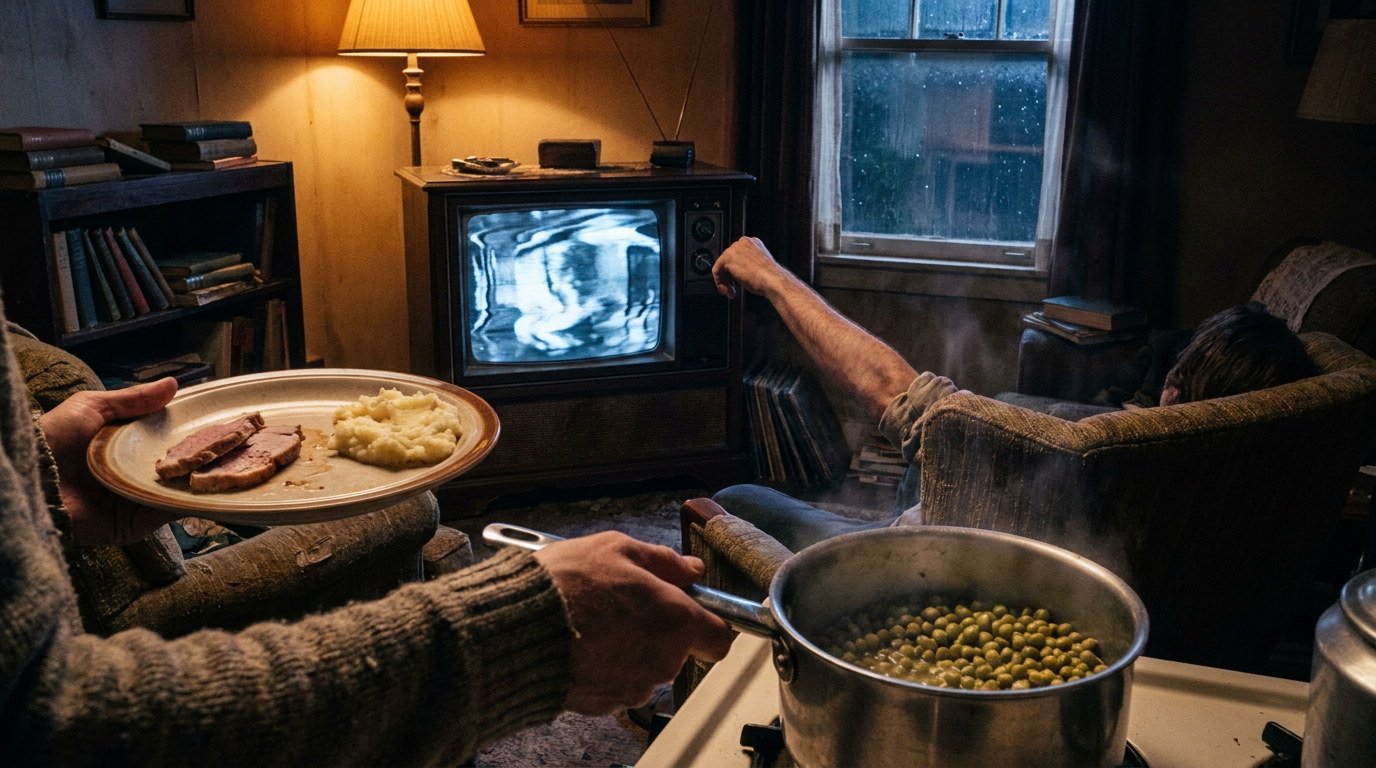
3 min readI carried the supper through before the picture settled. The potatoes were already losing their steam, and the peas had wrinkled in the saucepan while I struck the side of the television with my palm.
The cable men had been along our street that week. They drilled through the front walls and left a white wire pinned above the skirting, neat as piping on a cake. Mine entered behind the television and smelled faintly of hot dust.
There was little worth watching. A quiz, a sermon, a play in which everyone stood too close together. I left the set muttering to itself while I ate from a tray.
Since Arthur died, I had taken to eating in the sitting room. The kitchen table seemed indecently large for one plate. In the sitting room, at least, there were voices.
I was buttering a potato when the picture changed.
It showed a woman laying a cloth across a table.
For a moment I thought it was an advertisement. Then I saw the wallpaper behind her, yellow roses on cream. Mine was yellow roses on green. Her mantelpiece had the same shallow crack at the left corner. Her window was where mine was, though the curtains were blue and hung an inch too short.
She was perhaps my age. Her hair was pinned in the same practical roll I wore when cooking, but she had put the pins in from the wrong side. She moved through the room without looking at the camera.
No words appeared. There was no music. I could hear only the small sounds of her supper: a spoon against china, the stiff complaint of a drawer.
I put down my fork.
Her table stood where mine had stood before Arthur became ill. She used our brown plates, or plates very like them. One had a white chip on the rim. She placed it at the near end, turned the chip away, then reconsidered and exchanged it for another.
That was something I always did for Arthur.
A man came in carrying the evening paper.
He was older and heavier than Arthur had been. His hair was almost white, and he wore spectacles Arthur never needed. Yet he folded the paper lengthwise before setting it down. He rubbed his thumb over the place where his wedding ring sat. When the woman reached past him, he touched the small of her back without looking up.
I knew that touch.
The woman brought in the meat. She had overcooked it. Arthur would have praised it anyway, and so did the man, though I could not hear the words. His face made the old, kindly effort.
Then he took the carving knife and cut the crisp end from the joint.
He placed it on her plate.
The room seemed to draw very quiet around me. Even the refrigerator in the kitchen stopped its humming.
The woman was not me. Her nose was finer, her shoulders narrower. She wore my apron but had threaded the neck strap through the buckle incorrectly. She had nearly my life, furnished with nearly my things, and the man loved her in all the small ways Arthur had loved me.
That was the impossible detail the cable had brought into the house: not another room, nor another supper, but a stranger for whom my place had been kept warm.
I watched until they cleared the table. Before leaving, the woman gathered the crumbs into her palm and tipped them onto a saucer for the birds.
She forgot the crumb beside the salt.
Arthur always forgot that one too.
Afterward the screen returned to the sermon. A mild man was speaking about doors.
I switched the television off. In the dark glass, my sitting room appeared with its green roses, its single tray, and the white cable entering through the wall.
For several evenings I set two plates.
Nothing returned.
Still, when I carve a joint, I leave the crisp end untouched. It cools beside the knife while the television warms, waiting for someone who is almost hungry enough.