Before the Sound Arrives
by Z. Marlow
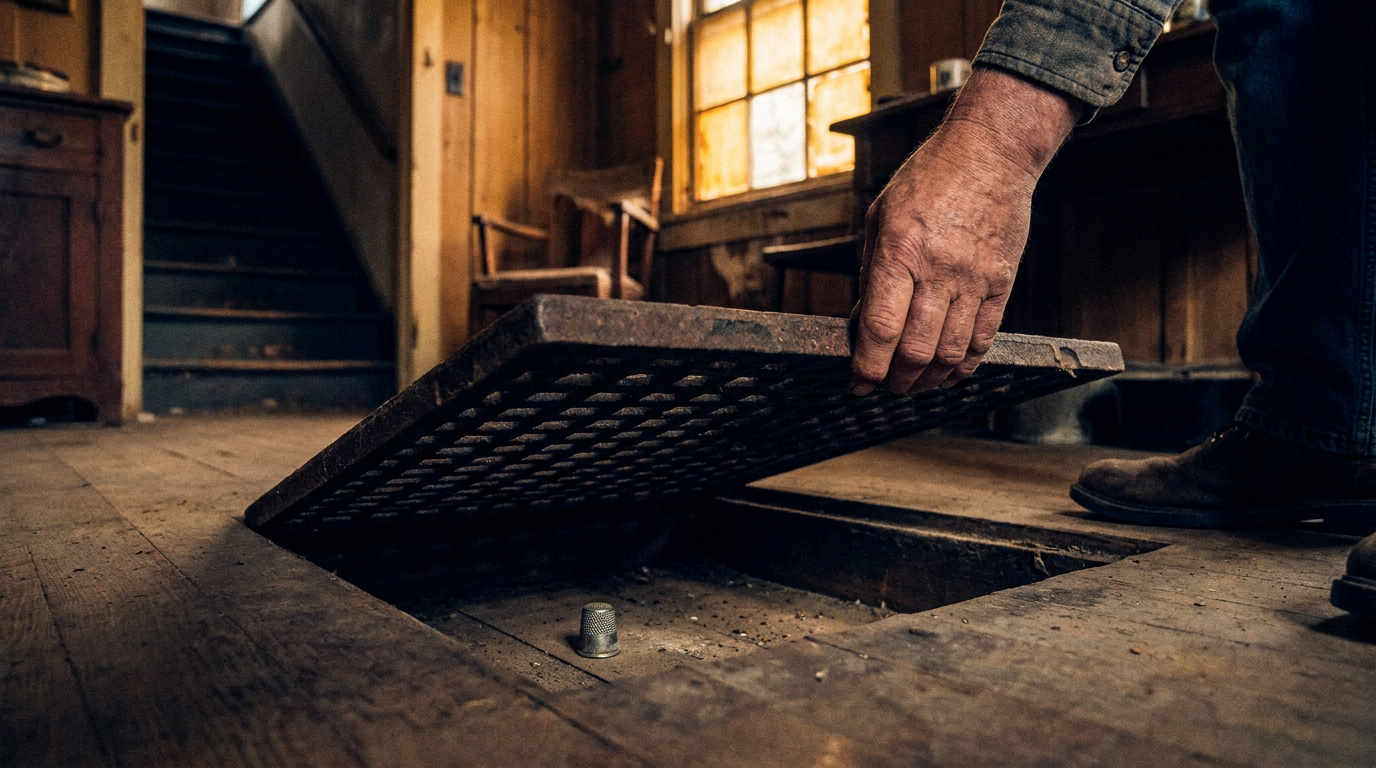
3 min readYou lift the grate to retrieve your thimble and hear the cup break downstairs.
It is a small sound, softened by distance: china striking the kitchen flags, followed by Mrs. Foss saying, “Oh, bother.”
Your thimble has rolled beneath the brass fins of the hot-air register. You find it among grey crumbs of coal dust. While you are replacing the grate, the sound comes again, clearer this time, from the kitchen below.
Then Mrs. Foss says, “Oh, bother.”
At supper, she serves your tea in a cup without a handle.
“I heard it break before it broke,” you tell her.
Mrs. Foss butters her bread to the edges. She has kept the house on Bellweather Row since her husband’s lungs failed, and meets every difficulty with the same square patience.
“The flues carry noises,” she says.
“Upward?”
“Generally.”
“Before they happen?”
She looks at the register near the stove. Its little brass shutter is closed.
“Generally not.”
The house was built for winter. A furnace crouches in the cellar, feeding warm air through brick channels to every room. The registers breathe out smells of scorched dust, boiled cabbage, boot polish, and sometimes the lavender soap Mrs. Foss keeps wrapped in blue paper.
After the cup, you begin to listen.
On Tuesday, the grate beside your bed gives a dry click and a man coughs beneath the floor. Half an hour later, Mr. Pelling returns from the rain and coughs in precisely that way while removing his coat.
On Thursday, you hear three slow knocks. That evening, someone comes to the front door and knocks three times. When Mrs. Foss opens it, the step is empty. A wet footprint darkens the stone, narrow at the heel, as if left by a bare foot.
Mrs. Foss scrubs it away with salt.
After that, she closes the registers at dusk.
They open themselves.
The change begins at the bottom of the house. You hear each shutter turn in its frame: kitchen, parlour, first landing, Mr. Pelling’s room. The sound climbs through the walls, brass rubbing softly against brass.
Your own grate opens last.
Warm air touches your face.
From below comes the noise of the front latch lifting.
You wait, but the latch does not lift downstairs.
Not yet.
A moment later, the register gives you the sound of a door opening, then another. Footsteps cross the hall. They are light and unshod. They pause at each room as they climb.
You go to Mrs. Foss. She is already awake, seated upright in bed with her shawl around her shoulders.
“How far?” she asks.
“The first landing.”
She nods. “Help me with the wardrobe.”
Together you push it across her door. The wood complains against the boards. Mrs. Foss smells of lavender soap and sleep.
“Has this happened before?”
“Once,” she says. “My husband heard it.”
“What did he do?”
“He opened the door.”
Below you, the front latch lifts.
The house draws a breath.
Every register slams shut except the one in your room.
You understand then. The sounds have not been leaking backward by accident. The house has been passing them upward, room by room, giving each sleeper time. The flues are not its lungs.
They are its voice.
From your open grate, you hear yourself whisper, “It knows which room is empty.”
Mrs. Foss grips your hand.
The footsteps begin downstairs. They stop at the kitchen, then the parlour. At Mr. Pelling’s room there is a long pause, followed by the gentle settling of his mattress.
No one cries out.
The steps continue upward.
You and Mrs. Foss stand behind the wardrobe, listening as they pass her door and enter your room. The grate there closes with a small, satisfied click.
Morning comes thin and colourless. Mr. Pelling’s bed is neatly made. On your pillow lies a warm hollow, the size and shape of a resting head.
The furnace has gone out.
Still, when you hold your hand above the grate, something below breathes against your palm.