Before You Lift
by Z. Marlow
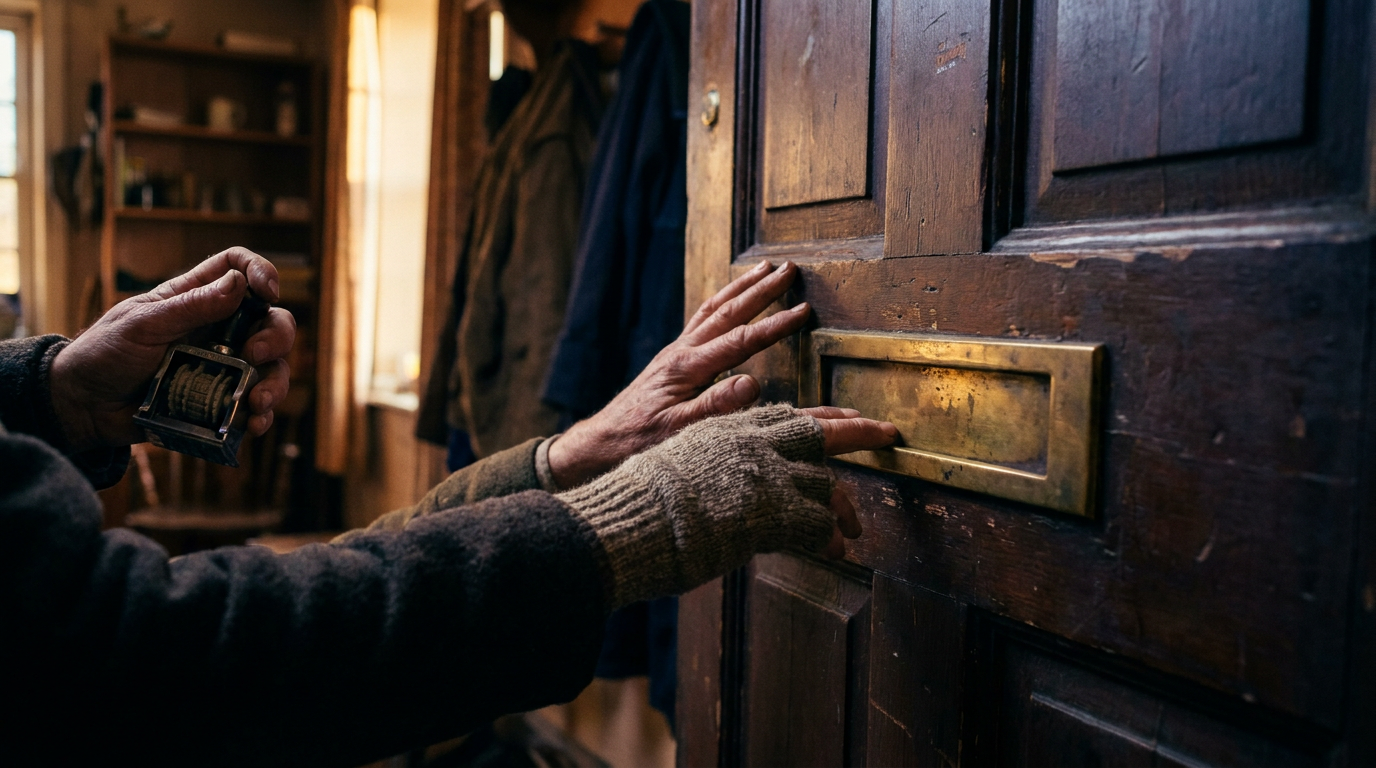
3 min readI caught Noll lifting Widow Prent’s letter flap without knocking, so I struck his knuckles with the date stamp.
Not hard. The stamp was oak, and the date was Tuesday.
“You’ll lose a finger that way,” I told him.
He laughed because boys from larger places laugh at useful advice. Noll had come from Bellweather, where the streets are numbered and the postmen wear red braid as if letters might respect a uniform. He considered our arrangements quaint. He had already called the sorting room a cupboard and asked why the town bothered employing him when the post delivered itself.
This was nearly true.
Every house in Blithe has a brass letter flap. Before raising it, the householder knocks twice upon the brass. Visitors are expected to do the same. Nobody can say when the custom began. Widow Prent claims it keeps moths from the envelopes. The butcher says it warns the postman to withdraw his hand. Since I have never put my hand through anyone’s flap, this is slander, though sensible slander.
I told Noll it was courtesy.
“To whom?” he asked.
That was Noll’s difficulty. He wanted a noun for everything.
The sorting room stands behind the post office counter. Its far wall is fitted with narrow pigeonholes, each bearing the name of a house. If I slide a letter into Curdle Cottage, it drops behind the flap at Curdle Cottage, though the cottage is beyond the millpond. Letters for the hill farms take longer. One hears them whispering through the wall like mice in dry grass.
No road is required. Rain never delays us. This is why our post office has only one umbrella, and that belongs to me.
Noll spent his first week testing the arrangement. He tied blue thread to an envelope addressed to the schoolmistress, then posted it through her pigeonhole. The thread went in after it until the reel spun bare. When he walked to the schoolhouse, the envelope was waiting on the mat, but the thread had not followed.
“It must be somewhere,” he said.
“Most things are,” I replied.
After that he began knocking.
Not from belief, of course. Noll was very particular about that. He knocked because Widow Prent threatened to box his ears, because children shouted reminders from windows, and because once, at the tannery, something knocked back.
He told me it had been an echo.
“Twice?” I asked.
“A double echo.”
There is no shame in making the world reasonable. We all do it. Some of us merely use better materials.
On the first cold morning, we found a new pigeonhole in the sorting wall. The wood around it was pale and damp. No brass label had been fitted, and when Noll held his candle near, the flame leaned inward.
He put his eye to the opening.
I ought to have stopped him. Instead I was counting stamps.
Noll remained there for some time. Then every letter flap in Blithe lifted at once.
The sound crossed the town softly: brass upon wood, brass upon wood, from the almshouses to the hill farms. A flock of little lids opening.
Noll stepped back. His face had changed, though only in the way a face changes when it understands that it has always been visible.
“What did you see?” I asked.
He would not answer.
I told him there was nothing to fear. I reminded him of children walking home after dusk, of old people falling beside cold hearths and being found before morning, of Widow Prent’s kitchen fire never once spreading beyond her own rug. Blithe takes notice. That is hardly monstrous. Neglect is monstrous.
Noll left before Christmas.
The new pigeonhole remains. It has acquired a brass label, although I did not order one.
There is no house name on it.
Only a small engraved instruction:
KNOCK FIRST
So I do. Each morning, before I sort the post, I knock twice upon the wall.
Lately, something has begun lifting the flap.