Passage for Small October
by Z. Marlow
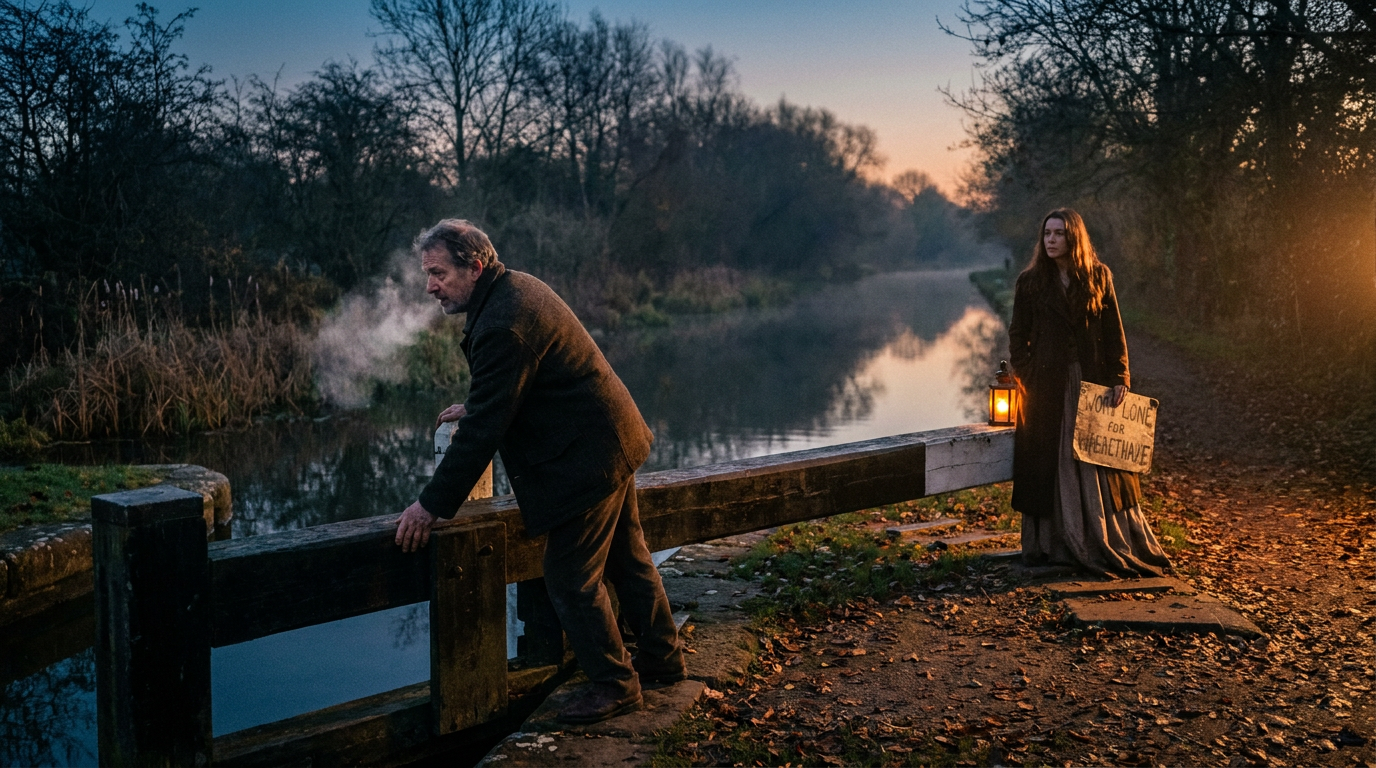
3 min readI am bringing the lower gate home when the woman steps off the towpath. She waits beside the balance beam, holding a painted board against her skirts. The evening is cold enough to silver her breath. Behind her, the canal lies flat among the reeds, carrying the last pale strip of sky.
“No more passages,” I tell her. “Not before morning.”
She looks into the empty lock. The brick walls are wet and green, though no boat has entered since noon. A little water trembles around the sill.
“I have no boat,” she says.
The board in her hands is oak, long and narrow, with screw holes at either end. Its paint has blistered from weather. Under the mud I can read the name Small October in faded yellow letters.
I know that name. Everyone along this reach does. Small October was a narrow grain barge, green in the bows, with a cabin stove that always smelled of baked apples. It went down beyond the alder turn during a winter flood. The woman’s husband and younger daughter went with it.
She rests the board on the coping stone.
“It never came through,” she says.
“There was nowhere for it to go.”
“Even so.”
The upper pound presses darkly against the gates. I have shut both paddles. The chains hang slack, and the iron teeth of the gearing are still. I put my palm to the timber and feel the ordinary strain of held water.
The woman leans over the lock.
“Small October,” she calls.
The name leaves her mouth and passes into the masonry. I feel it under my boots, not as sound, but as the small internal movement of a key.
Water begins to rise.
It comes without foam or current. The wet line climbs the bricks while the paddle chambers remain closed. A smell of river mud fills the air, followed by coal smoke and warm apples. The woman takes my sleeve, gently, as if we are standing together at a burial.
At first there is only a reflection upon the water: a green bow, a folded tarpaulin, the dull shine of a kettle in a cabin doorway.
Then the barge gathers around its reflection.
Small October sits low in the lock. No rope holds it. No ripples touch the walls. The woman’s husband stands at the tiller in his patched brown coat, and their daughter kneels on the cabin roof, trailing one hand through water that does not move.
Others are aboard.
They stand close along the gunwales, people I remember from kitchens, towpaths, sickbeds. Old Nerris the cooper is laughing without opening his mouth. The twin boys lost under the mill wheel are wrapped in the same red blanket. Near the bow, my mother holds a basket of white currants.
Beside her stands a boy with scraped knees and a crooked fringe.
It is me, at eight years old.
My mother has remembered me there, and so I have not aged everywhere.
She looks up. Her lips shape the name she used when fever made me small enough to carry. No living person knows it now.
I do not answer.
The woman beside me raises one hand. Her husband inclines his head. Their daughter smiles, not sadly, and lays her palm against the inside of the hull where her mother’s hand rests against the outer plank.
I take the windlass and open the upper paddles.
This time the machinery moves. Water thunders into the lock, breaking the vision into long ribbons of green and gold. The gates strain, then loosen. When I push the beam, Small October passes upstream without wake or sound.
The painted board is blank now.
We stand together until the water settles. From below the closed gate comes the soft knock of another hull, patient in the dark, waiting for its name.