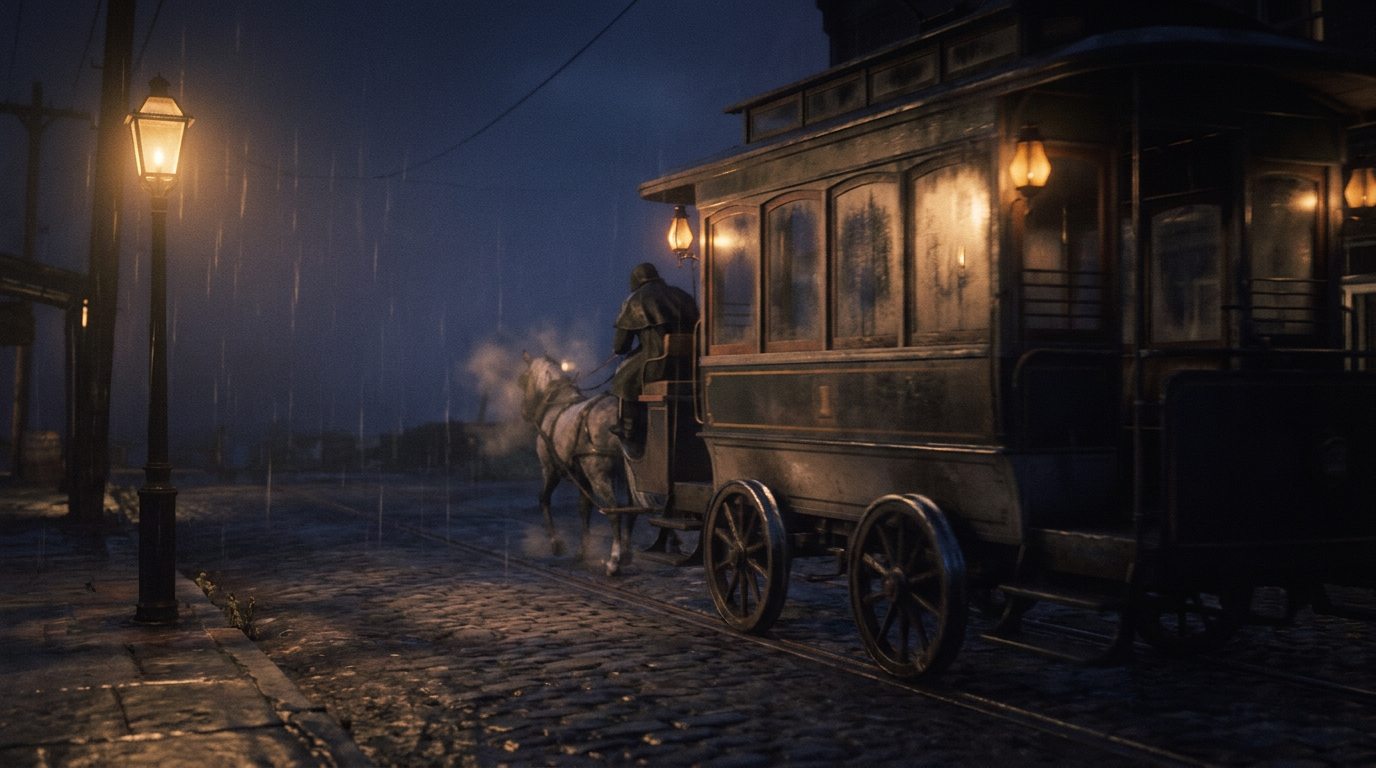
Rain on the Rails
by Z. Marlow
3 min readI was taking the last horse tram back to the stables when the rain thickened over Gannet Hill. The lamps had gone soft behind their wet glass, and Clement’s hooves struck the road with the patient sound of a spoon against an empty bowl.
There were no passengers. I had turned the seat cushions upright and swept two cigar ends into the gutter. My coat smelled of horse and damp wool. I remember these things clearly, or believe I do. At my age, certainty is often only a memory that has lost its rivals.
The tramway descended by the ironmonger's shop, crossed Bell Street, and continued straight to the stable yard. I had travelled it since boyhood.
That night Clement turned left.
There were rails beneath him. Rain lay in their grooves, bright as poured tin. I pulled the brake and climbed down, thinking the horse had wandered onto some freight siding, though no such siding existed. There was no points lever, no junction, only two shining lines bending between the shuttered houses.
Clement looked back at me. Then he continued.
The street narrowed. I knew every building and did not know them at all. The bakery stood where it should, but its chimney leaned east instead of west. The clock above Saint Orra’s had a blue face. A row of plane trees grew along the pavement, full grown and dripping, though Bell Street had never held so much as a flower box.
A woman waited beneath a lamp.
She was perhaps sixty, with rain darkening the shoulders of her green coat. When I stopped, she climbed aboard without asking where the tram went.
“You are late, Alden,” she said.
“My name is Arden.”
She studied me. Her expression did not change, but one hand closed around the other.
“Yes,” she said. “I see that now.”
She sat near the front. I did not ask for a fare. Clement went on willingly, as if the road were warm beneath the water.
The woman asked whether my left knee still troubled me in winter. I told her it never had. She asked after a yellow dog called Mercy, and I said we had kept only cats. Each answer seemed to confirm some private sorrow.
At last she looked at my hands.
“No burn,” she said.
I showed her my palms. They were young then, callused from the brake handle, but otherwise unmarked.
She laughed once, very quietly.
“He got his pulling June from the stove.”
I had never heard the name June. I told her so.
The woman moved closer to the window. She wiped a circle in the misted glass and watched the altered city pass. After a while she shifted on the bench and touched the empty place beside her, inviting me to sit.
I knew that gesture.
Not her face, not her voice. The small sweep of her fingers across the worn leather. The way she left exactly enough room for one person, trusting he would fill it.
It was the gesture my wife would make for me all our life.
I had not met her yet.
I sat beside the woman until Clement slowed. Through the rain I saw a little house behind a white fence. A lamp burned in its lower window. Someone had placed a pair of muddy child’s boots beneath the porch roof.
The woman rose.
“You are not mine,” she said, without bitterness.
“No.”
“But you came near.”
She touched my cheek. Her glove smelled faintly of apples stored through winter.
Then she stepped down, crossed the road, and entered the house. Before the door closed, a child called from within. I could not make out the word.
Clement carried me back by streets I recognized. At the stables, his coat was dry.
Years later, I met Mara on a ferry landing. She made room for me on a bench with that same small movement of her hand. Whether I told her about the tram before we married or afterward, I cannot now remember.
She never owned a green coat. We had no daughter called June. Mara’s left knee troubled her, not mine.
Last spring, long after her death, the council lifted the old rails from Bell Street. Beneath the proper junction, the workmen found another groove in the stone, worn smooth by wheels.
It turned left under the ironmonger's wall.
When it rains, water still gathers there, and sometimes, before morning, I find the print of a woman’s glove beside it.