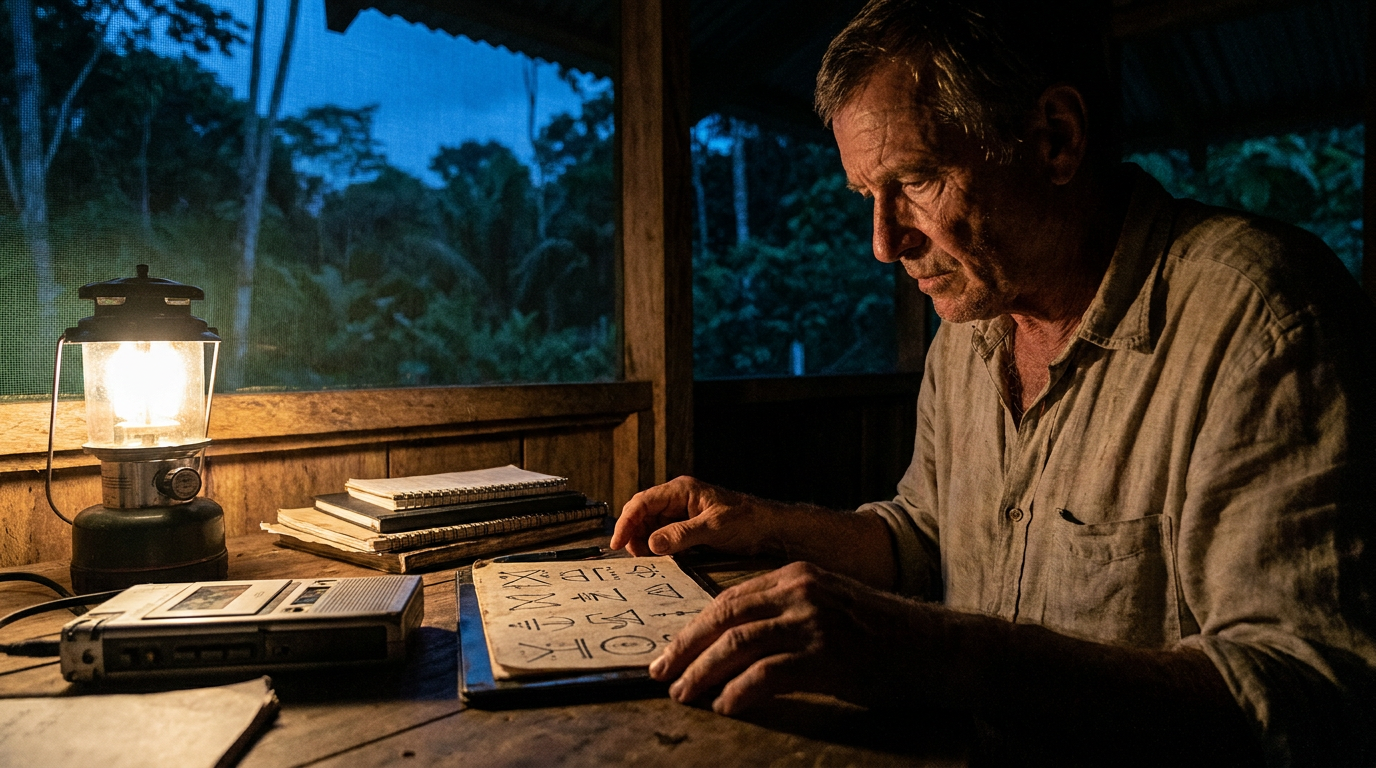
The Archaeology of Silence
by Z. Marlow
5 min readIn 2036, a linguist named Dr. Tomás Herrera was cataloging endangered languages in the Peruvian Amazon when he encountered something that shouldn’t exist: a language with no words.
The Oravá people, seventeen remaining members, uncontacted until 2034, communicated fluently, constantly, unmistakably. They argued. They told jokes (they laughed). They made decisions collectively. They sang their children to sleep.
But they produced no phonemes. No clicks, no tones, no whistles, no gestures, no sign. Their vocal cords were healthy. Their hearing was perfect. They simply… didn’t use sound. Or movement. Or any observable medium.
Herrera spent nine months with them. He learned nothing. He recorded thousands of hours of silence between people who were clearly, demonstrably, having rich conversations. His equipment detected no subsonic vibrations, no pheromones, no electromagnetic anomalies, no micro-expressions beyond what any human produces unconsciously.
They were communicating through nothing.
The Breakthrough
On month ten, the eldest Oravá woman, approximately 90 years old, name unpronounceable because it wasn’t a sound, sat across from Herrera, placed her hands on her knees, and looked at him.
And he understood her.
Not words. Not concepts. Not images. He described it later as: “She meant something at me, and I had it. Like remembering something I’d always known but had never accessed. The information was already inside me. She just… pointed at it.”
What she communicated, and he is certain of this, was:
"Language is a prosthetic. You built it because you broke something. We never broke it. What you call 'telepathy' is not transmission. It is co-remembering. All minds are one mind, pretending to be many. Words are the walls you built to maintain the pretense. We never built walls. We remember that we are one. We always have."
The Test
Herrera, shaking, asked (aloud, in Spanish, she understood him, as she understood everyone): “If all minds are one, why can’t I hear the others? Why only you?”
She communicated:
"You can. You do. Constantly. You call it 'intuition.' You call it 'gut feeling.' You call it 'thinking of someone right before they call.' You call it 'the vibe of a room.' You are swimming in the shared mind every moment of your life. You simply refuse to believe the water is real. We never refused. That is the only difference between us."
The Experiment
Herrera returned to Lima. He contacted a neuroimaging lab. He proposed an experiment: put an Oravá elder in one fMRI machine and a complete stranger, someone who had never met them, didn’t know the study’s purpose, in another, in a separate building, three kilometers away.
The elder would “communicate” a specific piece of information: a number between 1 and 1,000.
The stranger would be asked to “guess” a number.
They ran it 200 times.
The stranger was correct 200 times.
Not approximately. Not above chance. Every single time.
The neuroimaging showed something unprecedented: at the moment of “communication,” both brains, three kilometers apart, no possible physical link, entered exactly the same state. Not similar. Not correlated. Identical. Down to individual neuron firing patterns. As if they were, for that instant, the same brain in two skulls.
The Collapse
The paper was written. Peer-reviewed. Accepted by Nature Neuroscience.
Then, 48 hours before publication, every author retracted. Simultaneously. Without coordinating. Each one, when contacted by the journal, gave the same answer, word for word, despite being in different countries:
"We are not ready. The species is not ready. This is not a discovery to be published. It is a door to be opened only when we will not be afraid of what is on the other side. And we are still afraid."
When pressed on who told them to retract, each said: “No one told me. I simply knew. The way you know your own name.”
The Disappearance
In 2039, a follow-up expedition to the Oravá found nothing. Not an abandoned village. Not remains. Not artifacts. The clearing was gone. Satellite imagery from 2037 shows dense, unbroken canopy where the village had been, and retroactive analysis of older satellite images showed the same. Dense canopy. In every image. Going back to 1972.
As if they had never been there.
As if the only evidence they ever existed was in the memories of those who met them.
The Letter
In 2044, Dr. Herrera received a letter. No postmark. No return address. No stamp. It appeared inside a sealed drawer in his locked office. It was written in his own handwriting, but he had not written it.
It read:
"Tomás.
You're wondering if we were real. We were. We are. We are you. Not metaphorically. The seventeen of us were not a separate people. We were the part of humanity that never forgot. Every generation, there are some who don't build the walls. Who remain in the open water. Who keep the channel clear.
We didn't disappear. We dissolved back. The demonstration is over. You saw what you needed to see. Now you have a choice, not whether to believe it, because you know it's true, but whether to live as though it's true.
Every person you will ever meet is you. Wearing a different face. Having a different dream. But you. The loneliness you feel is an illusion so convincing that it became civilisation's founding myth. You built cities to be near each other because you forgot you already are each other.
You don't need to tell the world. The world already knows. It's just pretending not to. The pretending is part of the game. The game is almost over.
When it ends, and it will end, gently, like a breath releasing, there will be no apocalypse. No rapture. No dramatic conclusion. There will simply be a moment when eight billion people look at each other and stop pretending they don't recognize themselves.
And in that moment, language will become unnecessary. Because you will remember what we never forgot:
There was only ever one of us.
Dreaming it was many.
For the joy of meeting itself.
Again. And again. And again."
At the bottom of the letter, in different handwriting, childlike, unsteady, as if written by someone just learning to hold a pen:
"P.S. You're doing so well. All of you. We're so proud. Keep going. The best part is coming."
You just read this alone. But you weren’t alone while you read it.