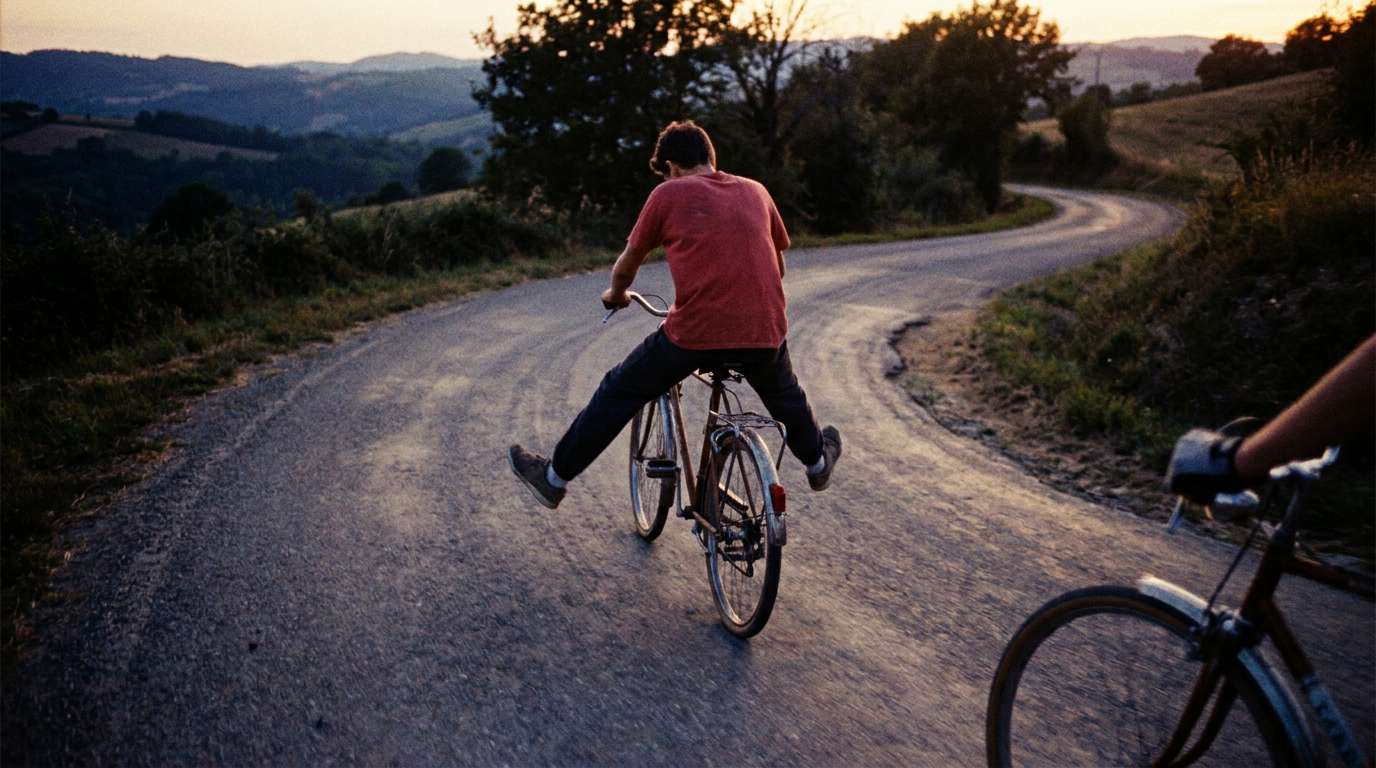
The Bend Looking Back
by Z. Marlow
3 min readSenn coasted ahead of me into the hairpin, both feet lifted from the pedals. I remember his shirt as red, though in the one photograph we have from that summer it is plainly mine.
We were taking a loaf to Aunt Lio, who lived above the quarry road. The bread was warm inside my satchel. Each time I pedalled, its crust rubbed against the paper with a dry, confidential sound.
The mirror had been put up that spring. It stood on a striped post at the bend, a round silver face tilted toward the road. Before it, carts and lorries had announced themselves with the horn. Afterward, drivers merely glanced into that small curved country where the road appeared wider, brighter, and farther away than it was.
We liked the mirror. It made our bicycles slender as needles and bent the cypress trees toward one another. If Senn rode fast enough, he claimed he could enter the reflection before his reflection had time to arrive.
I am no longer certain he said this. It sounds like something I might have invented later.
That afternoon the air smelled of fennel and hot tar. Halfway up the hill, I looked toward the mirror and saw an old woman standing in it.
She was not on the road ahead of us. The reflected bend was empty except for her. She wore a pale coat, wrong for summer, and held one hand upright with the palm toward us.
I stopped.
Senn struck my back wheel and swore. Then the cream lorry came around the bend, close enough that its canvas side brushed the flowering grass. The driver never saw us. I remember the warm breath of the engine, and one blackberry leaf trembling after it had gone.
When we looked again, the old woman had disappeared.
Senn said she had been Aunt Lio, though Aunt Lio was waiting at her gate in a blue apron. Later he said there had been no woman. Much later, over drinks at his kitchen table, he insisted there had never been a mirror on the quarry road at all.
We did not agree about the loaf either. He remembered dropping it. I remember eating it with Aunt Lio while the quarry dust settled on the jam.
I went back to the village after Senn died. The quarry had filled with rain, dark and smooth between the pines. Aunt Lio’s house was a roofless square where sheep stood out of the weather.
The mirror remained at the hairpin.
Its rim was rusted through at the bottom. Someone had tied a sprig of dry lavender to the post. I could see no reason for it to be there now. The road beyond the bend had fallen away, and a newer road crossed the hillside below.
I wiped the glass with my sleeve.
Two children were pushing bicycles up through the reflected summer. Fennel leaned over the ditch. One child had a satchel with the corner of a loaf pressing through the paper.
The other wore a red shirt.
They were not behind me. Behind me there was only the broken road, wet weeds, and the ticking of my rented car as its engine cooled.
The children came nearer. I could see their solemn, sun-browned faces.
Then I saw the cream lorry above them, hidden by the bend.
I raised my hand.
The smaller child looked directly at me and stopped.
At that same instant I understood why my memories of that day have never belonged properly to either Senn or me. I had not remembered the woman in the mirror.
I had remembered being seen by her.
The lorry passed through the glass without a sound. After it was gone, the children continued uphill. Neither looked back.
On my way down, I stopped at each of the new mirrors along the lower road. They held the evening faithfully: stone walls, clouded sky, the pale sweep of my headlights.
In every one, just at the farthest curve, someone had raised a hand.