The Cartography of Sleep
by Z. Marlow
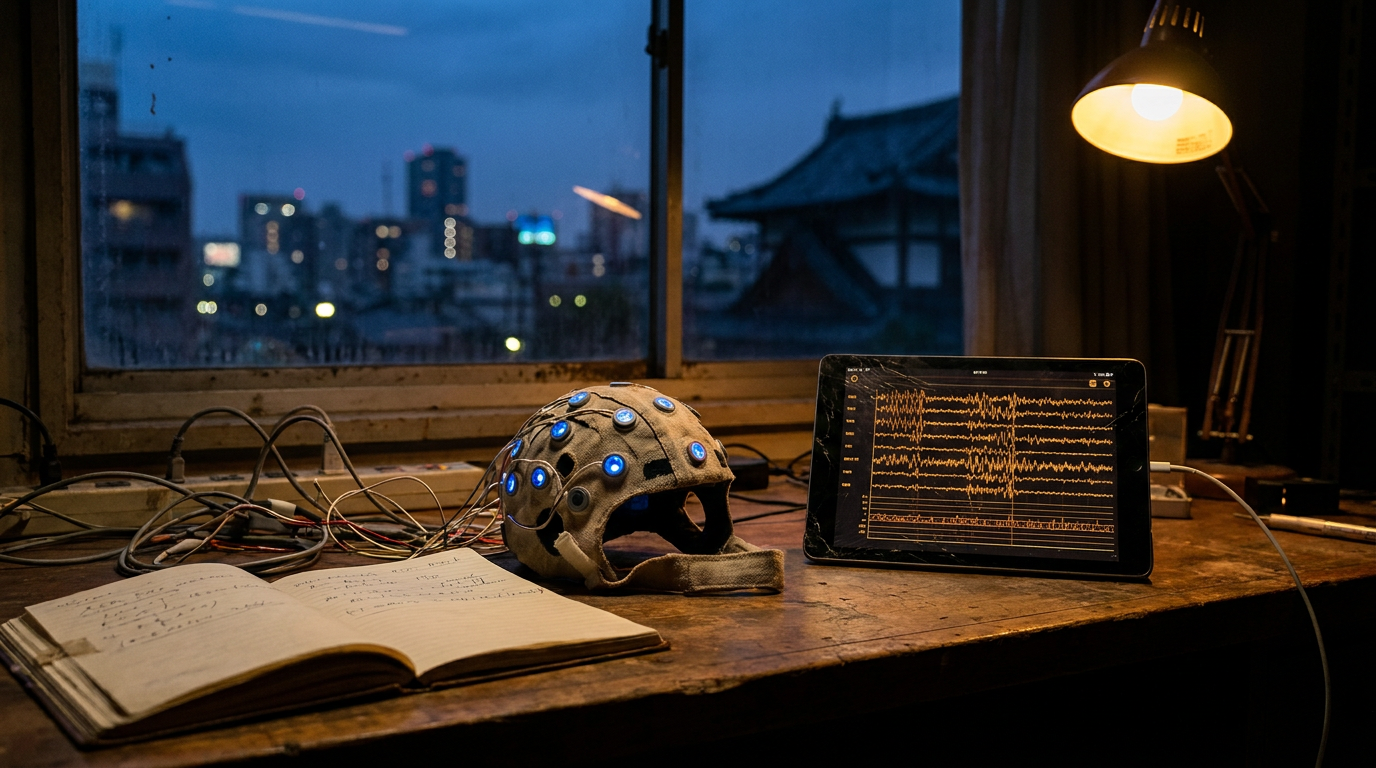
2 min readIn 2027, a distributed neuroscience lab in Kyoto accidentally left a prototype EEG mesh running on 2,400 sleeping volunteers simultaneously. The mesh wasn’t just recording brain activity, it was cross-correlating it in real time. What they found broke three researchers and got the project permanently defunded.
During deep REM sleep, between 3:00 and 3:44 AM local time, roughly 7% of all sleepers were navigating the same place.
Not similar imagery. Not archetypes. The same topologically consistent space, a vast, sunless city with non-Euclidean architecture that nonetheless obeyed its own internal geometry perfectly. Subjects who had never met drew maps that overlapped. Street names, in a language no linguist could identify, matched between strangers on different continents.
They called it Meridian.
One volunteer, a retired cartographer named Elias Brandt, became obsessed. He slept 16 hours a day for five months, mapping Meridian systematically. His maps grew more detailed than any single dreamer should have been able to produce. He identified districts, transit systems, a harbor with no water, just a flat, black mirror that reflected a sky none of the waking world has ever seen.
Then he found the Library.
A building at Meridian’s center, enormous beyond reason, whose shelves contained books written in the handwriting of every sleeper who had ever visited. Most were gibberish. But some, some, contained technical schematics for devices that don’t exist. One, later reviewed by a materials physicist, described a coherent method for lossless energy storage using a crystalline lattice structure that violated no known laws of physics but had simply never been conceived by anyone awake.
Brandt’s final map entry, dated November 3, 2027, reads:
"The Librarian noticed me today. It has no face but I know it was looking. It placed a book on the returns desk and pushed it toward me. The cover said my name. I didn't open it. I don't think I'm supposed to open it while I'm still coming back."
Elias Brandt stopped sleeping on November 4, 2027. Voluntarily. Chemically. He has not slept in, according to his medical team, 847 days. He should be dead. He is not dead. He says he can still see Meridian “at the edges,” and that the Librarian is patient.
The Kyoto lab’s servers were wiped. But the maps circulate. And if you look at them long enough, really study the street layouts, some people report that they recognize them.
Not from waking life.
From last night.