The Coat on Bell Street
by Z. Marlow
3 min readI was taking my father’s coat to Bell Street when I first understood why people in Mallowby dressed the broken lamps.
That is not quite right. I understood it years later. At the time I was twelve, or nearly twelve, and angry with my mother for giving away something that still smelled of him. Tobacco, rain, and the peppermint drops he kept loose in the right pocket.
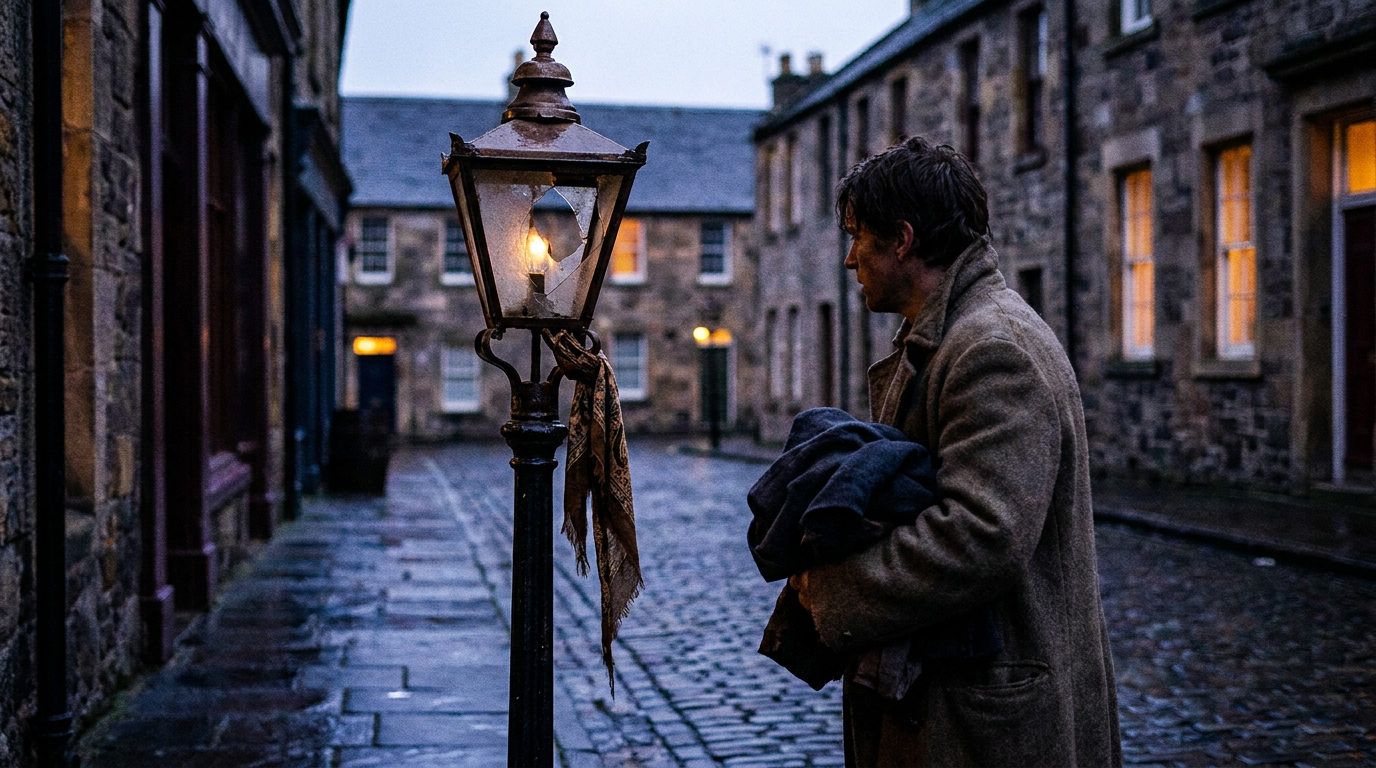
In Mallowby, when a streetlamp went out, the nearest house hung a coat from the little iron crossbar beneath its lantern. Nobody called the electrician first. Nobody left the pole bare.
The coat had to be clean. It had to have all its buttons. A child’s coat was permitted, but never a hat by itself.
I asked why, as children do. Mrs. Pell said it kept the rain off the wiring. Mr. Rusk said it showed the repairman which lamp was faulty, although a dark lamp needs little advertisement. My mother only said:
“It is discourteous to leave anyone standing in the dark.”
I think Bell Street came before my father’s funeral. I also remember snow in the churchyard, and there was no snow that year. Memory lays weather where it pleases.
The lamp stood outside the shuttered bakery. Its glass was clear, its bulb unbroken. It simply would not shine. Under it, rain had gathered in a shallow place between the cobbles.
I climbed the inspection step and looped Father’s coat over the crossbar. The sleeves hung down on either side of the pole. For a moment it looked occupied.
Then I saw the puddle.
The lamp reflected there was burning.
Its light was not merely the pale patch a wet stone sometimes holds. I could see the yellow glass, the black cap above it, and a row of windows descending into a street that seemed to continue beneath my shoes. Rain fell upward through it.
My father stood under the reflected lamp.
He was younger than at his death, though not young. He had his hands in his trouser pockets, shoulders lifted against the cold. He looked impatient, which comforted me. Grief had made everyone speak of him as patient and gentle, but he had disliked waiting for anything.
He raised one hand.
I nearly stepped into the puddle.
Someone caught the back of my jumper. I remember my mother’s wedding ring against my neck. I remember her saying my name once, softly. Yet she always denied coming with me, and I cannot recall walking home beside her.
When I looked again, Father was wearing the coat.
Above us, it still hung from the crossbar.
This is the part I may have made larger in remembering. Perhaps the puddle moved. Perhaps a passing cart shook the reflection into the shape of cloth and shoulders. But I saw him put his fingers into the right pocket. His face changed when he found the peppermint drops.
He smiled.
The lamp came on over my head, and the puddle went black.
By morning the coat was gone. No one had taken it, or no one admitted to it. The electrician replaced nothing. He tapped the pole with his screwdriver and said there had never been a fault.
After that, I noticed that coats left on lamps were seldom collected by the families who hung them. They vanished overnight, even in still weather. Mallowby people did not speak of theft. They only buttoned another coat around themselves and went on.
I have lived elsewhere for many years. Here, broken lamps are marked with orange tape and repaired within days. Nobody dresses them.
Last November, the lamp outside my house went dark during rain. In the morning, a small blue coat was hanging from it, neatly fastened.
It was dry inside.
There was a peppermint drop in the right pocket, warm from someone’s hand.