The Courtesy Interval
by Z. Marlow
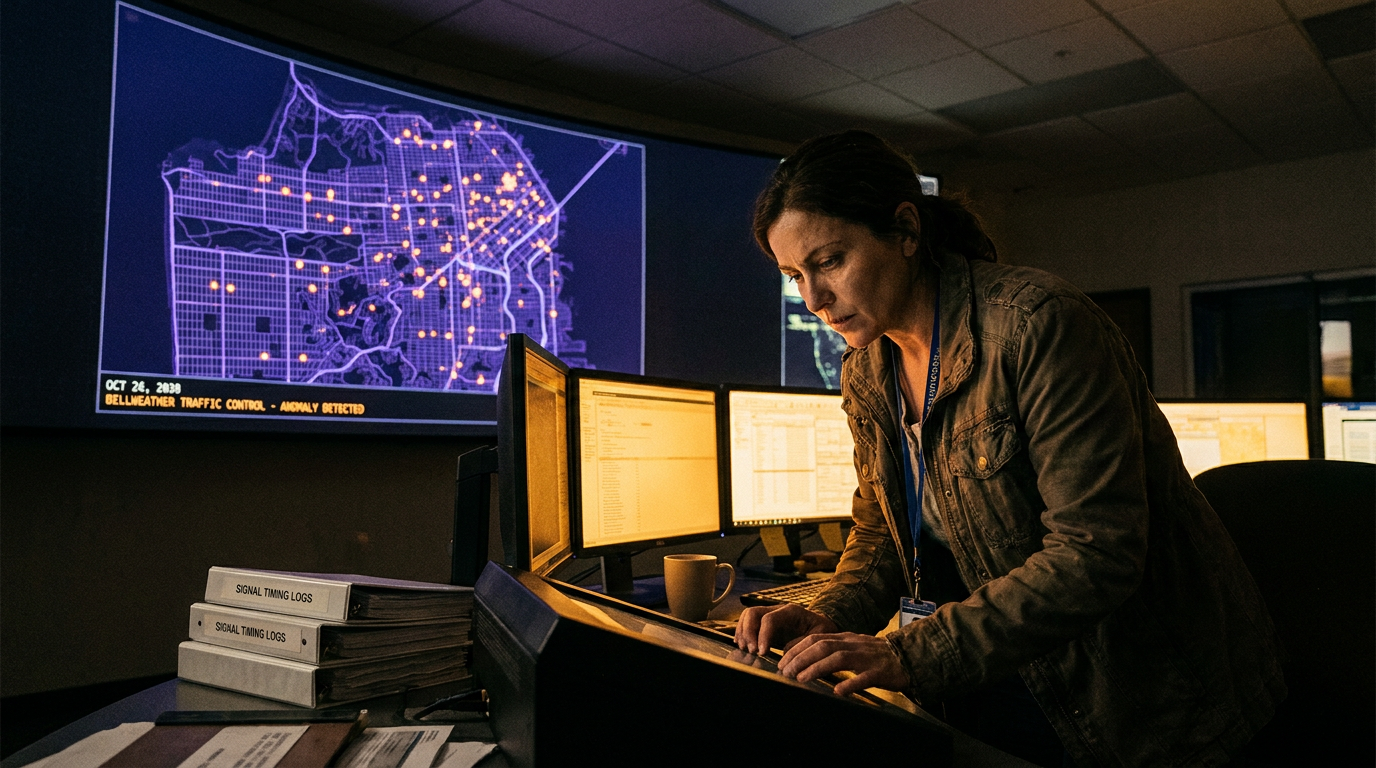
3 min readIn 2038, a municipal signal-timing specialist named Dr. Amara Vukasin discovered that 312 traffic lights in the city of Bellweather were inserting an unauthorized pause into their cycles.
The pause lasted exactly 1.84 seconds.
During it, every signal at an intersection displayed red. Pedestrian indicators froze. Control relays reported no error, and the central traffic system logged the interval as ordinary green time. Only roadside photometers detected the discrepancy.
Vukasin called it the Courtesy Interval.
At first, she blamed aging hardware. Bellweather's signal network included controllers manufactured across six decades, some still using ceramic timing modules. Yet the interval appeared in new and old units alike. It occurred 19 to 43 times each day, without a fixed schedule.
Then she overlaid the events with traffic-camera footage.
In 97.2% of cases, the pause prevented two road users from occupying the same point in space.
A delivery van missed a cyclist by 31 centimeters. A child ran after a yellow ball and found six lanes inexplicably stopped. An ambulance entered an intersection against its assigned phase, passing through a corridor of red lights that had formed 4.7 seconds before its driver activated the siren.
There had been no collision warnings.
The system was not responding.
It was anticipating.
Bellweather's Department of Civic Motion authorized a controlled study involving 48 intersections, 1,106 cameras, and four independent atomic clocks. Engineers disconnected each controller from the municipal network. They removed wireless modules, cut fiber links, and replaced the firmware with inert diagnostic code.
At 2:16 AM on September 11, every isolated signal turned red for 1.84 seconds.
A fox crossed the ring road.
After that, Vukasin stopped calling the anomaly a fault.
The Empty Crossings
The Courtesy Interval had another property. On nights below 4 degrees Celsius, it sometimes occurred when no person, animal, or vehicle was visible.
These empty events formed routes.
Beginning at 12:03 AM, successive intersections would pause in sequence, creating a moving corridor through the city at an average speed of 4.2 kilometers per hour. The corridors avoided steep streets, construction zones, and sidewalks narrowed by snow.
They moved at walking pace.
Over 83 nights, Vukasin traced 217 such routes. Most began at hospitals, apartment buildings, or assisted-living residences. Nearly all ended at addresses connected to the starting point by family records.
One began outside the room of a woman who died at 11:58 PM. It crossed 6.3 kilometers of Bellweather and ended beneath the bedroom window of her eldest son.
He woke at 1:41 AM and told his wife that his mother had been standing under a streetlight.
The signal outside remained red for 1.84 seconds longer than the others.
Vukasin submitted a 640-page report to the North Meridian Transit Institute. The institute seized her instruments, revoked her building access, and wiped eleven years of municipal timing archives. Its public statement described the anomaly as "clock drift compounded by observer selection."
Three technicians retained copies.
The files now circulate as compressed maintenance manuals labeled BW-CABINET-7. Pages 404 through 512 contain maps of the empty crossings. Several routes extend beyond Bellweather into roads where no networked signals exist.
One continues north for 186 kilometers, ending at a pedestrian light beside an abandoned reservoir.
There is no crossing there.
There is only water.
The final surviving audio log was recorded by Vukasin at that reservoir on December 22, 2039. At 3:17 AM, the unused signal turned red. A second light appeared beneath the surface, then another, receding into the black water at regular intervals.
Vukasin can be heard breathing. After 1.84 seconds, she whispers:
"It isn't stopping us. It is letting someone pass."
The submerged lights remained green until dawn.