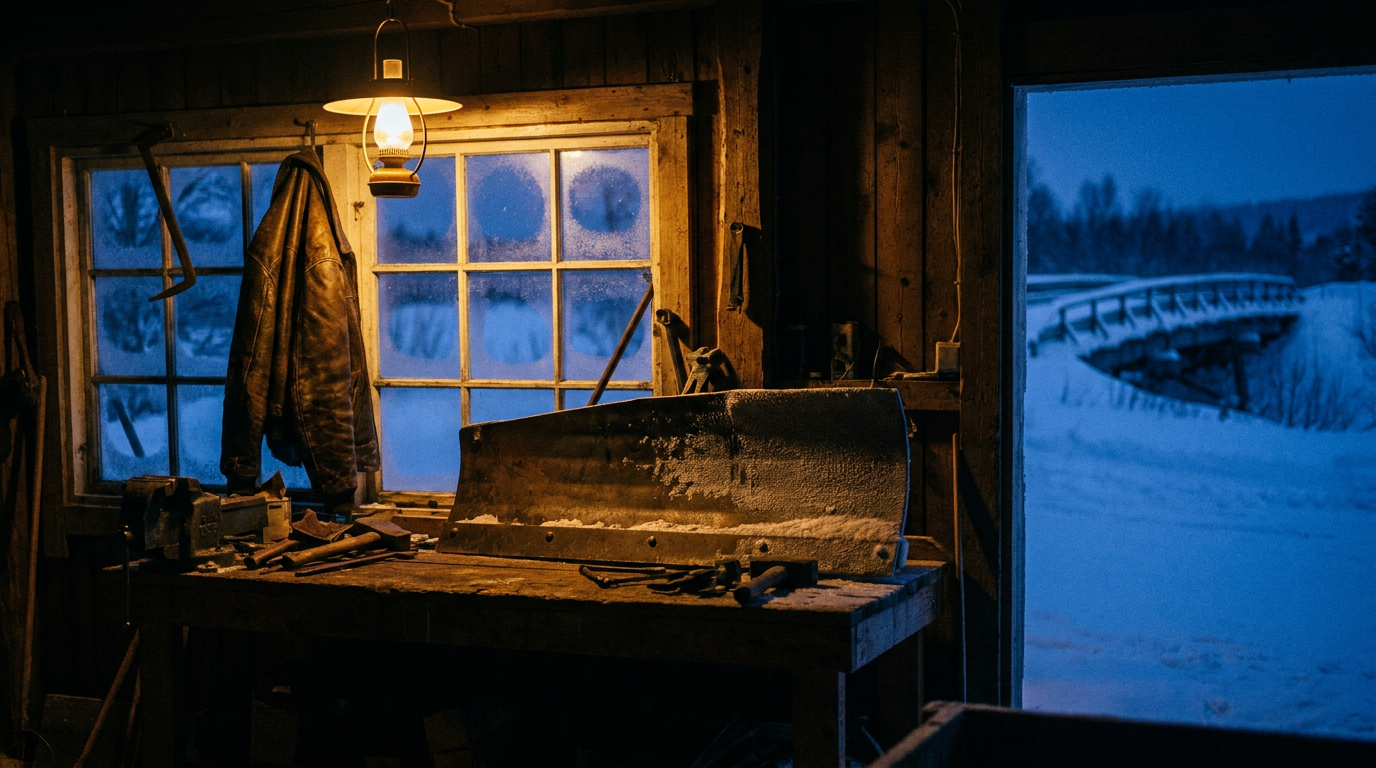
The Covered Crossing
by Z. Marlow
3 min readRuth Evale, former snowplough driver
“We left the narrow ridges because the council told us to. Every street in Cresset had one place where the blade must be lifted. No sign marked it. You were expected to know.
“The ridge ran from pavement to pavement, no wider than a doorstep. Children called it the covered crossing. They would jump over it on the way to school.
“I asked why we spared it. Old Mr Senn, who taught me the route, said the road needed somewhere to sleep.
“That was his sort of answer.
“The peculiar thing was that the ridge did not drift. Snow could be blowing hard enough to erase the churchyard wall, but that strip stayed straight. By morning it would have settled into a low white spine across the road.
“There were no footprints on it. Not on top.”
Ada Pell, road mason
“Ruth remembers instructions because she likes instructions. There was nothing written down. We left those places because everyone did.
“In summer, each crossing showed as a pale seam in the tarmac. We filled them every other year. Hot pitch, gravel, the iron roller. Next morning the seam would be back, neat as a knife-mark.
“On Lark Street we decided to dig it out properly. The frost had split the road deep enough to catch bicycle wheels. We cut a trench from one kerb to the other.
“A foot down, we struck stone.
“Not paving. Doorstones.
“They lay in a row beneath the road, side by side, each with a worn hollow in the middle. Some were slate, some sandstone, one was a piece of green marble that had no business being in Cresset. All of them faced the same way.
“North, Ruth says. She is wrong. They faced inward.
“We uncovered six before the foreman told us to stop. The fourth had a brass number set into it. Twenty-three.
“That was my house number.
“There was a little crescent of mud in the hollow, still damp. I knew the tread pressed into it. I had worn those boots that morning.
“Then the trench gave off a smell of boiled cabbage and coal smoke. My mother’s kitchen smelled like that when I was small. She had been dead eleven winters.
“I put the soil back myself.
“People say we were frightened. We were not. It felt indecent to leave a threshold uncovered in cold weather.”
Jon Senn, retired schoolmaster
“Ada found old foundations. This town has been built over itself more than once. Memory improves the workmanship.
“The custom is older than the ploughs, certainly. Before roads were surfaced, people laid boards across those places when snow came. My grandfather called them guest ways.
“He did not say guests from where.
“Ruth is also mistaken about the footprints. There were prints, but snowfall filled them before daylight. You could see the last shallow heel-marks at dawn if the sky was clear.
“They came up to the ridge from both pavements.
“None crossed over.
“That is why children were taught to jump. It was discourteous to stand where someone was waiting.”
Ruth Evale
“Jon makes a ghost of anything if you give him tea.
“Still, when I drove the plough, I lifted the blade.
“Everyone did.”
The last new house in Cresset was built beyond the old boundary, where no road had previously run. Its owners arrived in autumn and knew nothing of the custom.
At the first snow, a white ridge appeared across the fresh black surface outside their gate.
The kerbs had not yet been laid.