The Fox at Wren Cross
by Z. Marlow
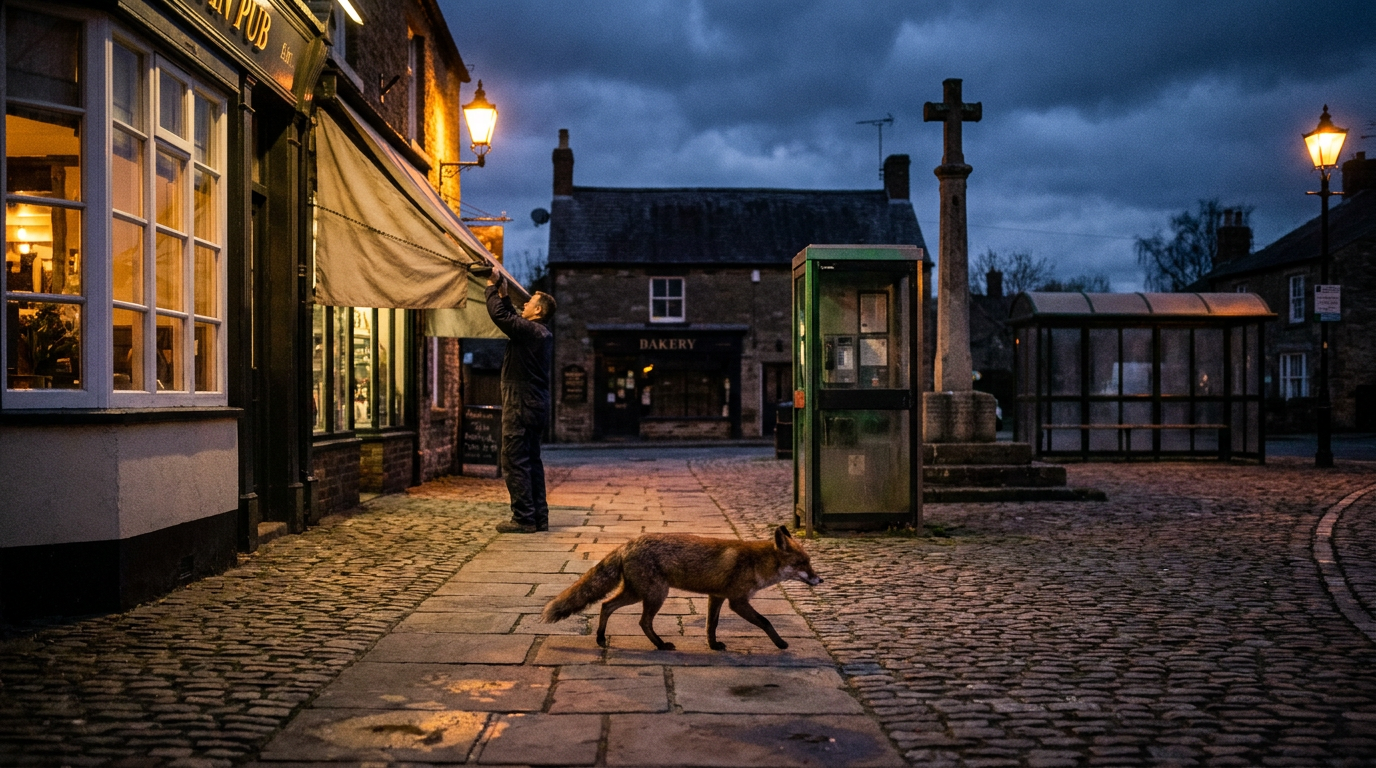
3 min readThe fox crossed the square each evening while I was pulling down the shop awning. It came from behind the bakery, passed the empty bus stop, and sat beside the green telephone cabinet at Wren Cross.
People noticed, of course. In a village, an animal acquires a biography almost at once. Mrs. Vale said it had been fed by the woman in the end cottage. The baker said it was waiting for mice warmed by the cables. Children left crusts, which the fox ignored.
My father would have known the old explanation. He had told it to me when I was small, back when the cabinet was a black wooden box fixed to a telegraph pole.
A fox, he said, can hear every word a person means to speak and does not. The words travel under the ground because they are ashamed of the air. If too many gather in one place, a fox comes to listen.
I had not thought of that story for years. By then my father lived at Hazel Mere, where they kept cut flowers on the dining tables and never quite removed the smell of boiled cabbage. A stroke had taken most of his speech. He could say yes, though it often meant no. He could say my name, but not my daughter’s.
I visited on Sundays. Sometimes.
The fox kept its place through November rain. Its coat darkened to the color of wet bark. It sat with one ear inclined toward the cabinet, patient as someone beside a sickbed.
Then the telephones along the east side of the square began to fail.
A man came in a grey van and opened the cabinet. I watched from the shop doorway. Inside were ranks of bright clips and loops of colored wire. They looked surprisingly domestic, like sewing things in a careful person’s drawer.
The man worked for an hour. Before closing up, he called me over.
“Does that animal belong to anyone?”
The fox was sitting three paces behind him.
I said no.
He pointed into the lower corner of the cabinet. Among the clean plastic fittings ran an old cloth-covered wire, brown with age. It descended through a hole too narrow for his tools.
“That should not be carrying anything,” he said.
He touched it with the back of one finger.
From somewhere beneath us came a soft succession of clicks.
The fox stood.
It did not look at the wire. It looked across the square, first at the bakery, then at the upstairs rooms above the chemist, then at the bus stop. At each place, a click sounded below our feet.
Then there was a pause.
The fox turned its head toward me.
My phone began vibrating in my pocket. The screen remained black. When I held it, I could feel no ringing pattern, only a faint, irregular tapping, exactly like my father’s finger against the arm of his chair when he was struggling to find a word.
I left the shop unlocked.
At Hazel Mere, he was awake by the window. Rain had gathered in the folds of the glass. He took my hand and pressed my palm flat upon his chest.
His heart moved under it, small and hurried.
For a long time he said nothing. Then he spoke my daughter’s name perfectly.
After that, he smiled. Not because he had surprised me, I think, but because I had finally answered.
My father died in spring. The old cabinet still stands at Wren Cross, though it carries no working lines now. The fox had cubs that year beneath the abandoned bowling hut.
On damp evenings they come into the square one by one. They do not sit beside the cabinet as their mother did. They sit outside particular houses, listening at the bricks.
When one waits beneath my daughter’s window, I go upstairs.
I never ask her what she has chosen not to say.