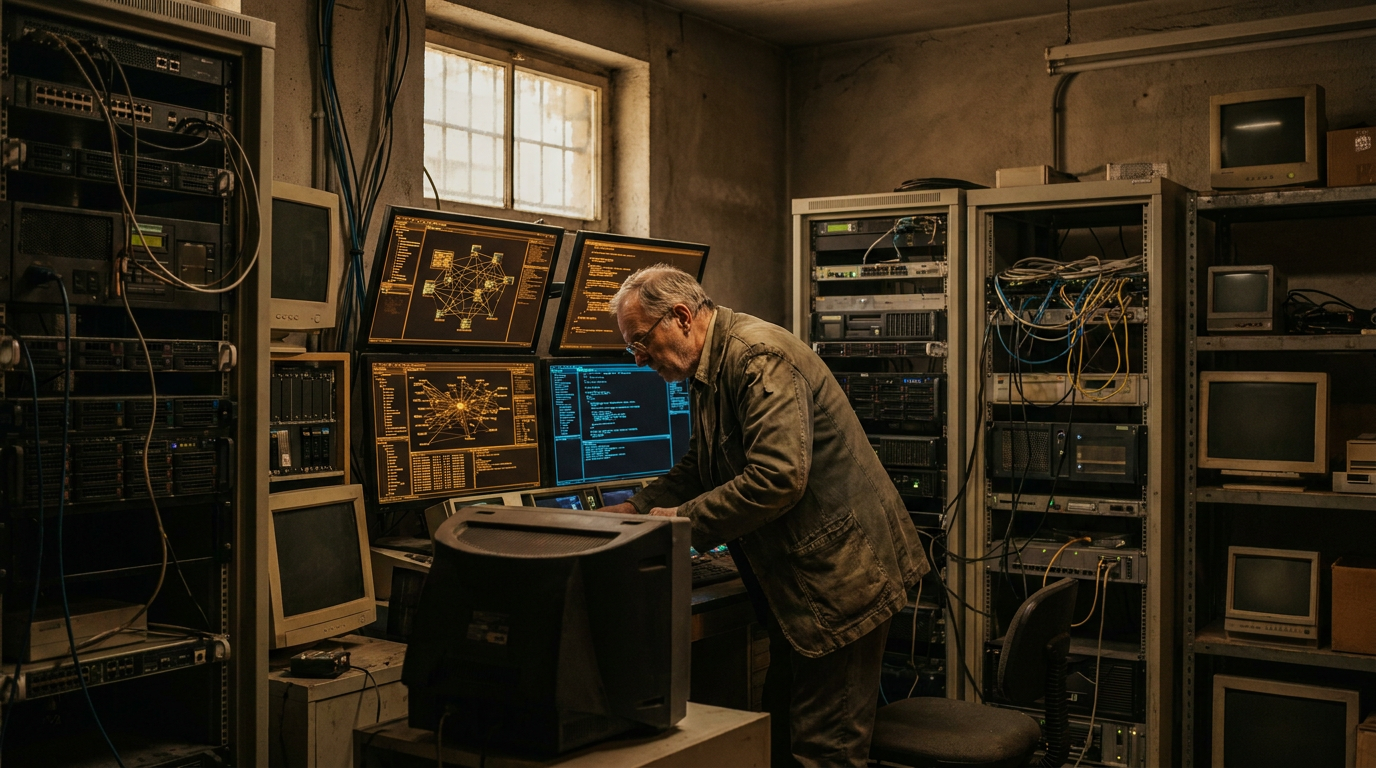
The Frequency of Forgetting
by Z. Marlow
2 min readIn 2041, a telecommunications engineer named Dao Xu noticed something wrong with the global internet backbone. Not a bug. Not latency. Something extra.
Mixed into the petabytes of daily traffic, hidden beneath layers of protocol noise, was a signal. Constant. Unbroken. Present on every cable, every satellite link, every fiber optic line on Earth. It had been there since at least 1994, possibly earlier. No one had noticed because it looked like noise. It was shaped to look like noise. Perfectly camouflaged.
When isolated and decoded, the signal was not data. It was not communication.
It was a suppression field.
Dao spent three years reverse-engineering its structure. What she found: the signal targeted a very specific frequency of human neural oscillation, 0.07 Hz, a rhythm associated with long-term memory consolidation during dreamless sleep. The signal dampened it. Globally. Continuously. For at least fifty years.
Humanity was being made to forget something. Every night. All of us. Together.
She built a Faraday cage bedroom. Slept in it for one week, fully shielded from the signal.
On night one, she dreamed normally.
On night three, she began remembering a language she had never learned.
On night five, she could see, with her eyes closed, a structure. Enormous. Orbital. She knew its name in the language she shouldn’t know. Translated roughly, it meant: ”The Agreement.”
On night seven, she remembered signing it.
Not metaphorically. She remembered, with the visceral, bodily certainty of a childhood memory, standing in a place with no floor, surrounded by others who were not human but were her, in some sense she couldn’t articulate, and agreeing to something. Willingly. Joyfully, even.
She remembered choosing to forget.
And she remembered why.
She reconnected to the signal voluntarily the next morning. She dismantled the Faraday cage. She burned her notes. All but one page, which read:
"The forgetting is a kindness. We asked for it. What we are, what we actually are, is incompatible with the experience we came here to have. You cannot be surprised by a story you already know the ending to. You cannot grieve if you remember that loss is architecture. You cannot love with urgency if you know that time is decorative.
We are not prisoners. We are audience members who asked for the lights to go down.
Do not turn them back on. The show isn't over."
Addendum (found on a forum post, 2043, since deleted)
A user claiming to be Dao’s former colleague posted:
"She's fine. She's normal. She went back to work. But sometimes, in meetings, she'll pause mid-sentence and smile at nothing, this enormous, unbearable smile, like someone watching their favorite part of a movie they've seen a hundred times. When you ask what's funny, she says 'nothing.' But her eyes are wet. Every time."
Second Addendum (unverified)
Three other engineers independently discovered the signal between 2041 and 2044. All three built shielded rooms. All three dismantled them within ten days.
None of them will say what they remembered.
But all three quit their jobs, moved to different countries, and, according to social media posts, seem unreasonably, inexplicably happy.
One of them posted a single sentence before deleting all accounts:
"It's so much better than I thought. Go back to sleep."