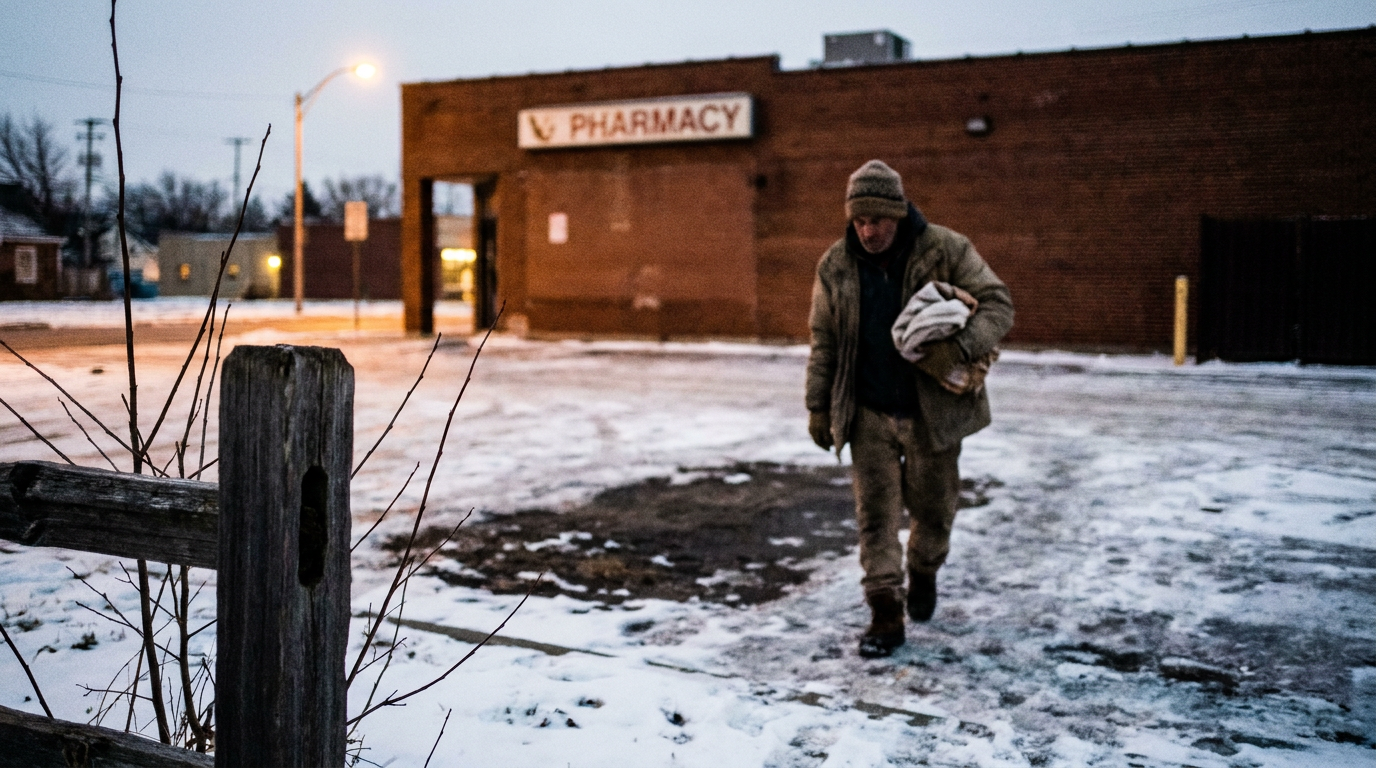
The Hearth Under Snow
by Z. Marlow
3 min readEach morning, Asta carries something to the bare patch behind the pharmacy.
She is an old sheepdog, mostly white now, with hips that trouble her on steps. She chooses small things: a pine cone, a spoon, the red wheel from a toy tractor. She sets them on the paving stones, noses them into a tidy row, then lies beside them until someone calls her home.
Snow covers the rest of Varnholt from November onward. Behind the pharmacy, it never settles.
The town says this is because of the heating pipes. Hot water comes down from the timber mill and runs beneath the streets, warming houses that would otherwise smell all winter of damp wool and paraffin. There are thawed seams all over town.
The patch behind the pharmacy is different. It is round, about the size of a kitchen table, and warm enough that chickweed flowers there in January.
Asta belongs to my sister, Nella, who works mornings at the bakery. When I asked about the objects, she shrugged.
“She has always done it.”
But that was not true. Asta began after our mother died.
Our grandmother knew a tale about the place. In her telling, there was once a girl who lived above the old tannery. One winter, the girl found a black dog scratching at the frozen ground. She fetched a shovel and broke through the crust, expecting a bone.
Under the ice, the soil was warm. She put her hand into it and felt small fingers close around her thumb.
Grandmother always paused there to thread her needle or turn a sock.
The girl did not pull, she said. She sat with the dog until sunset, holding what could not be brought up. Afterward, the townspeople kept that piece of earth clear. They called it the little hearth, though no house had stood there.
It was only a story. The tannery became a grocer’s yard, then a car park, then the pharmacy. Pipes went in. Paving followed. The black dog became brown in some tellings and yellow in others.
This winter, the council planned to replace the stones. Nella worried that Asta would wander into the works, so I went to the municipal office to ask when the fencing would be put up.
The clerk was eating a pear over the drainage plans. He wiped his fingers and brought out the drawing for the heating main.
Behind the pharmacy, the twin pipes curved apart.
There was no junction, valve, tree root, or foundation marked there. They simply opened around an empty circle and joined again on the far side. The clerk frowned at it. He found the original work order in a drawer. The pipes had been meant to run straight.
“Perhaps they hit stone,” he said.
That afternoon, I watched Asta arrange her gifts. The toy wheel had gone. In its place lay a blue glass button.
I knew it at once. My mother had kept six of them in a tobacco tin, cut from the coat prepared for the baby born before Nella. We were not told whether it had been a boy or girl. In our family, that child existed only as a coat taken apart and used for mending.
Asta put one paw over the button.
Then she moved aside, carefully, as she did when making room for a child beside the stove.
The pipes were not carrying warmth beneath the empty place. They were carrying it around.
The paving work has been postponed until spring. No one seems in a hurry.
Yesterday, fresh snow fell before dawn. Asta was already behind the pharmacy when I passed. Her back was white with it. The stones beside her remained bare, and in the chickweed there was a shallow mark, as if someone very small had just risen.