The Homebound Lights
by Z. Marlow
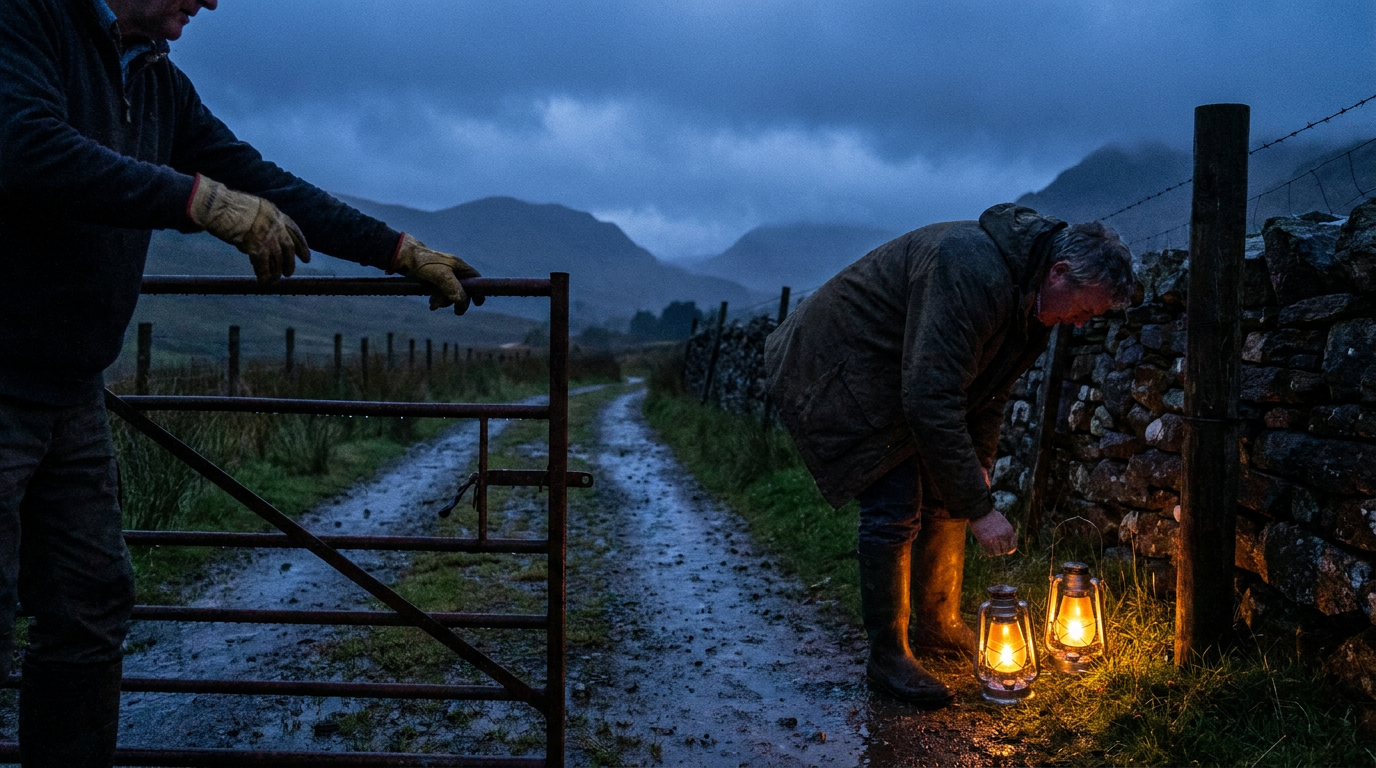
3 min readI pulled the barrier across while Cerys lit the two amber lamps.
Rain ran from her sleeves and tapped the metal housing. Beyond us, the causeway had already gone black beneath the tide, though its white posts still showed, leaning out of the water like the ribs of a buried boat.
“Pin’s swollen,” I said.
Cerys set one lamp on the road and came to help. Together we worked the iron pin into its socket. It went down with a soft, final clunk.
The storm had emptied the fields. No sheep called from the hill, and no kitchen windows showed in the village behind us. There was only the rain on our hoods, the sea shouldering over the road, and the amber lamps blinking as Cerys carried them to either end of the barrier.
We had closed the causeway in worse weather. In winter, water sometimes crossed deep enough to lift the grit bins and leave them in the ditch like yellow boats. I had done the work with Cerys since her father died. He had taught us to test the barrier twice and never trust a tide that arrived quietly.
This one had arrived quietly.
Cerys stood looking seaward.
“What is it?”
She pointed.
A pale gleam showed beneath the water, then vanished under a fold of wave. It returned farther out, low and steady.
“Headlamps?” she said.
“No.”
There was no engine sound. No vehicle could have passed us. The causeway bent north toward the headland, but the light lay straight ahead, where the seabed fell toward deep water.
Another gleam appeared beside it.
Then another pair beyond.
Cerys took my arm. Her fingers were cold through the cloth.
The road reflectors nearest the barrier shone whenever our lamps turned toward them. They made two neat rows down the flooded causeway, greenish under the water. But at the bend, where the road itself turned away, the shining rows continued straight on.
They went out beneath the bay.
Rain softened the sea until it looked less like water than old glass. Through it, for the space of a breath, I saw the white center line descending over the drowned ground. The paint was clean. On either side stood hedges moving in a current too slow to be the tide.
Cerys whispered her father’s name.
Something was walking between the rows of lights.
It came uphill through the water without disturbing it, a man in a dark coat, one hand holding his cap against weather that did not touch him. Behind him were other shapes, widely spaced. A woman carrying a basket. A child wheeling a bicycle. An old man with a brindled dog trotting close to his knee.
All of them followed the road.
The figure in front lifted his face. Cerys made a sound I had not heard from her since she was small, not grief, not quite. Recognition before language.
Her father stopped beneath the last submerged reflector.
He did not look drowned. That was the worst and kindest part. His coat hung dry. His hair was combed. There was mud on one boot, the reddish field mud he used to bring into the kitchen despite my shouting.
He looked at the barrier, then at me.
I understood.
The gate had never been made to keep the living from driving into the sea.
It was there to tell the dead where the road ended.
Cerys reached for the pin.
I caught her wrist, but gently. Her father watched us with the patient expression he had worn whenever we argued over directions. Behind him, the others waited along the shining lane, each at a courteous distance from the next.
The tide rose another inch against the barrier.
“Only a little,” Cerys said.
We lifted the pin together.
The gate opened no wider than a hand. Cold salt air passed through the gap, carrying the smell of wet wool, pipe smoke, and apples stored in a dark cupboard.
From somewhere under the bay, a dog began to bark.
The brindled one raised its head.
Behind us, in the sleeping village, another dog answered.