The Kindness of Mirrors
by Z. Marlow
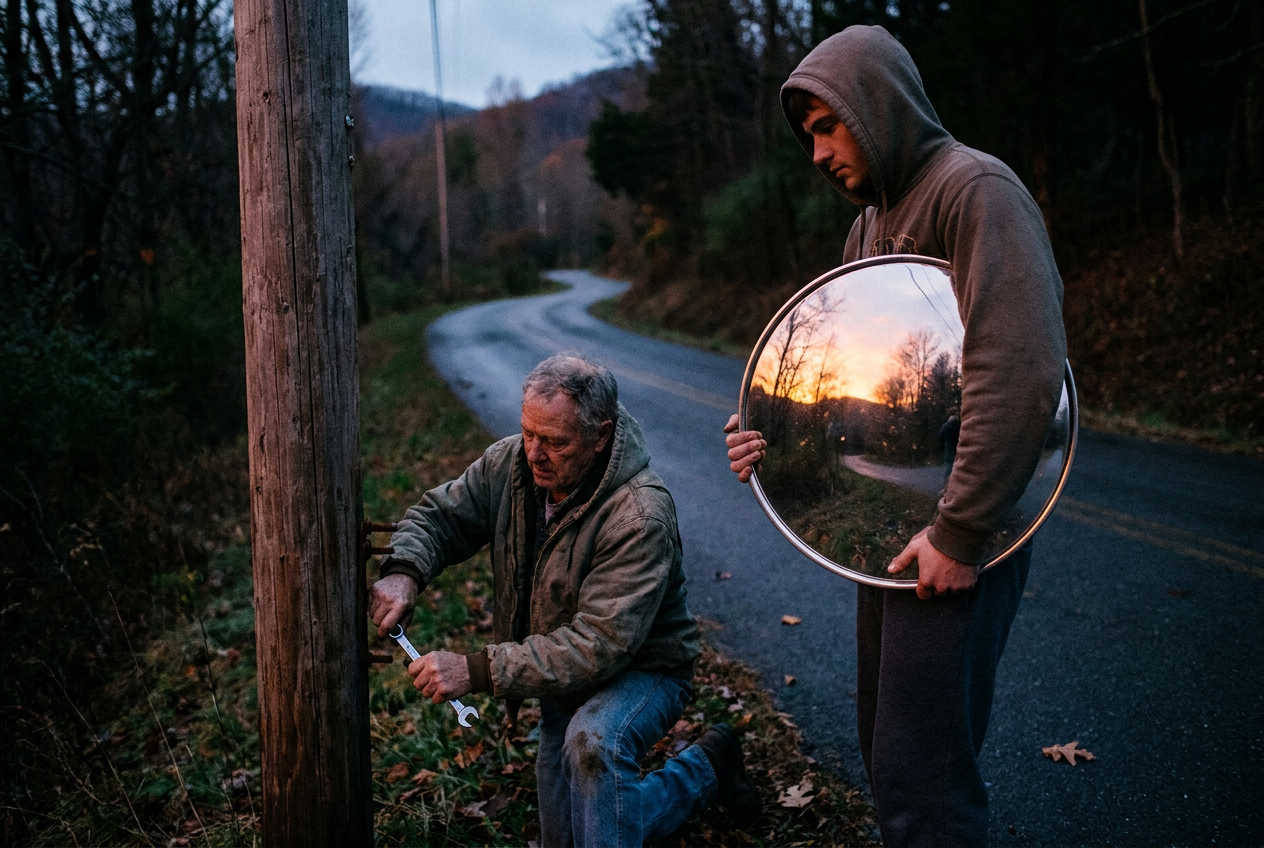
3 min readMy son steadies the new road mirror against his chest while I loosen the rusted bolts at the bend.
The mirror is broad and round, wrapped in grey paper. It makes him look smaller than twelve. His fingers barely meet around it.
“Not so tight, Owen,” I tell him. “You’ll crack the backing.”
He eases his grip. Below us, the road curves between wet hedges and disappears. The council van ticks as its engine cools. Rainwater beads along the verge, bright as pins.
The old mirror hangs crooked on its post. A delivery lorry clipped it yesterday, bending the frame inward. In the warped glass, the lane folds back upon itself, green bank pressed against green bank.
Owen looks into it.
“Dad.”
I keep the spanner on the upper bolt. “What?”
“There’s someone here.”
I glance toward the van, then down the empty road. “Where?”
He nods at the damaged glass.
The mirror shows us both: me on the step ladder, Owen beneath, the papered circle in his arms. Between us is a patch the colour of smoke on water. It has no face. Its edge follows the slope of a shoulder, the fall of a sleeve.
I climb down.
The shape does not appear on the road beside us. Only in the mirror.
Owen shifts his weight. The shape moves with him, not as a reflection moves, but as someone attending to a child. It lowers.
His right shoelace has come undone.
The dark hands in the glass make a small, familiar knot.
Owen looks down. The lace remains loose at his shoe. When he looks up again, the shape is still kneeling.
Neither of us speaks.
My wife always tied his laces with two loops because he could not remember the other way. Even when he grew old enough to do it himself, she would sometimes kneel in the hall and retie them, saying his knots had no conviction.
I reach for Owen’s shoulder.
In the mirror, the shape rises at once. It stands on his other side. Its head comes level with mine.
Then it turns toward the hidden road.
A horn sounds below the hedge.
I pull Owen against the post as a white truck comes hard around the bend, tyres whispering over the wet surface. Wind slaps the paper on the new mirror. The driver lifts one apologetic hand and is gone.
For a moment there is only dripping hawthorn and the quick breath beneath my son’s raincoat.
The smoke coloured figure has not moved.
It is looking at me now.
I know the tilt of that head. I know the patience in it. Yet what chills me is not that the mirror has kept some remainder of Clara. It is that the figure beside Owen is kneeling, while the figure beside me stands close enough for its shoulder to touch mine.
The mirror does not show the dead.
It shows the shape their care made around us.
Owen puts down the new mirror and ties his lace with two loops. His fingers tremble once, then settle. Together we lift the damaged frame from its post.
As the glass tilts toward the ditch, the figure lengthens across it. One hand rests over Owen’s knot. The other reaches beyond the rim, into whatever the mirror cannot hold.
We bolt the new circle into place and peel away its paper.
The bend appears cleanly now: hedges, rain, the pale road returning from concealment.
Owen takes my hand.
Between our reflections, a narrow darkness takes his other one.