The Light at Rookery
by Z. Marlow
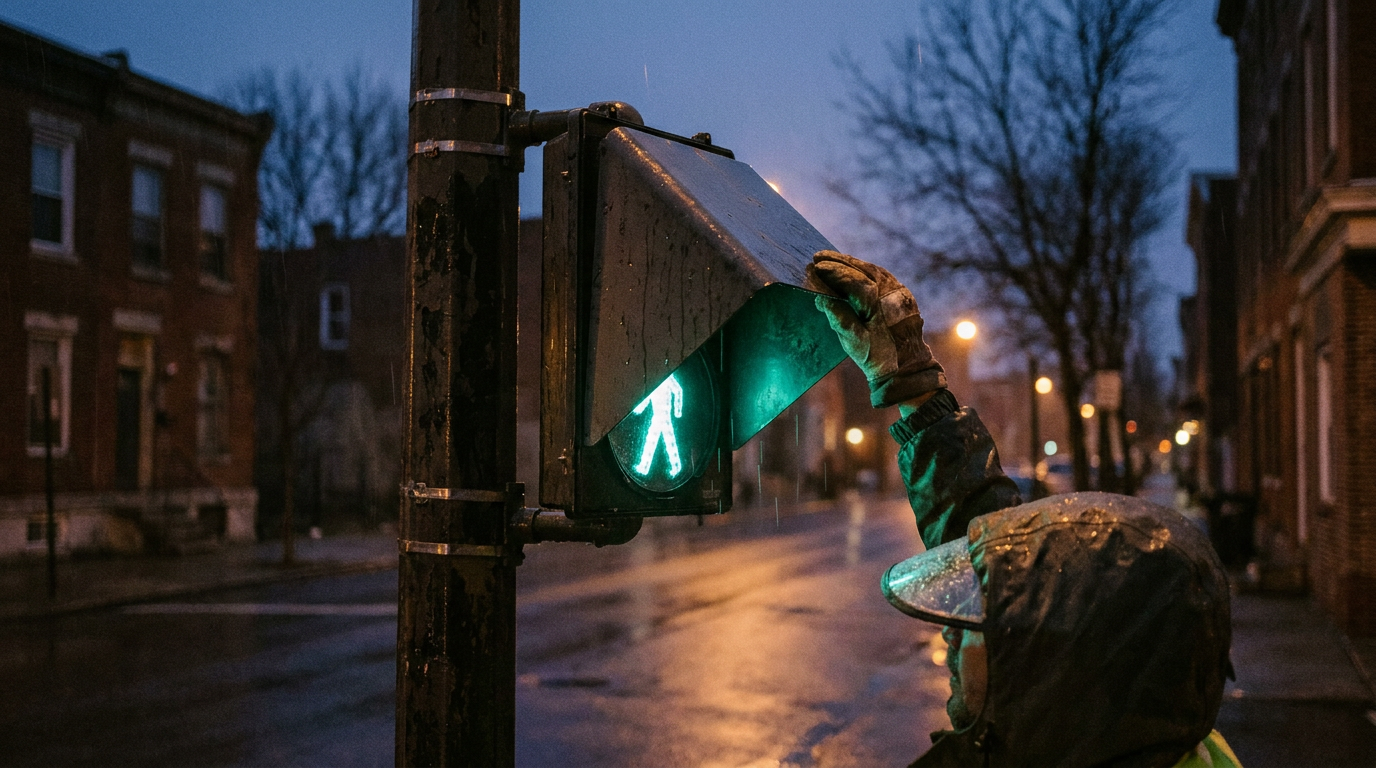
3 min readI lift the hood from the crossing lamp while rain ticks on the plastic visor. Inside, the wiring is dry and orderly. The green light below continues to show a walking man to the empty road.
Rookery Lane is quiet at that hour. The bakery has not opened, though warm yeast already scents the alley behind it. Water gathers in the dimples of the yellow paving. Across the road, the little green figure walks without getting anywhere.
People here call him Tamsin.
The name belonged, they say, to a woman who kept the old ford before there was a bridge. She carried a lantern glazed with green bottle glass and led travelers through after storms. If the river was safe, she crossed first. If it was not, she stood on the far bank with the lantern held against her skirt.
There are several endings to her story. In one, the miller refused to wait and took his cart into the flood. In another, Tamsin went in after a child. My grandmother said neither was true. She said Tamsin simply grew old, as people did then, and one evening the river took over her work.
If the green light walks, you may follow.
The ford became a stone bridge, then a paved road. When the first electric crossing was installed, its walking figure was green. This was considered proof enough.
Children still call out, “Morning, Tamsin,” before they cross. Older people pretend not to. At midwinter someone leaves a currant bun on the control box, wrapped in greaseproof paper.
I maintain the signals for the town. Usually this means cleaning contacts, replacing cracked visors, and removing the small grey nests that spiders make around warm screws. It is not work that encourages folklore.
The fault at Rookery Lane was simple. The walking figure had become indistinct. One leg was shorter than the other, and its head seemed bent.
I removed the green lens and reached for the stencil plate behind it.
There was no stencil plate.
The glass was plain. The lamp beneath it was an ordinary green lamp. Yet on the outer visor, visible even from inside the open housing, a man continued to walk.
I switched off the supply.
He remained for the length of a breath, then took one more step and vanished.
My father was struck at Rookery Lane when I was nine. This happened later in the story, though earlier in my life. I remember his oranges rolling into the gutter, each one perfectly bright in the rain.
He had been crossing legally. People always mentioned that, as if permission should have made him heavier.
The next morning I returned with a new lens. Dawn had thinned the clouds to pearl. A woman waited at the kerb with a white terrier tucked under one arm.
The signal changed.
The green figure appeared, but it was not the square-shouldered symbol shown in the catalogue. It was a narrow man carrying a string bag. His left foot dragged slightly, as my father’s had after an accident in the cooperage. Something round showed through the mesh of the bag.
The woman crossed. Halfway over, she looked back, perhaps wondering why I had made a sound.
The figure walked beside her, though more slowly.
That was when I understood what my grandmother had meant. The green light did not show us when the road was safe. It showed the road whom it must still allow across.
Since then, I have inspected every pedestrian signal in town. None contains a stencil.
Most mornings the figures are ordinary. A bent woman. A running child. Someone carrying flowers. Once, during snow, the light showed two people holding hands, though I stood there alone.
Last night, Tamsin appeared before the button was pressed. She was taller than I expected, with a lantern held against her skirt.
She did not cross.
She stood on the far side, facing the dark road, and waited for something that had not yet reached the bridge.