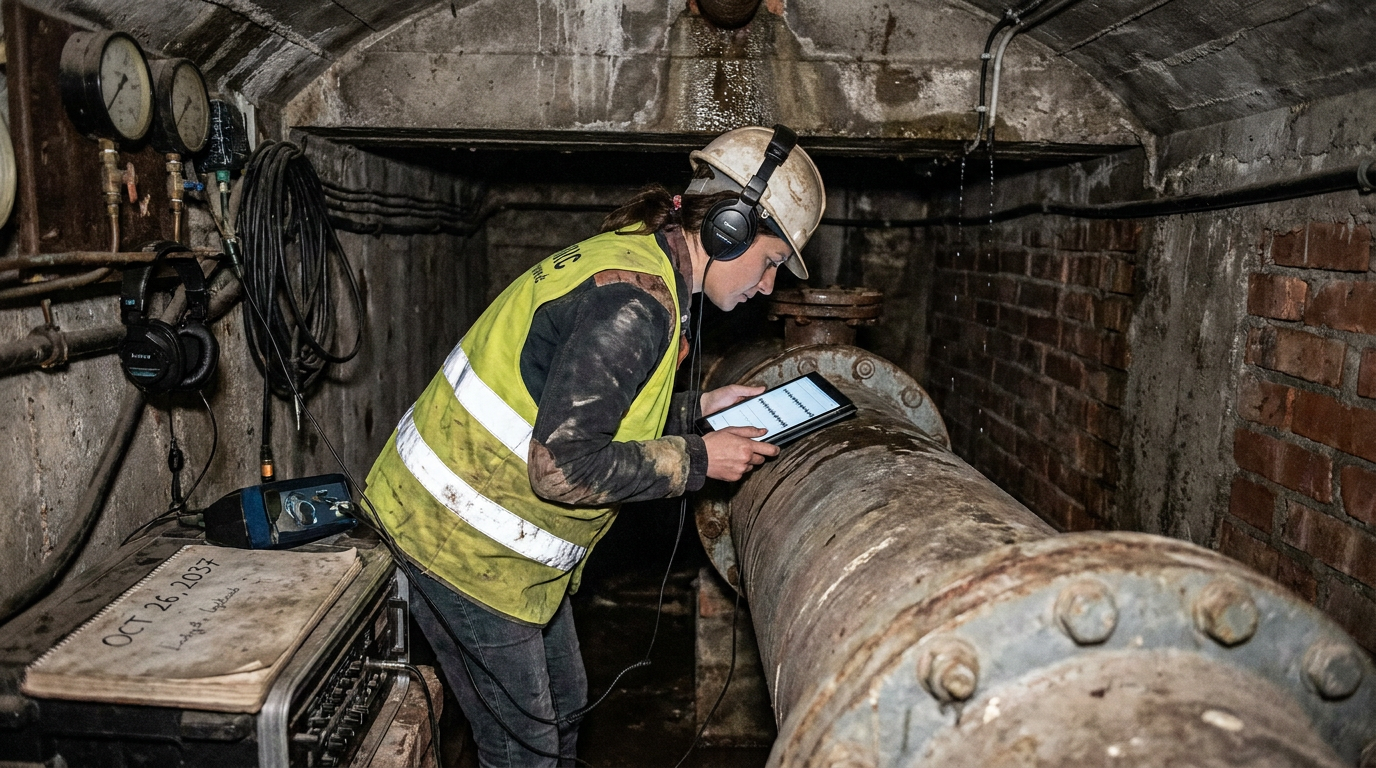
The Listening Pipes
by Z. Marlow
3 min readIn 2037, a municipal resonance engineer named Dr. Amara Vuković discovered that 14.6 kilometers of cast-iron water main beneath the city of Bellweather were humming in perfect thirds.
The sound measured 18.2 decibels, below the threshold of ordinary street noise, and occurred only between 2:11 and 2:19 a.m. It was first detected by accelerometers installed to locate a suspected pressure leak in District Nine. No leak was found. Water loss across the sector remained precisely 0.00 percent.
The pipes were simply singing.
Vuković called the anomaly the Bellweather Choir. Her initial report identified three stable frequencies: 41.2, 51.9, and 61.7 hertz. Although their ratios were not mathematically exact, they fell within 0.04 percent of a justly tuned minor chord.
The mains had been laid between 1908 and 1986 by six contractors using four iron alloys, two joining systems, and no unified plan.
There was no mechanical reason for them to resonate together.
On March 3, Vuković’s team placed 312 sensors across hydrants, valves, pumping stations, and residential service lines. At 2:11 a.m., every sensor registered the chord. At 2:14, a fourth frequency appeared at 82.4 hertz.
At 2:16, the water pressure rose by 0.7 kilopascals across the entire city.
At 2:19, it stopped.
The following morning, 2,804 residents reported unusually vivid dreams. The Bellweather Civic Sleep Survey had been distributed as part of an unrelated public-health study, giving Vuković an accidental sample comprising 11.3 percent of the population.
Of those who remembered dreaming, 68 percent described a room beneath the city.
Forty-one percent mentioned wet blue tiles.
Nineteen children drew the same circular door.
The Office of Municipal Integrity authorized a controlled interruption on March 17. Pumping Station Four was shut down, reservoirs isolated, and all nighttime industrial use suspended. The mains held 22.8 million liters of motionless water.
At 2:11 a.m., the chord began as usual.
This time, hydrophones recorded modulation within the lowest frequency. Vuković slowed the signal by a factor of 32 and identified repeating intervals resembling speech. Her linguist, Professor Nkiru Sayegh, rejected that interpretation for three days before producing a partial transcription.
The intervals did not correspond to words. They corresponded to addresses.
There were 143 of them.
Each address belonged to a building connected to the original 1908 water network. At 137 locations, investigators found a resident awake during the eight-minute event. Most were elderly, nursing infants, working late, or unable to sleep.
At the remaining six addresses, the named buildings had been demolished.
At one, the pipes terminated beneath an empty playground.
Excavation revealed a sealed service branch descending 9.4 meters deeper than municipal records allowed. Its inner wall was dry, warm, and lined with calcium deposits arranged in concentric bands. Radiometric analysis dated the oldest deposit to approximately 12,600 years before the pipe was manufactured.
At the end of the branch stood a circular iron door.
It opened inward.
Vuković entered with two inspectors and a fiber-optic camera. The recovered footage shows a tiled chamber measuring 5.1 meters across. Its walls are pale blue. In the center is a stone basin filled with clear water, despite having no visible inlet.
The camera microphone captured the city’s chord at 63 decibels.
Then a fifth tone joined it.
All three investigators removed their helmets simultaneously.
“It isn’t calling us,” Vuković said. “It’s counting who is still awake.”
The transmission ended eleven seconds later.
Closure Summary
The Bellweather Subsurface Safety Directorate sealed the excavation on March 22. Vuković’s laboratory was defunded on April 1. Its servers were wiped under Emergency Infrastructure Protocol 8, and the 312 sensors were removed for “calibration defects.”
Copies of the data continued to circulate among plumbers, night-shift engineers, and apartment superintendents.
By autumn, reports had arrived from nine other cities. Always old pipes. Always 2:11 a.m. local time. Always the slight increase in pressure.
In three cities, sleeping residents dreamed of Bellweather despite having never heard its name.
The current archive contains 6,204 recordings of the Bellweather Choir. No two are identical. Analysts now believe each performance includes one additional tone, too quiet for instruments to isolate but audible to certain listeners through a glass of tap water.
The final surviving note in Vuković’s field journal is dated March 21, one day before the chamber was sealed.
It contains a pressure reading, a hand-drawn circle, and seven words:
“Tonight, the water hummed my answer back.”