The Lower Journey
by Z. Marlow
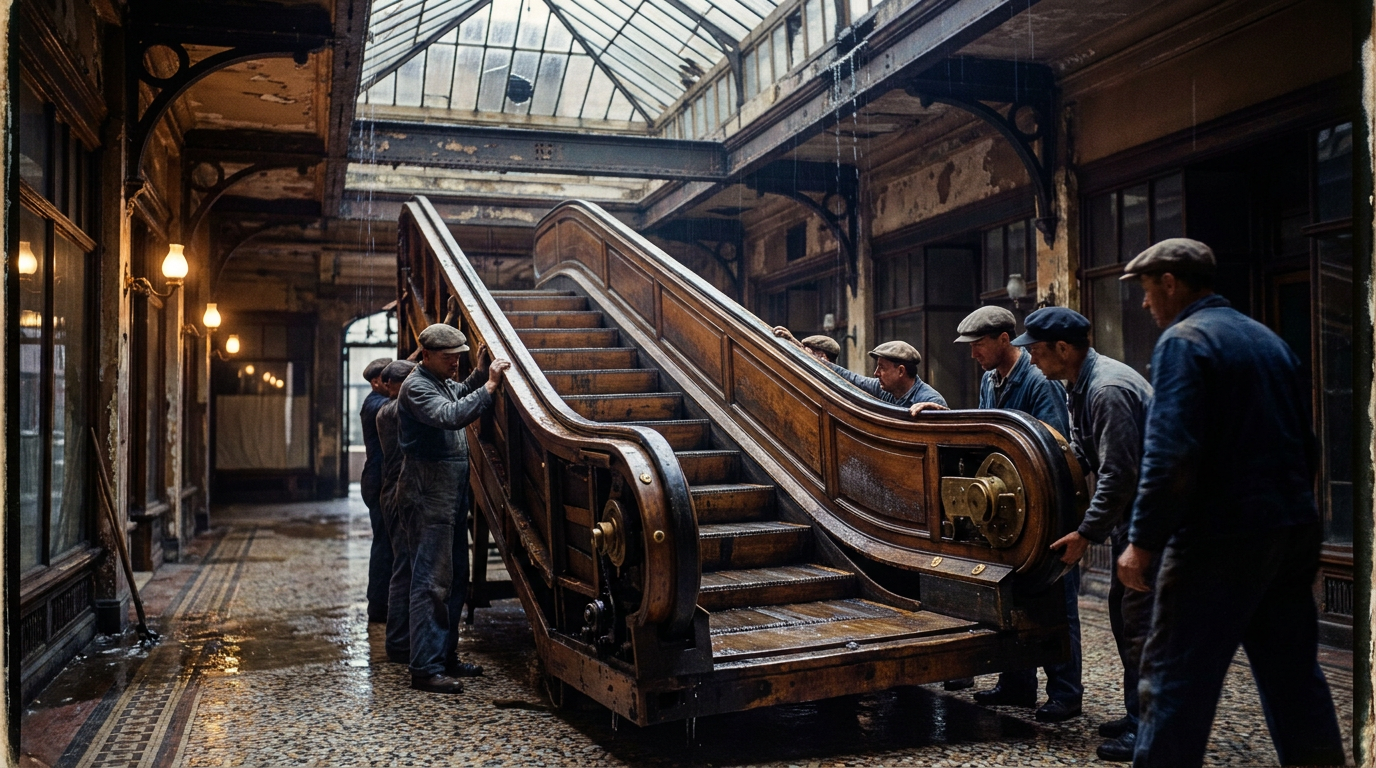
3 min readI helped lift the wooden escalator out of Bellwether Arcade when rain began coming through the roof.
It had carried shoppers between the tiled entrance hall and the upper gallery since my grandmother was a girl. Its treads were oak, darkened by shoes and floor wax. When it ran, it gave off a warm smell of oil, dust, and singed cloth. You could hear it from the street on quiet mornings, turning patiently behind the locked doors.
Our town had a story about it.
The old women at the market called it the lower journey. They said every moving stair made two trips: the one in daylight, where people stood upright with their parcels, and another beneath the floor, where the steps returned upside down.
Children understood this perfectly. They dropped buttons and boiled sweets through the gaps for the passengers underneath.
My mother disliked the story. She worked at the arcade hat counter and rode down each evening at closing time, one hand resting on the rubber rail. If I mentioned the people below, she would tell me to mind my laces.
Still, she never stepped onto the first tread.
She waited for the next one.
When her legs weakened, I collected her after work. She would stand very straight on the descent, smelling of lavender water and the cardboard boxes in which the hats were kept. Near the bottom, where the steps flattened, she always looked down as though someone had spoken.
Once I asked what she heard.
“Only somebody keeping pace.”
She died before the arcade closed. For years afterward, I used the fixed stairs.
The men dismantling the escalator were not local. They joked about its age and the black grease packed around the bearings. By noon they had removed the balustrades and opened the floor beneath the upper landing.
I climbed down with them.
The return track ran through a low chamber lined with white tile. There was barely room to crouch between the inverted steps and the concrete. Dust hung in the beam of my torch. The wooden treads passed overhead like the undersides of small boats.
Then one of the men called me back.
He had found marks in the grease.
They were shoeprints, laid neatly along the bottoms of the steps. Not smears from tools or boots. Soles and heels, each distinct. A child’s sandal. A broad work shoe with iron studs. The pointed toe of something made before my time. All faced the direction opposite to the visible ascent above.
There was no room for anyone to walk there. Even lying flat, a person would have been crushed by the returning staircase.
The foreman turned the mechanism by hand. The steps moved with a wooden sigh.
Print after print came toward us.
I knew my mother’s shoe before it reached the torchlight. The left heel had a small square missing from its edge, cut away when she caught it on the market grating. I had watched my father mend that shoe at the kitchen table, holding the little brass nails between his lips.
Her print passed directly above my head.
Beside it was mine, the narrow sole of a boy’s school shoe.
That was when I understood why she had waited for the second tread. She had not been afraid of traveling beneath the floor.
She had been making room.
The arcade is gone now. A pharmacy stands there, with a bright metal escalator that makes almost no sound. People step onto it without looking. Children lean over the rail. Old couples descend shoulder to shoulder.
Sometimes, near the bottom, a passenger moves one foot aside for no apparent reason.
Underneath, something keeps pace.