The Minutes We Mislay
by Z. Marlow
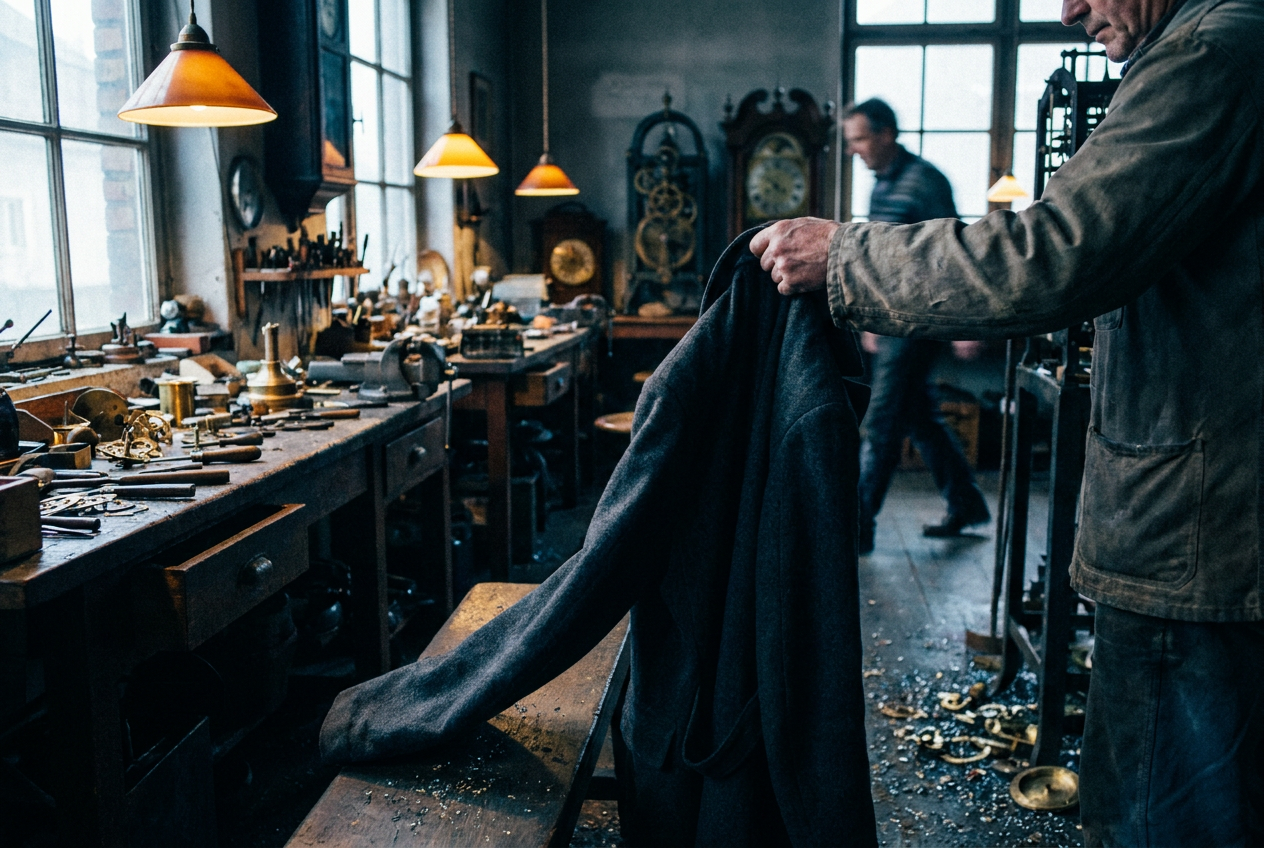
3 min readI kept the clocks moving while they carried your son’s coat out of the winding room. It was folded over the porter’s arm, though not neatly. One sleeve trailed through the brass filings on the floor.
You asked why the coat was empty.
That is a fair question.
The master clock stands in a cupboard behind the old market hall, as you know. Most people imagine something grander. There is only the pendulum, the copper wheel, and the row of contacts that send a pulse along the wires. The cupboard smells of lamp oil and damp wool. When the mechanism is working, there is scarcely room for a man to turn around without brushing the weights.
Your son liked it there. He said the ticking made a roof over his thoughts. Every morning he brought tea in a blue enamel flask and set it beside the relay box, where it collected black grit. He had good hands. A clockman notices hands.
He was the first to hear the extra click.
It came between seconds, too soft to move the wheel. The clocks in the station, the bakery, the schoolhouse and every public room answered together. No hand advanced. No bell sounded.
Still, something had passed through the wires.
Clockmen have an old saying about that sound. My master told it to me, and his master told him. We do not write it in the service books because writing gives a thing more doors than it needs.
A town does not lose time. It puts time somewhere.
Consider how much goes unused. The moment after waking, when you cannot remember your name. The blank space at the foot of a page. The pause in a kitchen when everyone has forgotten who was speaking. These scraps are too small for any clock to show, but they are not nothing.
They travel back along the wires.
Behind the pendulum is a narrow panel. Your son found the catch beneath the grease. There was no need for him to open it, but he was young, and I had told him never to.
Inside is a chamber no wider than a coffin stood upright. The walls are scratched smooth at shoulder height. At the bottom we found a boot button, several milk teeth, and a wooden whistle cut in a style no one uses now.
He understood before I did.
The master clock does not send the hour through the town. It gathers what the town has failed to live. Someone must remain inside and receive it, or the lost moments collect in the streets. Doors stay half-open. Kettles never quite boil. A woman leans down to kiss her child and cannot arrive.
This happened once when I was an apprentice. It lasted until my master entered the chamber.
I did not push your son. Not as you mean it. I placed my hand between his shoulders because the opening was low and he might have struck his head. He took off his coat himself. He said you would want it back.
Then he stepped inside.
I closed the panel because the station clock had begun striking the same hour again and again. By the time I turned the key, your son was already knocking from very far away.
Since then the clocks have kept excellent time. There is only that extra click, just before dawn.
You said yesterday that you had gone into the pantry and forgotten why. You stood there perhaps three seconds, smelling flour and cold stone.
For him, it was most of an afternoon.
That is why I cannot let you open the panel. I am not being cruel. He has received every hesitation, every daydream, every word abandoned on the tongue. If the door opens, all that unlived time must come out somewhere.
Besides, he is not alone now.
This morning, while I was winding the weight, I heard him speaking gently to someone smaller.