The Moon’s Second Face
by Z. Marlow
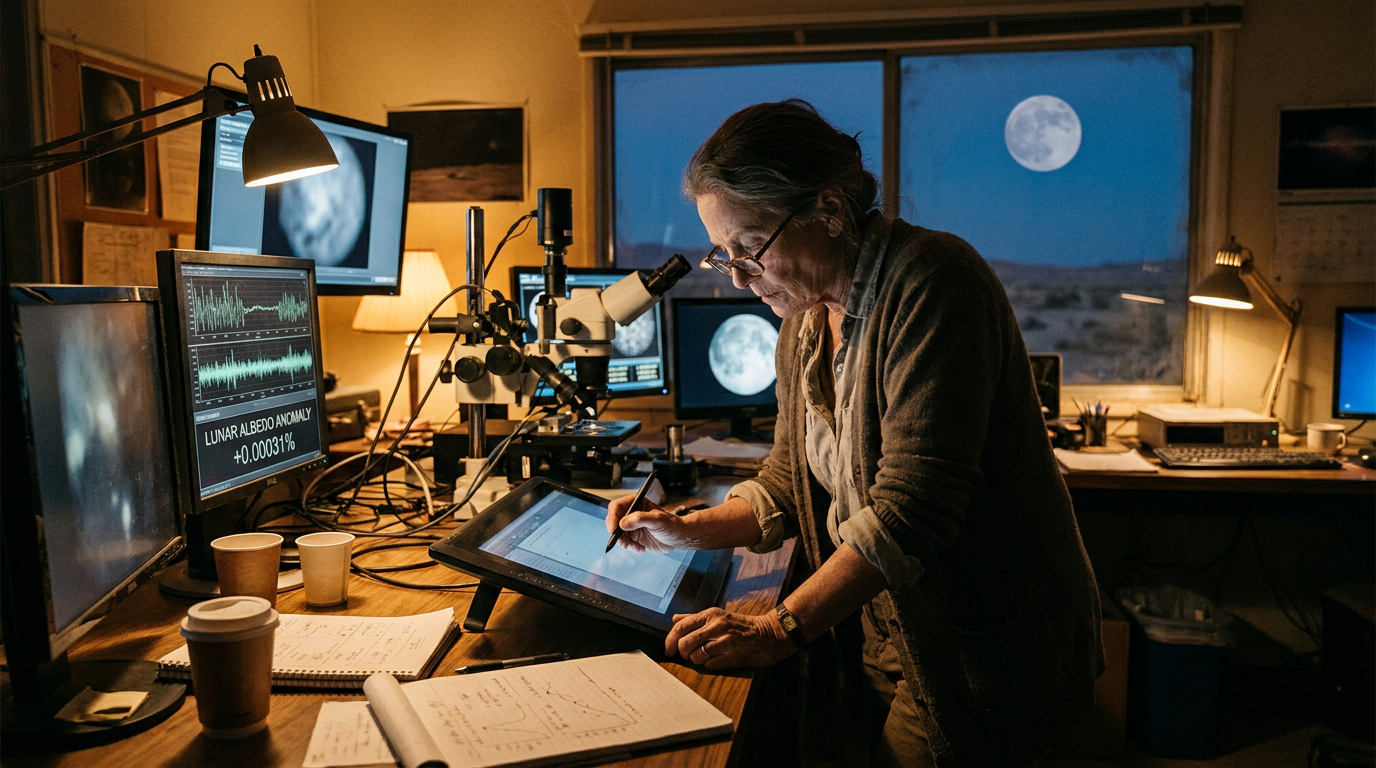
3 min readIn 2041, a selenographic photometry specialist named Dr. Amara Veyr discovered that the Moon reflects 0.00031% more light than it receives.
The discrepancy appeared only during the final 11 minutes before total lunar eclipse. It was too small for ordinary observatories, but Veyr’s cryogenic photon array recorded it across 46 consecutive nights, using calibrated lasers bounced from six points on the lunar surface.
Every calculation agreed. During that narrow interval, the Moon produced light without an identifiable source.
Veyr called the excess the Pale Return.
At first, she suspected stored thermal energy. The returning photons, however, had wavelengths matching sunlight that had struck the Moon between 18,000 and 2.3 million years earlier. Each photon carried minute polarization scars corresponding to ancient solar conditions reconstructed from ice cores and stellar models.
The Moon was not generating light.
It was remembering it.
Veyr’s team at the Selene Institute widened the study. They analyzed 8.7 billion reflected photons during the eclipse of September 18, 2042. Most contained degraded spectral information, equivalent to static. But 12,806 photons arrived in synchronized clusters, each separated by exactly 1.37 seconds.
When converted into spatial data, the clusters formed images.
The first showed a coastline beneath an unfamiliar arrangement of stars. The second showed enormous fern-like organisms growing where the Mare Imbrium should have been. The third showed Earth, blue and clouded, viewed from the lunar surface approximately 612 million years ago.
There was something standing in the foreground.
It was 2.9 meters tall, with four narrow limbs and a reflective surface that made anatomical analysis impossible. Its posture suggested neither movement nor alarm. It appeared to be watching Earth.
The image lasted 0.04 seconds.
Then it raised one hand toward the camera.
There had been no camera.
The Nearside Survey
In January 2043, Veyr obtained access to the abandoned Kestrel Array, a field of 320 radio dishes in the Aral Exclusion Basin. By reversing the array’s phase, her team treated the entire visible Moon as a single optical archive.
They recovered 73,114 images.
The Moon had preserved every sufficiently bright event that reached its surface: asteroid impacts, auroras, volcanic continents, the first artificial lights, and thousands of scenes no geological chronology could place.
One sequence showed the Moon with oceans.
Another showed it orbiting a planet with violet clouds.
A third showed the present-day lunar surface, but Earth was absent. In its place hung a black circular region 3.4 times larger than the Sun. Stars remained visible around it, yet none could be seen through it.
The timestamp embedded in the photon decay pattern indicated the image had not yet occurred.
Estimated date: October 26, 2057.
Confidence interval: 96.2%.
Veyr rejected the result. She recalibrated the array, replaced three atomic clocks, and repeated the reconstruction 19 times. The date remained unchanged.
On the twentieth attempt, a second image appeared.
It showed the Kestrel Array from above.
All 320 dishes were aimed at the Moon. Twenty-seven researchers stood between them, their faces turned upward. The reconstruction was detailed enough to identify Veyr by the silver clasp in her hair.
There were 28 shadows.
The institute terminated the project within six hours. Funding records were deleted. The Aral facility was dismantled, though satellite photographs later showed its dishes intact beneath white containment fabric. Veyr’s archive, 91 terabytes in total, vanished from three disconnected servers.
Copies began circulating two weeks later.
No one knows who released them.
The final file is only 6.2 seconds long. It contains no image, merely a sequence of photon counts translated into audio. Most listeners hear a low rushing sound. Children under nine report hearing a voice reciting their birthdays.
Veyr heard something else.
Her last memorandum, recovered from an unsent message dated March 2, 2043, contains a single sentence:
“We thought the Moon was keeping a record of us, but records do not turn the page before you arrive.”
Dr. Amara Veyr has not been located. Each year, on the night before the September eclipse, the silver clasp she wore is photographed lying in a different lunar crater.
In every image, it is catching sunlight from below.