The Northward Courtesy
by Z. Marlow
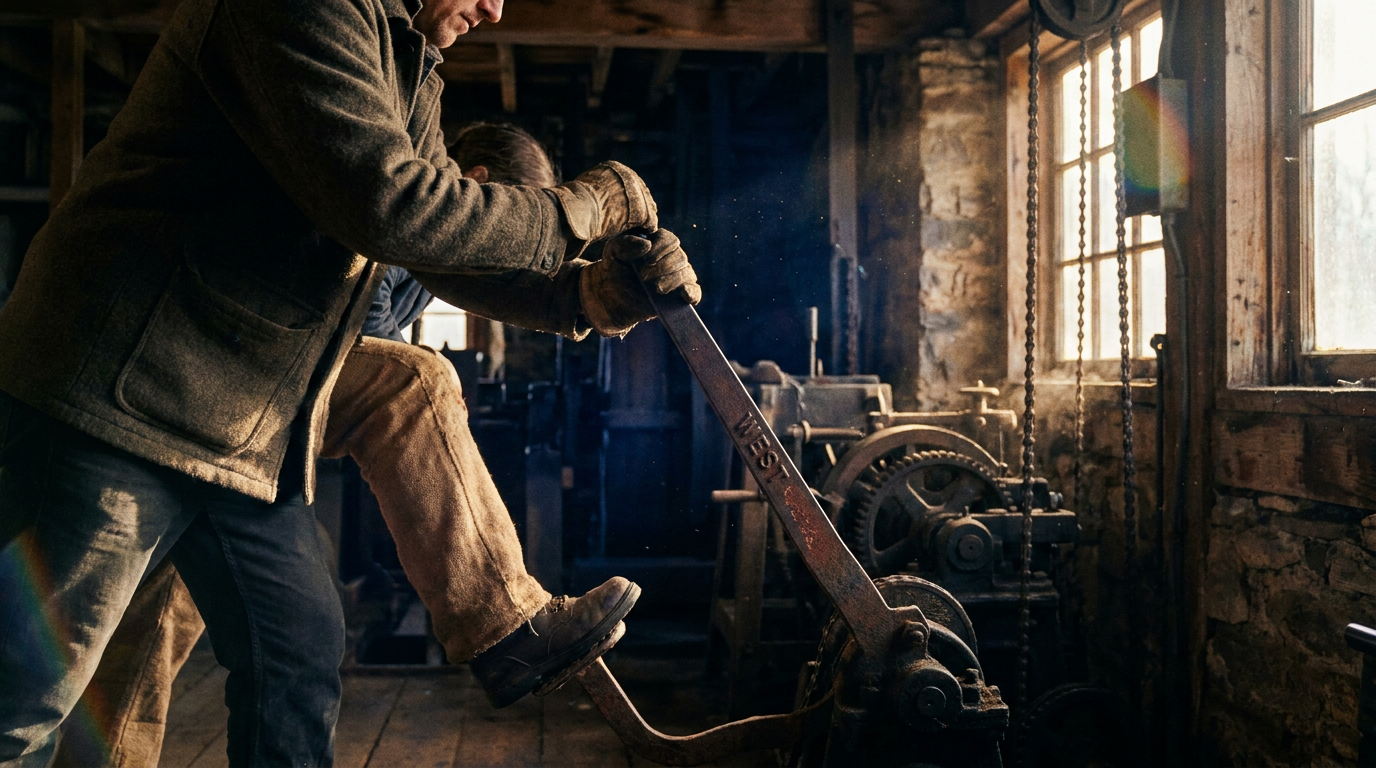
3 min readI pull the western lever while Annet keeps her weight on the brake.
The great arm outside settles against the evening sky. Its white paint is gray with soot, and the iron linkage gives its usual complaint beneath the floorboards. Across the valley, the next tower repeats our signal. Farther on, another pale arm moves above the firs. Then another, fainter than a bone seen through skin.
“Line closed,” Annet says.
“Not until they answer.”
She watches through my mother’s brass glass. The leather binding has gone smooth where three generations held it, though Annet insists the hollow fits her thumb best.
A shutter flashes at the farthest tower.
“Answered.”
I latch the lever. Below us, the station stove smells of hot dust and apple peel. Annet left her supper warming on its lid, folded inside a cloth. She has been hungry since noon but will not eat until I do, a tenderness she believes I have failed to notice.
She begins covering the message board.
“Leave the north lever,” I say.
Her hand pauses above the cloth.
There is no northern line. Our tower is the end station, built where the ridge falls into alder woods and wet pasture. Messages arrive from the western ports and go no farther. The north lever remains because removing it would leave a hole in the frame, and rain already finds enough ways inside.
My mother used to move it at dusk.
Not far. Just until the unused arm outside lifted above the chimney. She called it the courtesy signal. When I asked whom we were greeting, she said anyone still watching.
Annet knows the habit. She has seen me perform it every evening since the burial, though neither of us has spoken of why I continue.
“May I?” she asks.
I step aside.
The north lever is stiff. She leans into it, her braid slipping over one shoulder, and the hidden gears wake under our feet. Outside, the arm rises toward the darkening fields.
Nothing stands beyond us but the alders.
Annet takes up the glass. She aims it north because children will look where adults have taught themselves not to.
“There is an answer,” she says.
The room seems to hold its breath inside the warm smell of apples.
I put my eye to the glass.
At first I see only branches, black and fine against the last light. Then a white bar turns between two trunks.
Another lifts beyond it.
Farther north, where the land sinks and no tower has ever been built, a third arm rises. Beyond that, a fourth. They continue through the alder wood in a line too straight for trees, each one paler and more distant, passing over the horizon without growing small.
The nearest arm makes the sign for home.
It makes it incorrectly.
My mother always dropped the second stroke too soon. A childhood injury had stiffened two fingers, and when she designed the courtesy signal she built the same small error into it. I had thought the fault belonged to her hand.
The white bar lowers, then rises again.
Home. Home. Home.
Each station northward repeats the crooked gesture, one after another, until the motion reaches a darkness in which I can see no land at all.
Annet presses close against my side.
“Is Grandmother there?”
I give her the glass.
She looks for a long while. Her supper cloth stirs on the stove lid, letting out a thread of sweet steam.
“No,” she says softly. “She is nearer than that.”
The lever shifts beneath my hand.
Not much. Only the gentle answering pressure of someone taking hold at the other end.
Annet reaches over and lays her fingers beside mine. Together we keep the arm raised while night gathers around the tower, and from somewhere north of every map, the next station waits for us to let go.