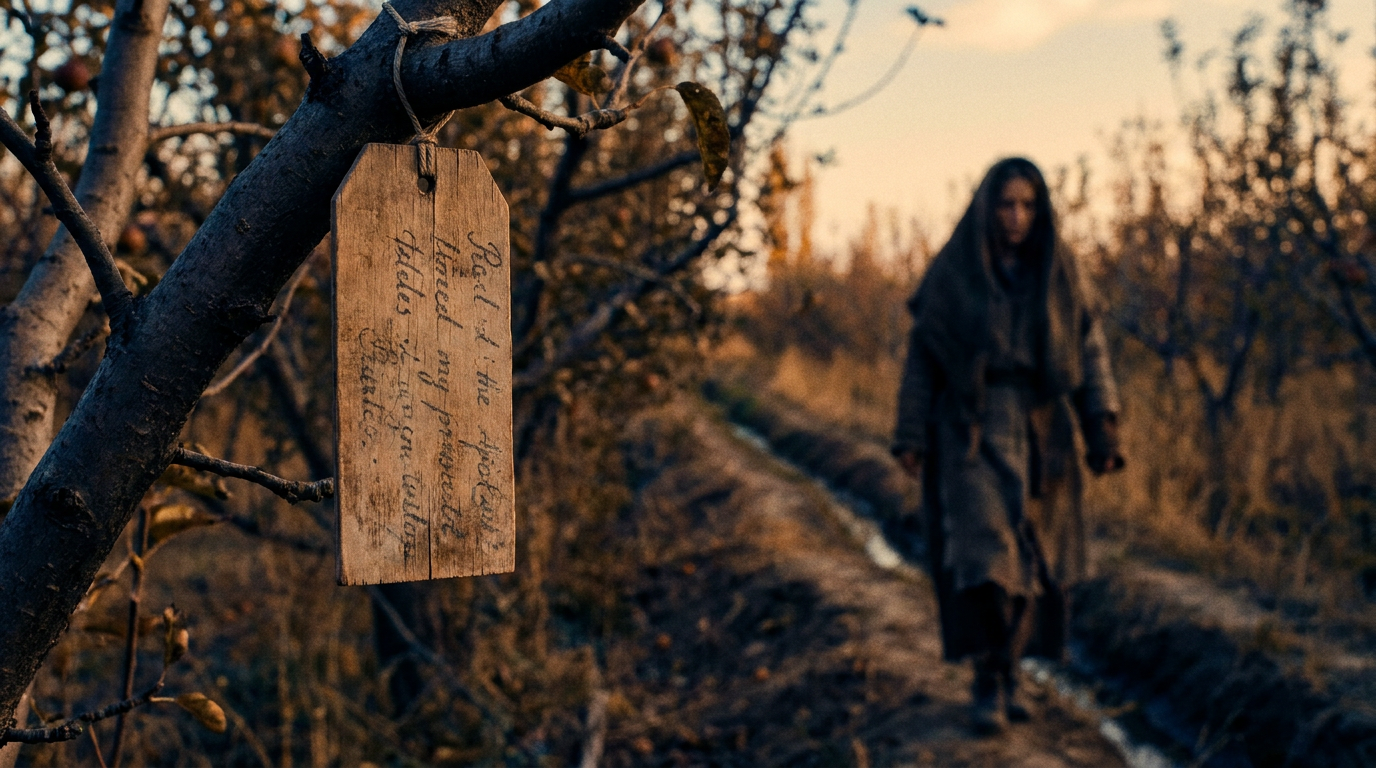
The Orchard Names
by Z. Marlow
3 min readIria Pell, daughter of the ditch keeper:
“We lifted the old gates before sunrise, while the wood was still swollen with night. My father worked barefoot so he could feel where the water pressed hardest. The mud between his toes smelled of mint and rust.
“That was the summer the first motor lorry came to Orra. The council sent tin gates to replace the ash boards. Each new gate had a number painted on it. My father disliked that. He said water had no use for numbers.
“The old boards carried names: Little Aven, Sella, Crow’s Sleep, Myra-in-the-Reeds. We thought these were names of farms, though no farm had borne them in living memory. Father said they were the names by which the water knew each turning.
“He was an old man. We let him talk.
“When we fitted the numbered gates, the lower orchards began to dry. Water reached the forks and gathered there, trembling against the new tin, though the gates stood open. Upstream it rose over our ankles. Downstream, dust settled on the apricots.
“Father walked from gate to gate, speaking the old names. Then the water went on.”
Tomas Avel, mason:
“It did not wait for words. That is Iria making a hymn of poor workmanship.
“The new gates were badly hung. I said so at the time. Pell shifted each hinge while he muttered, and naturally the flow improved.
“I remember the muttering because one word was repeated. Sella. He said it gently, as one might wake a child. The channel filled after that, yes, but there was a storm over the northern ridge. Rain can arrive underground before a cloud shows itself.
“What I cannot account for is the west branch.
“That branch had been dry since my grandfather’s day. It climbed slightly, which is why it had been abandoned. Yet when Pell spoke beside it, water crossed the junction and ran up the slope. Not quickly. It moved with the patience of oil.
“I followed it as far as the old pear ground. There were no trees left, only pale circles where the trunks had stood.
“At every circle, the water divided.”
Neve Varo, who was nine that summer:
“They are both wrong about the word.
“Old Pell did say Sella at the first gate. At the west branch he said Neve.
“I was beside him. He took my hand because everyone else had gone after the water, and he asked whether I heard my name. I told him yes.
“Then he said, ‘It is not yours yet.’
“I did not understand. My mother had named me Neve because snow fell on the day I was born. There had never been another Neve in our family.
“The water climbed to the pear ground and found the buried roots. That part is true. Small green shoots appeared before evening. Tomas cut one open with his knife. The wood inside was fresh and smelled sweet, though those trees had been burned before he was born.
“Old Pell sat among them until dark. He told me the orchard had named me first, and my mother had only listened.
“Iria says grief confused him. His wife was buried there, with the fever children. Perhaps she was. But when the water reached the last pale circle, something beneath the earth said my name in my mother’s voice.
“My mother was standing fifty paces away.
“She heard it too.”
The tin gates were removed before harvest. The old boards had already been burned, so new ones were cut from ash and left unmarked.
Water still passed through them.
Neve Varo lived long enough to see the orchards paved and the channels carried into pipes beneath the houses. She would not allow a tap in her bedroom. In winter, she slept with a bowl beneath the window, where condensation gathered from the glass.
By morning, there was sometimes a little water in it.
No one agrees whose name it used.