The Other Car
by Z. Marlow
3 min readI was oiling the lift doors when Mrs. Vale's spaniel began scratching at the wall behind me.
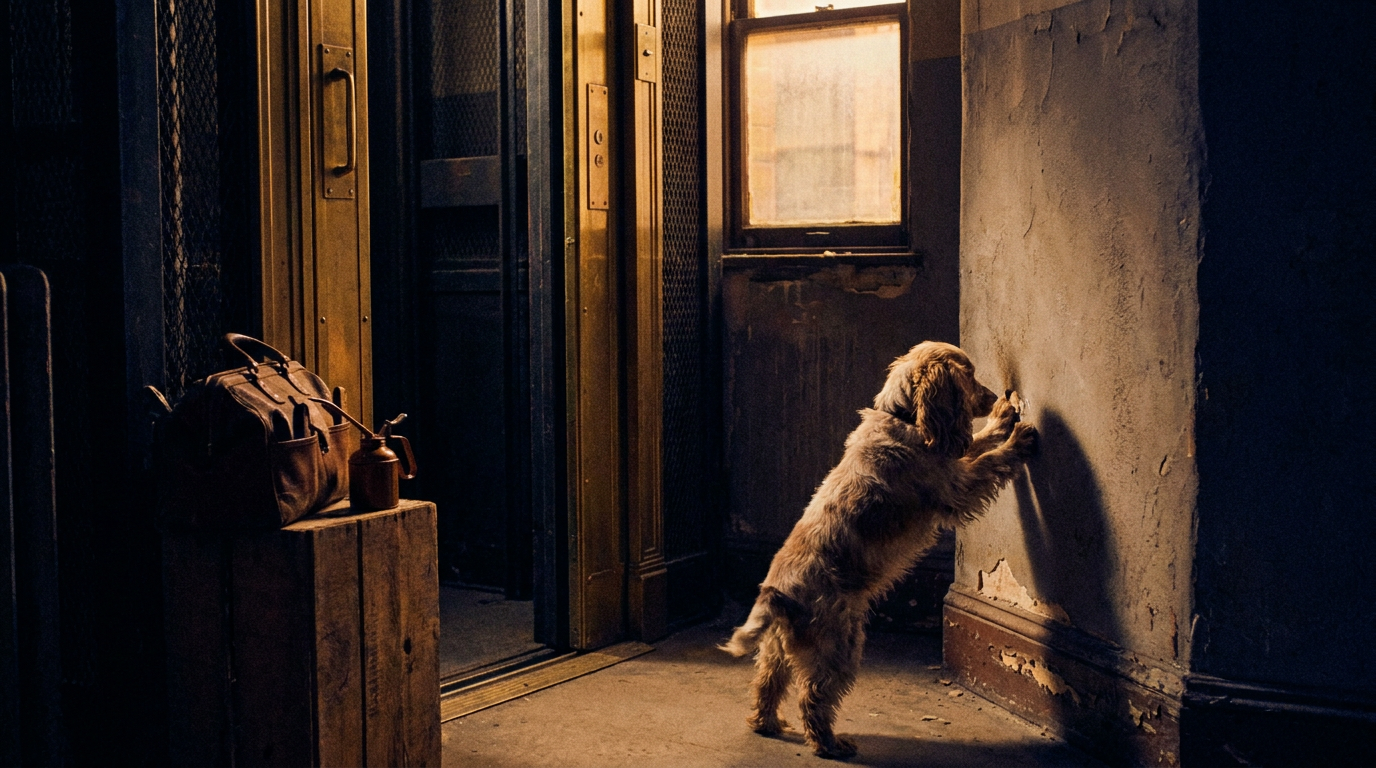
Pip was a courteous little animal, liver-colored, with a white blaze on his head. He never barked indoors. That morning he stood on his hind legs and worked both front paws against the wallpaper, stopping every few seconds to listen.
There was nothing behind the wall except the shaft.
I told Mrs. Vale mice sometimes got into the brickwork. This was reasonable. The building is old, and mice understand its hollows better than I do.
Pip looked at me while I said it.
The lift had been troublesome since autumn. It arrived gently enough, but after the doors closed, one sometimes heard another set close farther back. Residents complained of a draft smelling of face powder and wet wool. Twice I found a brass button on the floor, although none was missing from the panel.
These were small matters. A lift contains cables, relays, brakes, and darkness. Small sounds live richly in such a place.
Then Mr. Hest vanished from the fourth floor.
He was a narrow man who kept peppermints in his coat pocket for Pip. His hat remained on the peg inside his flat. His kettle had boiled dry, leaving a blue mark on the enamel. The police decided he had gone out by the stairs, perhaps confused, and Mrs. Vale accepted this because grief often dresses itself as practicality.
Pip did not accept it. Each morning he scratched the wall beside the lift.
At last I removed the service panel.
The counterweight should have passed behind it, a gray iron slab traveling in its guides. Instead, there was another car.
It moved silently on the far side of the shaft, going down as ours went up. Its walls were papered in faded green. A shaded lamp hung from its ceiling. Mr. Hest stood inside with one hand resting on a polished rail.
He looked comfortable.
That matters. People hear this story and fasten upon the wrong thing. He was not pounding the doors or calling for help. He had taken off his coat. Someone beyond the edge of my view appeared to be pouring tea.
Pip gave one soft whine.
Mr. Hest turned toward us. For a moment his face changed, not with fear, but with the tender embarrassment of a man seen through a bedroom window. He lifted one finger to his lips.
Then the other car passed below.
I closed the panel.
There has always been a counterweight. Every lift requires one. Without a descending burden, ascent is wasteful, violent, nearly impossible. We prefer not to picture the thing that falls whenever we rise, but machinery is not made kinder by our failure to imagine it.
The other car does not take everyone. It seems to favor those whose rooms have grown quiet around them. People who eat from one saucepan. People whose names are spoken mostly by pharmacists. I have never helped it choose.
I have only kept the guides clean.
Mrs. Vale went last Thursday. She entered the ordinary lift carrying Pip under one arm and a bag of library books under the other. The doors closed. A second pair whispered behind them.
When the ordinary car returned empty, Pip was sitting outside it.
He would not let me pick him up. He crossed the lobby and lay beside the wallpaper, his ear pressed to the plaster. His tail moved once, then again.
From within the shaft came the faint clink of a spoon against china.
Pip listened for a long time. Then he looked toward the stairs, where a young mother was carrying her sleeping child upward, step by careful step.
The lift began to descend.
Pip stood and followed the sound.