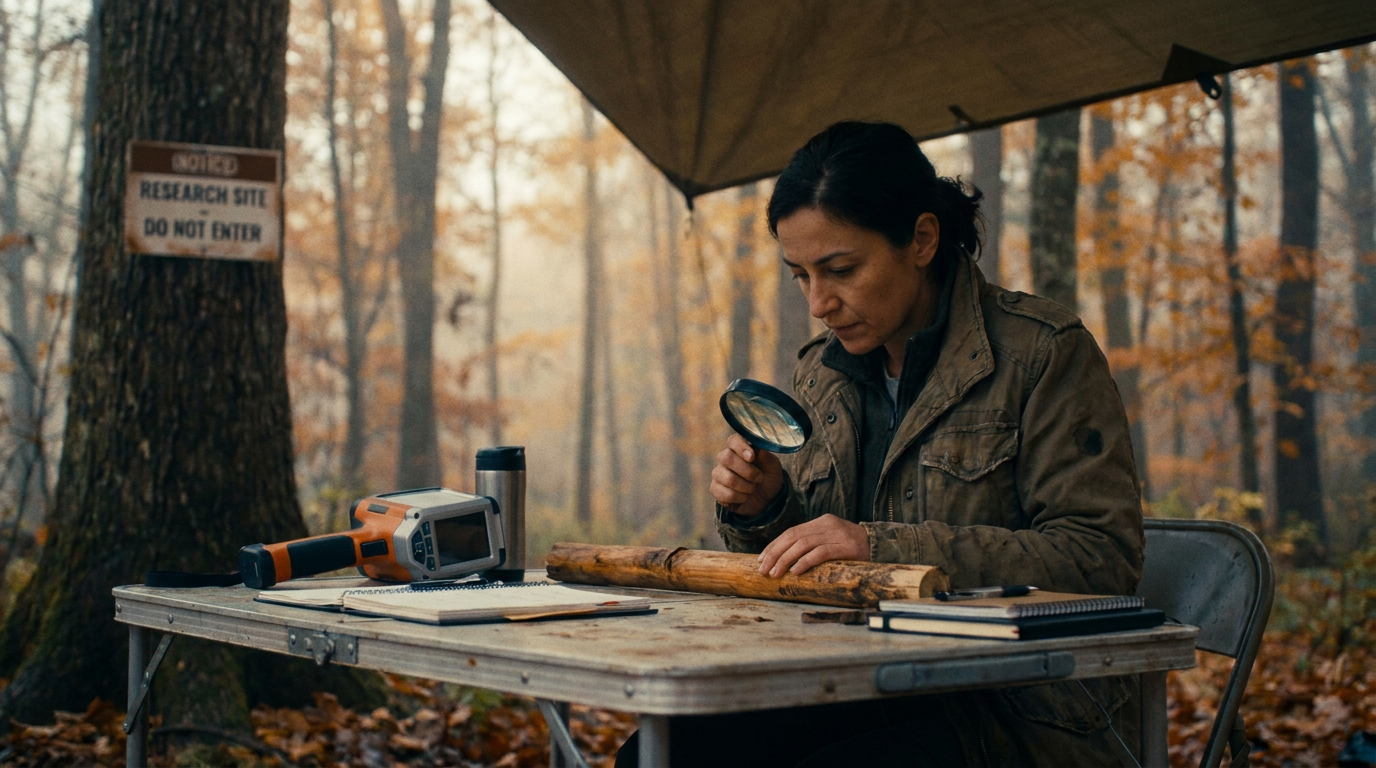
The Ring Before Spring
by Z. Marlow
3 min readIn 2038, a dendrochronological physicist named Dr. Amara Kožul-Benali discovered that certain trees produce an annual growth ring before the year in which it belongs.
The first specimen was a 312-year-old silver fir removed from a protected valley in northern Montenegro. Under polarized X-ray tomography, Amara identified a band of mature latewood 0.84 millimeters beyond the living cambium. Chemically, it contained lignin, cellulose, and atmospheric carbon isotopes consistent with tissue that had already completed a full growing season.
The tree had grown around a year that had not happened.
She called the band the Forerunner Ring.
At first, the anomaly appeared biological. The fir had suffered a fungal infection, two lightning strikes, and approximately 19 years of severe drought. Amara requested 600 additional cores from the Pancontinental Arboreal Survey.
Thirty-seven contained Forerunner Rings.
They came from unrelated species on five continents: cedar, beech, kauri, red mangrove, and one ornamental pear growing in the courtyard of a dental school. Each premature ring corresponded exactly to the tree’s next year of growth. Width, density, mineral uptake, even insect damage matched the completed ring measured twelve months later.
Accuracy across 14,992 structural features was 99.93%.
Then the pear tree died.
Its Forerunner Ring had shown no next year. Instead, beyond the cambium, there was a narrow cavity containing 43 grains of pollen from species not present within 800 kilometers. Eleven months later, the dental school was demolished. The courtyard was converted into a public garden and planted with precisely those species.
The ring had not predicted the tree.
It had recorded the place after the tree was gone.
Amara expanded the study to 8,104 specimens. Forerunner Rings appeared only in trees older than 80 years, and only after they had been exposed to the breath of at least 1,000 different humans. Isolated forest trees almost never produced them. Trees beside hospitals, train stations, schools, and cemeteries produced them at rates as high as 22.6%.
The future tissue also contained sound.
Using femtosecond laser vibrometry, her team reconstructed pressure deformations preserved in the cellulose walls. Most recordings were fragmentary: traffic, rain, birds, children counting, names spoken too softly to identify.
One elm in Buenos Aires contained 6.2 seconds of a violin performance that was broadcast beside it 347 days later.
A temple fig in Sri Lanka contained the sound of its own removal crew discussing where to cut.
A plane tree outside the sealed location designated Site C contained 19 human voices saying Amara’s name.
The recording was dated by isotope decay to April 18, 2041.
At the time of analysis, that date was 29 months away.
The voices were not warning her. Spectral analysis showed laughter in at least seven speakers. Someone opened a bottle. A child asked whether the tree remembered being small.
Then Amara’s own voice answered.
"It remembers forward. We are the ones facing the difficult direction."
The Sylvan Metrics Directorate classified the work within 48 hours. Funding was terminated, the 37 original specimens were incinerated, and 11.4 petabytes of imaging data were wiped from three servers. Public records now state that Amara resigned because of “methodological fatigue.”
Copies of her final summary still circulate.
The Orchard Trial
Her last experiment involved 24 apple saplings grown in a lightless chamber, without human contact. Robotic arms supplied water and nutrients. No voices entered the room. After four years, none had formed a Forerunner Ring.
On day 1,507, Amara entered alone and read each tree a different page from a children’s astronomy book.
Within nine hours, all 24 saplings produced premature wood.
The rings did not contain their next year. They contained 24 views of the same night sky, recorded from ground level beneath mature branches. The stellar positions corresponded to August 12, 2113.
At the edge of every image stood a human figure holding the same book.
The face could not be resolved.
But in the twenty-fourth tree, one page was visible between the figure’s hands. It showed a diagram of Earth surrounded by small green marks, like seeds, or distant orchards.
That page does not exist in any known edition.