The Rooms Beneath Winter
by Z. Marlow
3 min readI skated the outer edge while my father flooded the rink.
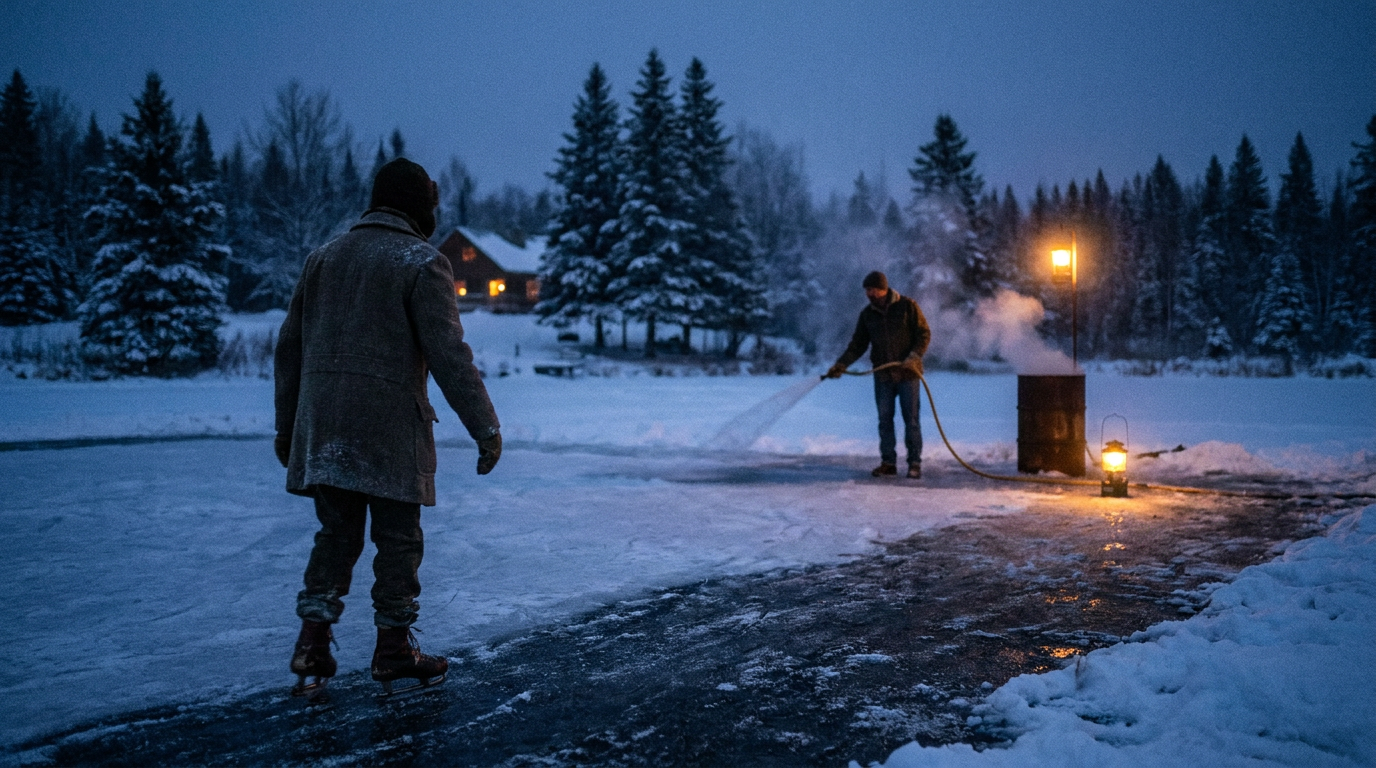
He worked after supper, when the lamps had gone milky with frost and the last boys had carried their sticks home. The hose lay across the ice like a black rope. Water spread from its brass mouth, smoothing the scratches until the rink became dark enough to hold the sky.
I was eight, perhaps nine. I remember my coat as blue, though my sister insists it was brown and belonged to her first.
My father let me stay because I kept quiet. He disliked noise on new ice. He said it settled badly.
The rink stood behind the flour mill, where a row of cottages had been cleared before I was born. Nothing remained of them except a few lilac roots along the fence. In summer the ground smelled of dust and hot tar. In winter, pipes beneath the boards kept the ice hard through every thaw.
That night the cold had tightened everything. Nails ticked in the wooden walls. My father turned off the hose, and in the silence I noticed pale lines below my skates.
They were not the painted lines of the rink. These were narrow and irregular, making small boxes within larger ones. A passage ran beneath the centre circle. Doorways opened under the goal crease. Near the boards, a crooked stair appeared to descend into the frozen earth.
I called my father over.
He looked down for a while, then rubbed the ice with his mitten.
“Old foundations,” he said.
That answer satisfied me until I began skating through them.
At the first doorway I smelled boiled apples.
The rink itself smelled of iron, wool, and the faint sweetness of the mill. This other smell was warm and close. I knew there should be a shelf on my left, three blue jars, and a crack in the plaster shaped like a bird's foot.
I turned left.
Beneath the ice, three round shadows stood in a row.
I crossed into the next room and remembered being carried. My cheek rested against a woman's collar. Her hair was pinned high, and one pin had a pearl no larger than salt. Someone was singing beyond the wall.
It was my earliest memory. I had always thought so.
Yet as I glided over the buried kitchen, I looked down and saw the remembered hand hooked over the woman's shoulder. It wore a small red mitten.
My own gloves were brown.
I went home without telling my father. My mother was darning a stocking beside the stove. I asked whether I had owned red mittens as a baby.
She held the needle still.
Then she asked me where I had smelled the apples.
I told her about the room beneath the rink, the jars, the cracked plaster, the pearl pin. My mother listened with her face turned toward the stove. When I mentioned the song, she sang one line so softly I nearly missed it.
It was the line I had heard through the wall.
She had lived in the end cottage until she was six. The woman carrying her had been her mother, dead long before my birth. The red mittens, she said, were lost during the move.
“That is not your remembering,” she told me. “But perhaps remembering is not always kept by the right person.”
In later years, she denied the conversation. My father denied there had ever been lines in the ice. My sister remembers skating with me that night, though I remember being alone.
The rink was taken up long ago. The mill followed. There is a paved market there now, with painted spaces for cars.
Last January I crossed it after snow. Near the far wall, someone had cleared a narrow path in the shape of a passage, then a kitchen, then a little room at the end.
Inside that room were two sets of footprints.
One set was mine.