The Seaward Face
by Z. Marlow
3 min readYou go down after the gale with a hod of lime and your father’s broad chisel.
The sea has withdrawn in a bad temper. Weed hangs from the lower courses of the wall, shining like boiled greens, and the beach is covered with things that do not belong together: a dead skate, a boot without laces, three apples bruised to the color of tea.
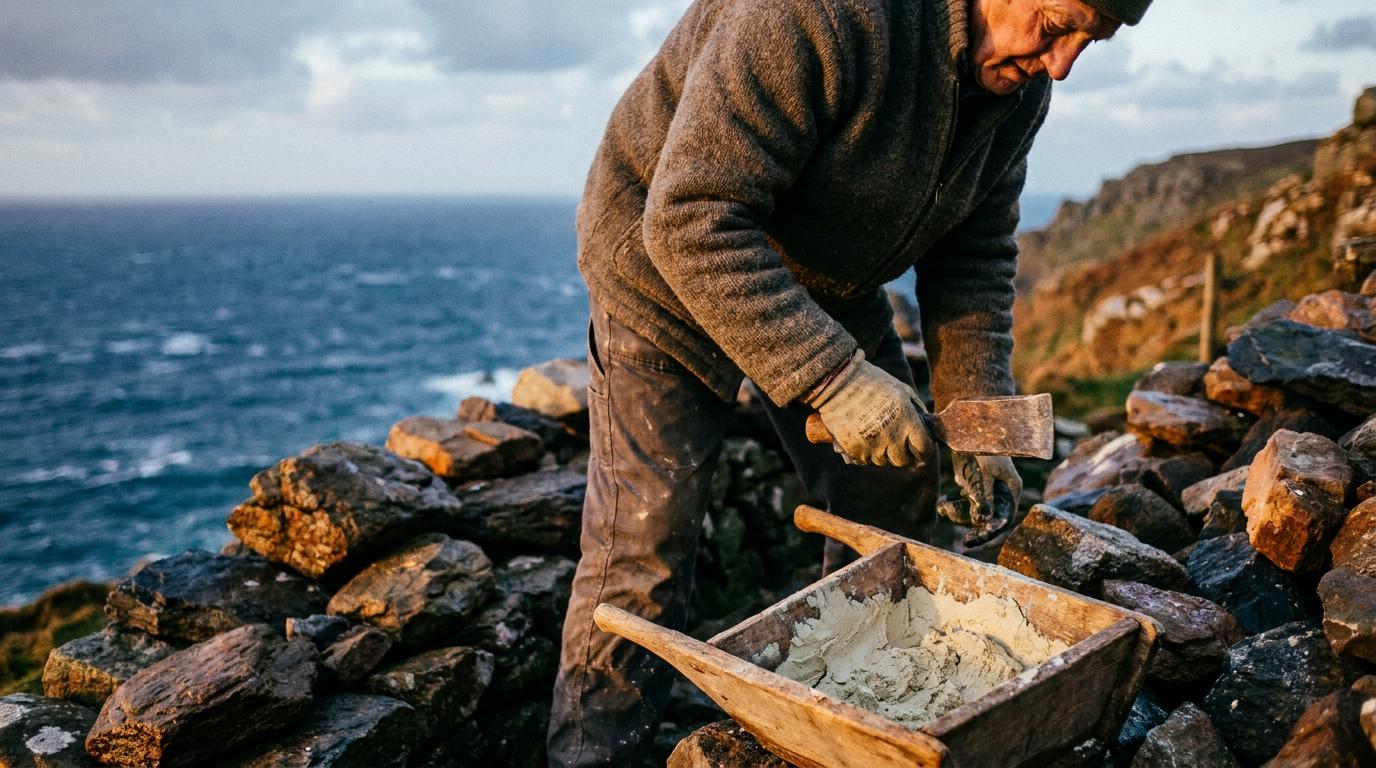
Your work is ordinary. You test the joints with the handle of the chisel, scrape out whatever has softened, and press fresh mortar into the gaps. Behind you, the town shakes out its rugs and relights its ovens. Someone is hammering a shutter back onto the bakery. The smell of wet flour carries down the lane.
By noon, your cuffs are white and the tide has begun to turn.
The damage is worst near the steps where children climb to look for crabs. A whole skin of mortar has peeled away, exposing the wall’s inner filling. Your grandfather called it hungry work. Anything hard went in: fieldstone, brick ends, broken chimney pots. The dressed blocks were saved for the outward face.
You kneel and begin clearing the hollow.
First comes a length of green glass, dulled by salt. Then a brass hook. Then a piece of painted crockery.
You know the pattern before you rub it clean.
Blackberries circle the rim, each fruit made from five dark thumbprints. Between two leaves is a thin blue stroke where your wife’s brush slipped. She laughed when it happened and said the branch had caught rain.
The plate stands at home on the dresser.
You used it that morning for oatcakes.
For a while you remain kneeling, the shard warm in your palm. Sunlight has reached the wall. Sand fleas jump among the stones.
You tell yourself that your wife copied an older design. Yet the blue stroke is there, and beneath it the tiny crescent left by her thumbnail when the glaze was wet. The shard’s broken edge passes neatly through a painted berry.
Deeper in the hollow lies a strip of yellow cloth printed with white clover. Your daughter’s best dress is made from that cloth. It hangs behind the washhouse door because the hem still needs letting down.
There is also a stair spindle, blackened with age. Its turning is plain except for one shallow nick.
You made that nick last winter while carrying the cradle upstairs.
The wall was built before your mother was born.
A wave folds over the lowest stones and falls back with a sound like sheets being dragged across a bed. You look along the seaward face. In every place where the gale has opened it, small colors show between the blocks: wallpaper blue, kettle copper, the red glaze of a flowerpot. Not rubbish. Rooms.
The town has always said the wall keeps the sea from the houses.
You understand then that this is true, but not in the way anyone means.
You replace the cloth and the spindle. You set the painted shard deep in the hollow, with the blackberries facing inward, and mortar the opening shut. Your hands are gentle. By the time the tide reaches the steps, the repair is smooth.
At home, your daughter runs to meet you in the yellow dress. Your wife has finished the hem. Supper waits beneath a cloth, and the blackberry plate is on the table, whole and bright in the lamplight.
You do not tell them what you found.
Later, while your wife washes and your daughter dries, the plate slips between their soapy hands. Both catch it. They laugh.
From the cupboard comes a small, clear sound.
Not a crack.
The sound a crack makes while it is still waiting.