The Shape at Tea
by Z. Marlow
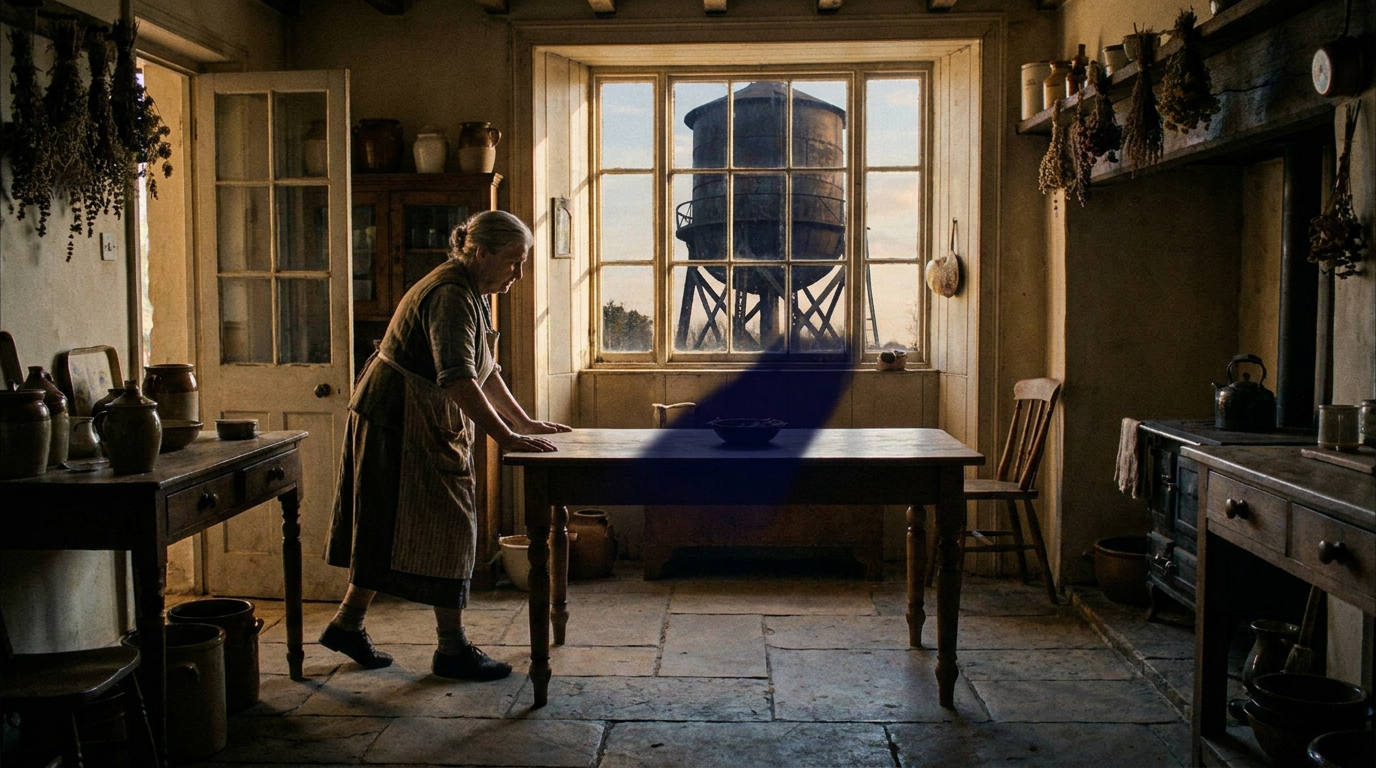
3 min readGrandmother moved the kitchen table every afternoon to keep it inside the water tower’s shadow.
The tower stood beyond the wash yard on four riveted legs. It supplied our row of cottages and the dye works downhill, where the gutters were sometimes blue and sometimes red. Before electric lamps reached our lane, its iron tank was the largest thing I knew. At noon it seemed to hold up the sky.
Grandmother watched its shadow through the window while she kneaded dough. When the dark edge touched the rosemary tub, she wiped her hands, took hold of the table, and dragged it three inches toward the stove.
There were always two cups.
One was hers, brown pottery with a chipped lip. The other had painted cherries and belonged to my uncle Samuel, who died before I was born.
He had gone into the reservoir meadow one hot morning to bring home a lost hoop. The grass there had been cut, and the air smelled of sap and warm iron. They found the hoop against the tower fence. They found Samuel farther off, lying neatly on his back. There was no wound on him. Grandmother washed his shirt herself and wore the buttons afterward on the inside of her coat.
She did not speak to the cherry cup. She poured tea into it, added milk, and set a currant bun beside the saucer. At dusk she emptied the tea onto the mint bed and gave the bun to me.
I thought this was simply what sorrow looked like.
Then, when I was nine, I saw the light.
The tower’s shadow covered half the kitchen floor, its cross-bracing making black bars over the boards. Between Grandmother’s chair and the empty one lay a small, human-shaped patch of sunshine. It had a round head, narrow shoulders, and one hand resting upon the table.
I went outside and looked up. The tank was solid. The ironwork had no gap that could have made such a figure.
When I came back, Grandmother was buttering the bun.
“You see him now,” she said.
The words were not a question.
The bright shape was the size of a child of twelve. Yet Samuel had died at seven.
Grandmother noticed where I was looking. “Last spring he was shorter.”
That was all she said.
Each year afterward, when I visited, the shape had changed. Its arms lengthened. Its shoulders broadened. One autumn, the bright head rose above the back of the empty chair. Grandmother replaced the cherry cup with a plain white one, because, she said, cherries were for children.
I asked her once how she knew what sort of man Samuel would have become.
She looked surprised.
“I don’t,” she said. “Neither does the light.”
It was not keeping him as he had been. It was keeping what had been taken.
Grandmother lived long enough to pour tea for a brightness taller than my father. By then her hands trembled, and I moved the table for her. The shape’s fingers reached almost to the bread knife, though they never touched it.
After her burial, the landlord told me the tower was coming down. Its tank leaked, and the dye works had begun drawing water from a new main. He was apologetic about the garden wall, which might be damaged when the legs were cut.
I spent the last afternoon alone in the kitchen. The tower’s shadow entered at its usual hour.
The place beside me was bright and man-shaped. For the first time, no cup had been set there.
I fetched the plain white one from the cupboard. I filled it carefully and placed it where the hand of light rested upon the table.
By then Samuel would have been older than Grandmother was when she first began waiting.
I wondered, as the tea cooled, whether the shape would ever stoop.