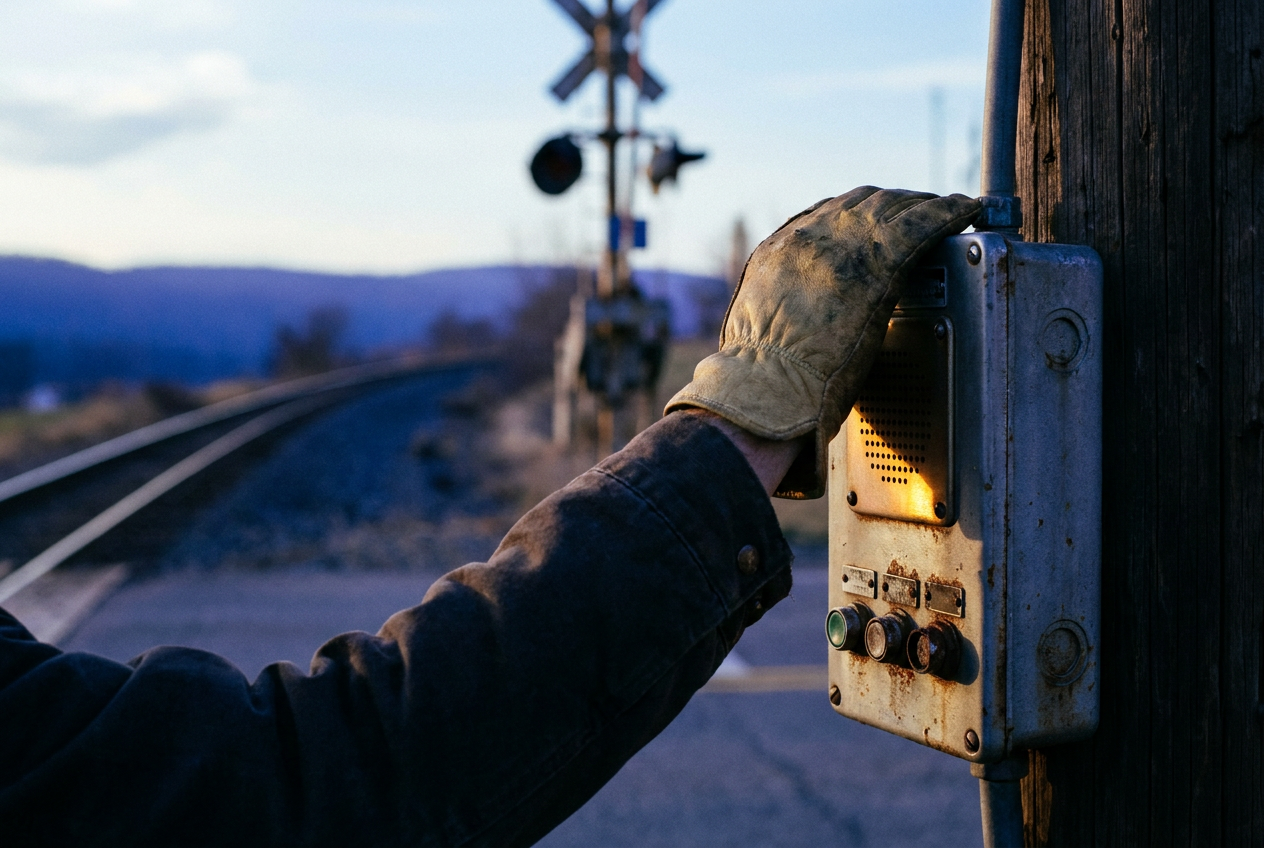
The Sound for Crossing
by Z. Marlow
3 min readYou are tightening the cover on the push-button box when the crossing begins to sing.
It is after midnight. Rain has polished the road, and the white stripes shine like strips of fish skin. No one waits at either curb. The red figure remains lit, one hand raised.
Still, from the speaker comes the small tune your mother used to hum while pegging sheets in the yard.
You stop with the screwdriver between your fingers.
The tune lasts only as long as the crossing interval. Then traffic receives its green light, though there is no traffic. Water ticks in the gutter. Somewhere behind the closed bakery, a bottle rolls and settles.
Marek, who has been holding the torch, asks why the box played a blackbird.
You tell him it did not.
He looks at you. His face is plain with surprise, not fear.
“My brother whistled that,” he says. “When we were boys.”
The fault report had described an intermittent chirp. Nothing unusual. Crossing speakers fill with grit, ants, rainwater. Sometimes a loose wire gives them a voice like a trapped cricket. You open the box again and find the connections dry, the copper bright.
At the next intersection, the signal is already sounding.
Marek hears a spoon tapping the rim of a glass. You hear your mother closing the garden gate: latch, scrape, latch. It is a sound you have not remembered in years, yet your body knows it. Your hand rises before you understand why, ready to wave from the kitchen window.
The green figure appears.
Across the empty road, rain bends around something.
Not a shape. Only a narrow absence in the falling water, moving from curb to curb with the patient pace of someone carrying a full cup.
You and Marek stand beneath the awning of a shuttered pharmacy. Neither of you speaks until the red figure returns.
Then another crossing begins, farther downhill.
You follow in the repair van.
The signals wake one after another through the sleeping town. Each gives Marek his brother’s whistle. Each gives you the garden gate. In upper windows, lamps come on. A woman in a yellow robe steps onto her balcony and whispers a name. An old man comes barefoot to his doorway, smiling so gently that you look away.
At the river road, people have gathered beneath umbrellas. They stand apart, listening to different things.
A baby crying once, then breathing.
A dog scratching at a pantry door.
A chair drawn back from a table.
Someone laughs. Someone kneels.
The crossings continue toward the bridge.
There, the sound changes.
You do not hear the gate now. You hear your mother call you in from the rain. Not your name as others say it, but the shortened form she kept from your childhood, softened at the end as if it were something warm in her mouth.
Marek grips your sleeve.
The green figure shines across the bridge.
Every person waiting beside you takes one step forward at the same time.
The road is empty, but the wet surface dimples beneath many feet. The sound moves out over the black water, crossing with them. You understand then that these signals were never made only for the living. They were placed wherever one side must wait for the other.
No one follows. Perhaps everyone understands something else.
By dawn, the crossings have fallen silent. The fault cannot be repeated. Marek writes “water ingress” on the work sheet, because there is a box for cause and it cannot be left blank.
You begin walking home.
At each intersection, you wait for the red figure, even when the streets are empty. You listen carefully.
At the final crossing, outside your own house, the speaker gives a soft click.
From the far curb comes the sound by which someone, someday, will remember you.