The Still Country
by Z. Marlow
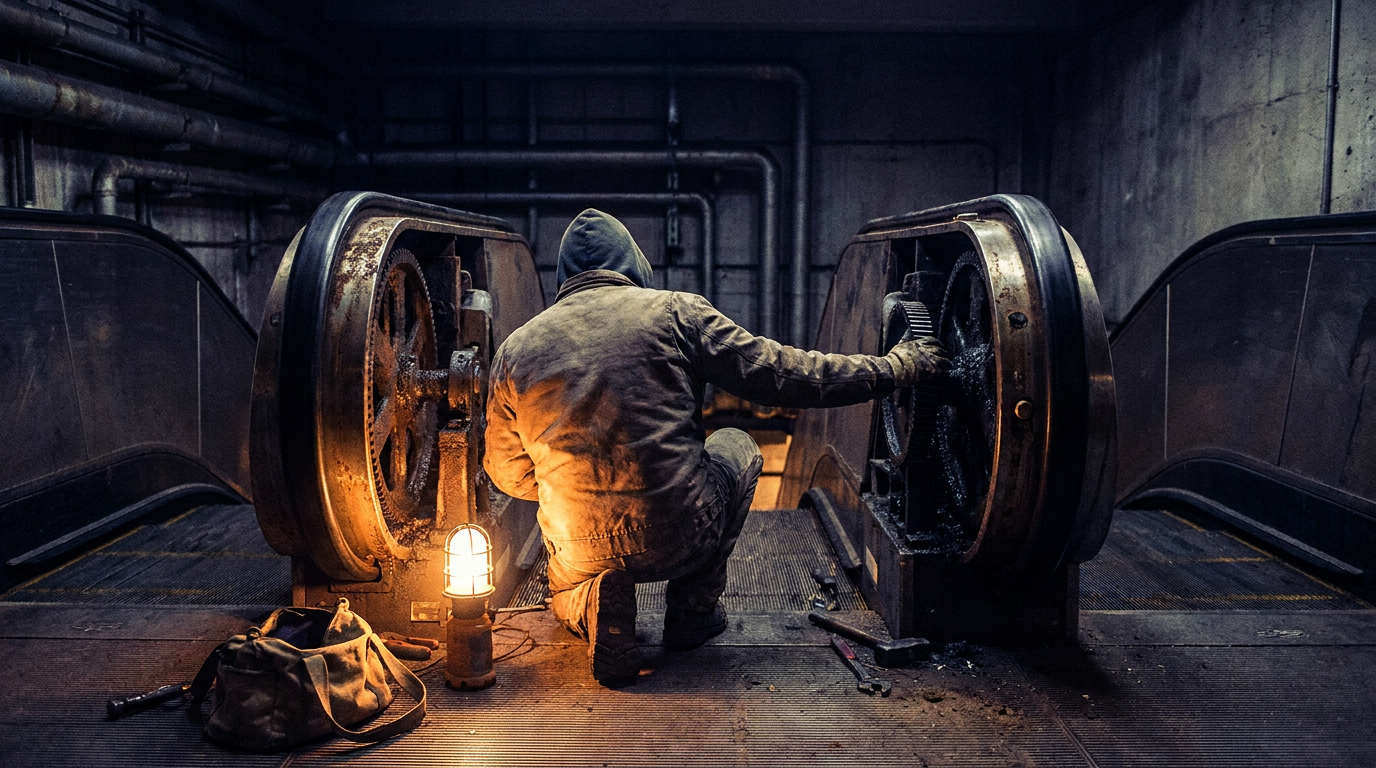
3 min readI am kneeling between the two escalators when the teeth cease to mesh.
Nothing stops. The left stair carries its empty procession upward, each aluminum tread shining under the concourse lamps. The right stair descends at the same patient speed. Yet the familiar grinding beneath them falls away, and a wind rises through the seam where the machines meet.
It smells of cut grass.
“Kill the power,” I say.
Mara has her hand on the red switch, but she does not press it. She is looking down.
The seam has widened. It is no longer the black finger’s breadth where ticket stubs and hairpins vanish. Between the moving rails lies a strip of green earth, perhaps as wide as a doorstep. Clover trembles there. A white moth climbs the wind and settles on Mara’s sleeve.
Above us, the departure hall remains closed and ordinary. The bakery shutters are down. Rain stipples the glass roof. Somewhere beyond the locked doors, a floor polisher hums.
Mara crouches beside me.
“That cannot be under there,” she says.
It is not. The escalator housing is packed with chains, rollers, grease trays, and wiring. I have opened it often enough to know its cramped iron anatomy. There is no depth for weather.
The green strip broadens.
Now we see a path descending gently between hedges. Beyond them lies a country under a pale sky. Low hills carry rows of dark trees. Chimneys stand among the fields, giving off thin blue smoke. Far away, something flashes like a river.
The wind is warm against my face.
A woman comes along the path.
She wears a red coat and carries a small suitcase. At first I think she is approaching us, but her steps make no sound, and she never grows larger. The path itself seems to pass beneath her feet. Behind her follows a boy in a school blazer, then a man holding a bunch of daffodils, then an old woman with both hands clasped around an empty birdcage.
They do not look at one another.
Mara reaches toward the grass. I catch her wrist before her fingers cross the seam.
“There,” she whispers.
Beside a hedge stands a long wooden bench. People sit upon it in coats from every season. Some hold parcels. Some sleep with their heads tipped back. A little girl swings her legs above the dust.
Each face is turned toward us.
Not toward Mara and me. Toward the escalators.
The understanding arrives without words, cold and beautiful.
Whenever we stand on a moving stair, some part of us refuses the journey. It remains perfectly still while the world carries our body away. Those still parts have gone somewhere together.
Mara makes a small sound. On the bench, between the girl and a man in a rain cape, sits Mara herself.
The other Mara is younger. Her hair is black, and she wears the yellow dress from the photograph pinned inside Mara’s locker. She smiles as if she has been waiting to be noticed.
Mara leans closer.
The country widens another handspan. Grass folds over the metal lip. One of the upward steps catches a root and draws it beneath the comb plate with a soft, fibrous snap.
The younger Mara rises from the bench.
“Do you hear that?” Mara asks.
I hear only the machinery and the rain, but then a voice comes through, faint as speech from the far end of a tunnel.
It says her childhood name.
Mara’s wrist turns in my grip. For a moment I feel how easily she could step across. The path is close. The warm wind lifts the gray hair from her forehead.
Then the down escalator gives a slight shudder.
The hills flatten. The bench thins to a brown line. The younger Mara lifts one hand, whether in greeting or warning I cannot tell.
“Now,” I say.
Mara presses the switch.
Both stairways halt. The seam closes with a neat metallic click, severing clover, sky, and the raised hand. We remain kneeling on the tiled floor, our faces reflected dimly in the steel.
Between us lies the white moth.
It opens its wings, and on each wing is the tiny map of a country with no roads leading out.