The Thirsting Arch
by Z. Marlow
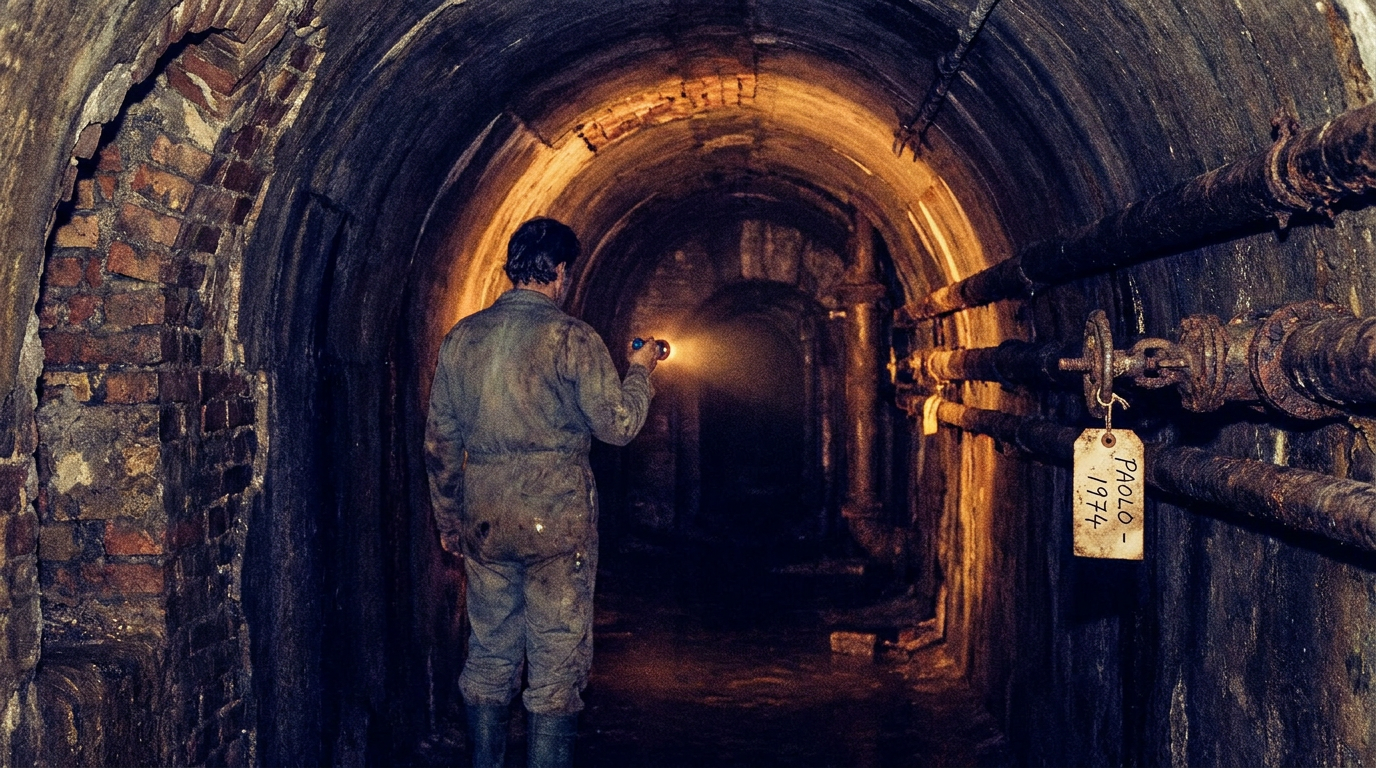
3 min readI lowered myself into the town conduit this morning, Paolo, although your funeral is not until tomorrow.
The drought has left the channel empty enough to walk. Usually the water reaches a man’s chest and presses him along like a loose cork, but today there was only a ribbon of mud underfoot. It smelled of pennies and cold roots.
Master Orso sent me to clear the fig branches from the intake. He remained above with the mule and the rope, complaining about flies. You would have liked how his voice followed me underground, growing smaller without growing farther away.
Beyond the bend beneath the dye-maker’s yard, I found an arch in the left wall.
I know that wall. I helped lay its lower courses when we were boys and Father still had all his fingers. There is solid hill behind it. Yet the arch stood open, with sunlight on the other side.
Not our sunlight. This was pale and without warmth, though I could smell hot dust and crushed thyme. I called to Master Orso. He answered from somewhere ahead of me, asking why I had stopped.
So I went through.
There was a town beyond the arch, built in a long valley of white stone. Its streets were narrow and clean. Copper basins stood beneath carved spouts, but every basin was dry. Curtains moved in upper windows. I saw no one behind them.
I had the sense that I had arrived late, then the stronger sense that I had arrived before anything.
You were waiting beside a fountain shaped like a sleeping ox.
You looked as you did last winter, not as they pulled you from the millpond. Your hair was combed. Your boots were dry. I wanted to embrace you, but you placed one finger against your lips and pointed upward.
There was no sky.
Our town hung above us, upside down and very far away. Every house, chapel, stable and bakehouse depended from the darkness by a thin column of water. I saw Mother’s blue roof trembling at the end of the kitchen tap. I saw Master Orso leaning over the conduit mouth, no larger than a beetle, his hands cupped around his shout.
The columns shivered whenever someone drew a bucket.
Then I understood why the town groans at night.
We have always said the aqueduct carries water down from the mountain. It does not. The water holds us where we are.
You touched the fountain. A little water welled from the ox’s stone eye. In it I saw rooms I did not know, each with a pitcher on the table. Some rooms were newly plastered. Some had collapsed into nettles. In one, an old woman unfolded this letter and read it aloud in your voice.
I asked whether you lived there.
You shook your head.
I asked whether I did.
You smiled, which was unkind only because I had missed it.
Then the sluice opened.
Water struck the arch behind me with the sound of a door slammed in a cathedral. I woke in the conduit with my cheek against the mud. Master Orso hauled me out by the ankles. He said I had been gone no longer than a breath.
The arch was gone. The wall was solid and wet.
They will bury you tomorrow on the hill above the settling pool. Mother has chosen the green coat you hated. I will put this letter into the mortar beneath the fountain in the lower square, where the conduit runs close to the surface.
You cannot answer. I know that.
Still, when I filled the washing jug tonight, a small current turned beneath the handle though the water was perfectly still. It smelled of thyme. At the bottom lay a single dry bootprint, pointing down.