The Wall at Kestrel Head
by Z. Marlow
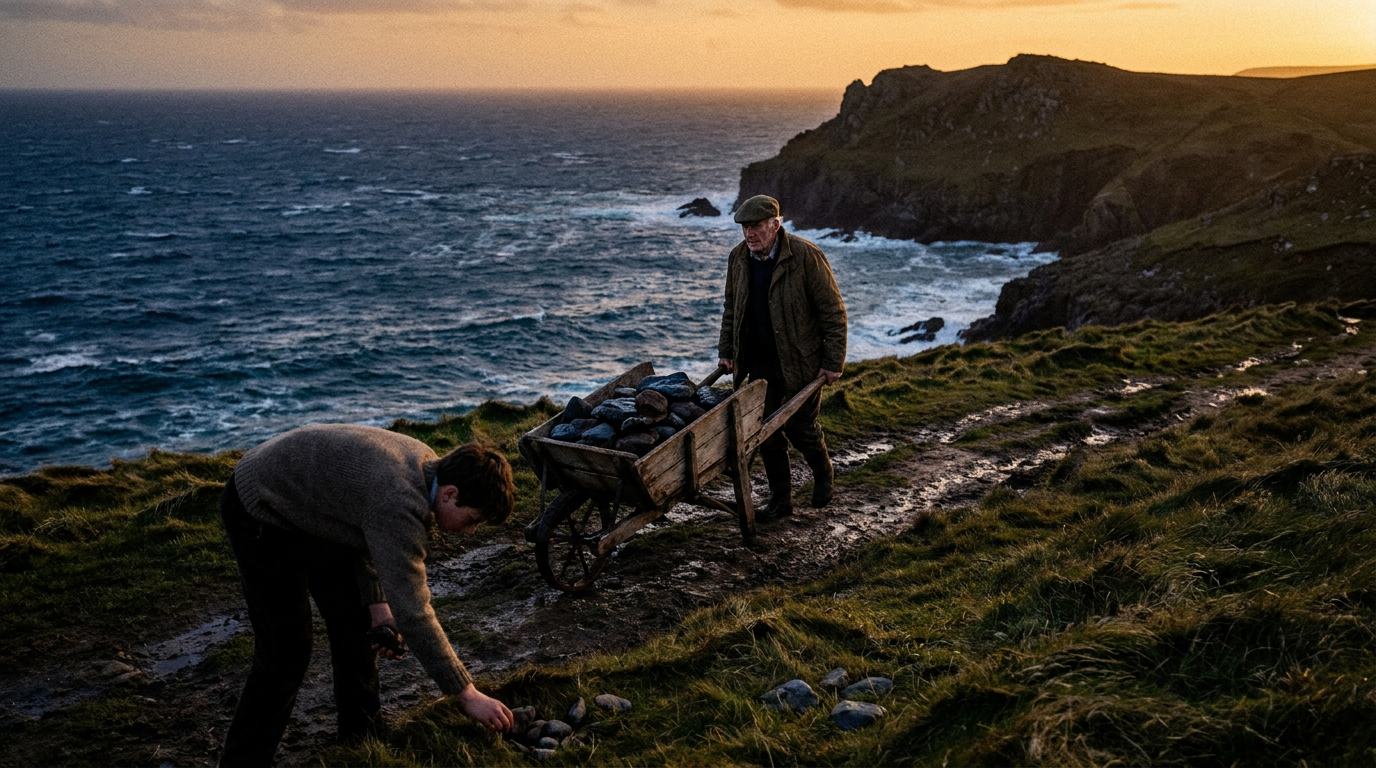
3 min readMy grandfather rolled the handcart along the cliff path while I followed, gathering stones the storm had thrown into the grass.
He was a waller by trade. His walls crossed the island in gray seams, dividing barley from pasture, one family’s ewes from another’s. The wall at Kestrel Head divided nothing. It ran beside the cliff for half a mile, then turned inland and ended at a boulder.
No sheep grazed there. The ground was too salty.
Grandfather repaired it after every hard gale.
I was twelve that autumn, unless I have joined two years together in remembering. Certain parts remain clear: the iron taste of rain, his red scarf tucked into his collar, limpets shining among the flattened thrift. Other parts feel borrowed from a dream I had later.
The breach lay near the headland. Five yards of wall had gone down, although the wind had blown from inland. Grandfather studied the scattered stones.
“We’ll need the dark ones first,” he said.
He meant the stones that had lain inside the wall, protected from lichen. They were slick and gave off a smell like opened oysters. In the crack of one I found a twist of white fiber.
“Wool,” I said.
He took it from me and wound it around his finger. It was finer than wool and cold enough to sting.
“Put stones in the cart,” he said.
All afternoon we rebuilt. He laid each piece without mortar, turning it until it settled with the small, satisfied knock I knew from childhood. The wall rose slowly. Beyond it, the sea had flattened under a yellow sky. There was no wind now, yet white water appeared here and there, far out.
Grandfather worked faster.
By dusk, only a narrow opening remained. Through it I could see the line of the horizon and, below, the dark slope of the cliff. The tide was coming in. It did not break against the rocks. It gathered there.
I remember asking why we had left the opening so long. I remember his answer less certainly.
“Nothing likes to be shut out without seeing the door close.”
He chose a long capstone from the cart. As we lifted it, I looked through the gap.
The white marks on the sea were no longer scattered. They had arranged themselves in rows, one behind another, all the way to the horizon.
Then the nearest one turned.
It had no face that I could describe. It was only foam folding upon foam, with two hollows where the evening showed through. Yet I knew, as plainly as I knew my grandfather’s hand beside mine, that it had been looking toward the island for a very long time.
Behind it, the whole sea turned with it.
Grandfather dropped his end of the capstone. It struck my boot and broke two toes, though I felt nothing until later. He seized the stone again and pushed. We heaved it onto the wall just as something struck the other side.
Not a wave. A weight.
The stones shifted under our hands. From between them came that same white fiber, curling in the still air.
We leaned there until the pressure passed.
Grandfather died before the new road reached Kestrel Head. The builders removed much of his wall and replaced it with wire, which was cheaper and did not harbor rabbits. I was living across the water by then. Perhaps this is why I cannot trust what I remember. Distance improves some memories and invents others.
I returned once, years afterward. The cliff path was wider. Cars stood where we had left the handcart. Only a short length of the old wall remained, ending neatly beside the road.
The day was warm and windless. Families ate sandwiches on the grass. Far below, the white water moved among the rocks.
A little girl beside me pointed out to sea and asked her mother why all the waves were waiting.
Her mother did not look up.
I did.
The wire fence had begun to bend inland.