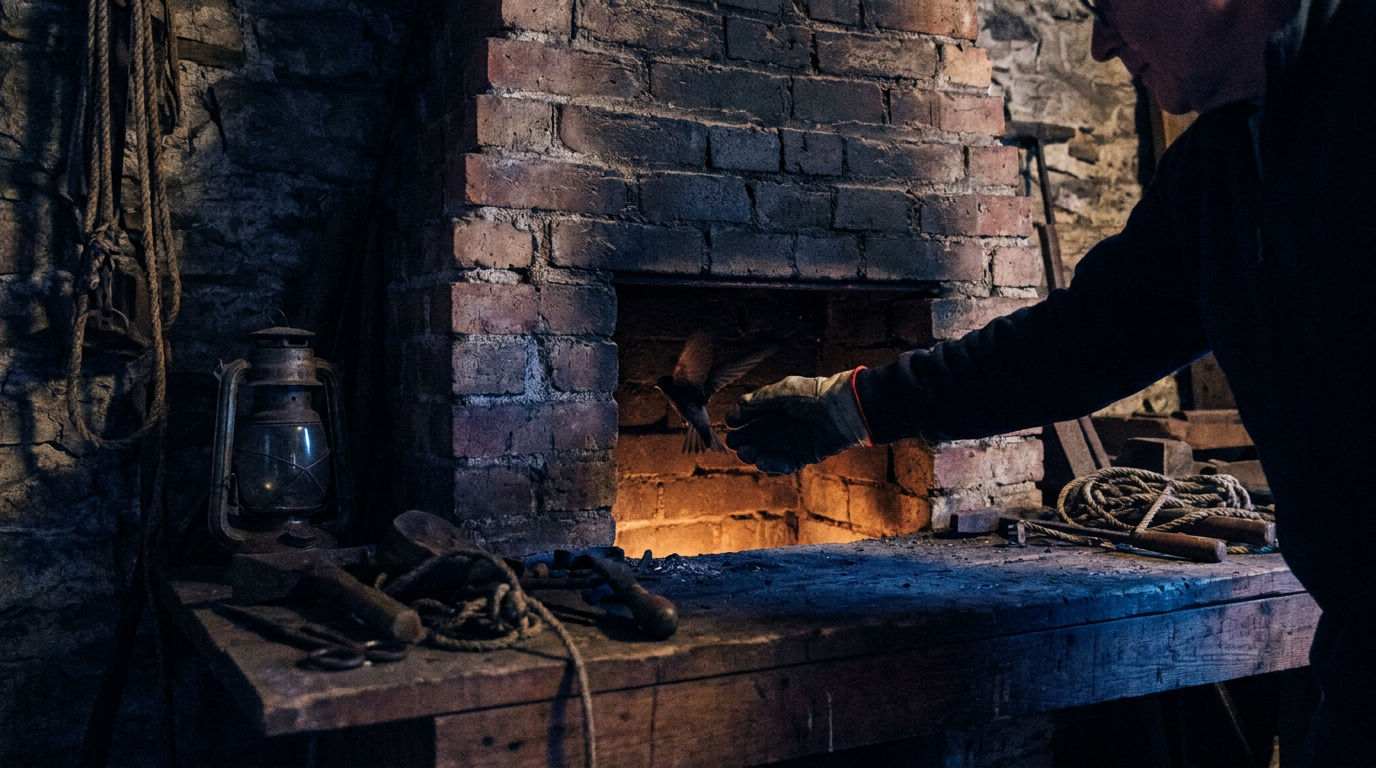
The Warmest Flue
by Z. Marlow
3 min readI send Tern into the stack before me. He goes willingly, which is how I know the blockage is not soot.
Order for Clearing the West Stack
- Remove the nursery grate. Lay sacking over the carpet, since Mrs. Vale dislikes a black heel-mark more than she dislikes smoke.
The opening is narrow. Turn your head sideways and empty your lungs. There is room to breathe once your shoulders pass the first bend.
- At the fork, take the left flue.
The right serves the drawing room below. You will smell beeswax and orange peel from the mantel. If you smell boiled cabbage, you have turned too soon.
Tern waits at the fork. He is a small jackdaw, black except for one grey feather under his chin. When I say left, he taps the right-hand bricks with his beak.
Ignore him.
- Climb until the mortar changes from gritty to smooth. Test each foothold before trusting it. The stack was repaired cheaply after the winter fire.
Tern remains below.
Call him once. He knows his work.
If he does not come, do not call again. A bird can hear more through brick than a man can, and Tern has always known when a room is occupied.
- At the iron brace, scrape downward.
This is where the soot should have gathered. Instead, I find the bricks clean and faintly warm. The air tastes of toasted flour.
There is no bakery in Vennel Court. There has not been one since I was a boy.
Tern comes up at last. He squeezes past my cheek, his claws pricking my ear, and vanishes into a gap no wider than a penny.
- Do not enlarge the gap.
This instruction is wrong. I enlarged it.
Beyond the bricks is another flue, running sideways. No chimney should run sideways for such a distance. I crawl after Tern with one arm ahead and the other pinned beneath me. The passage grows warmer. Somewhere close, a woman hums while she kneads dough.
I know the tune.
My mother used to sing it on washing days, before the fever took her. She had no proper words for the middle, only a low sound in her throat.
Tern gives that sound back to me from the dark.
- Continue until you reach the hearth.
This instruction is also wrong. There is no room at the end, only firelight shining through a square of thin brick.
Through a crack, I see a kitchen. Blue crockery stands on a shelf. A woman bends over a wooden table, her sleeves rolled to the elbow.
She is younger than I remember.
Tern sits beside her flour bowl.
She breaks a currant bun and holds half toward him. Then she looks directly at the crack.
“No, love. Not yet.”
The fire beneath me draws breath.
- Go back feet first.
Do not turn, even where the passage widens. The stack has more branches now. From some comes coal smoke, from others applewood, peat, damp twigs, pine resin. I hear kettles settling on hobs. A baby coughs. Someone laughs with my own voice, though I am not laughing.
Tern follows. He carries the bun in his beak.
- Seal the sideways flue with fresh mortar.
Mrs. Vale asks why her chimney smells of bread. Tell her old soot holds odors strangely. This is not true, but it is a kindness.
- Leave the nursery grate open.
Tern will not come to my hand. He stands inside the chimney, crumbs bright on his tongue, listening upward.
There are no more instructions. While I write this, he has begun carrying twigs into the wall.
The first is green with spring buds.