The Weight of Names
by Z. Marlow
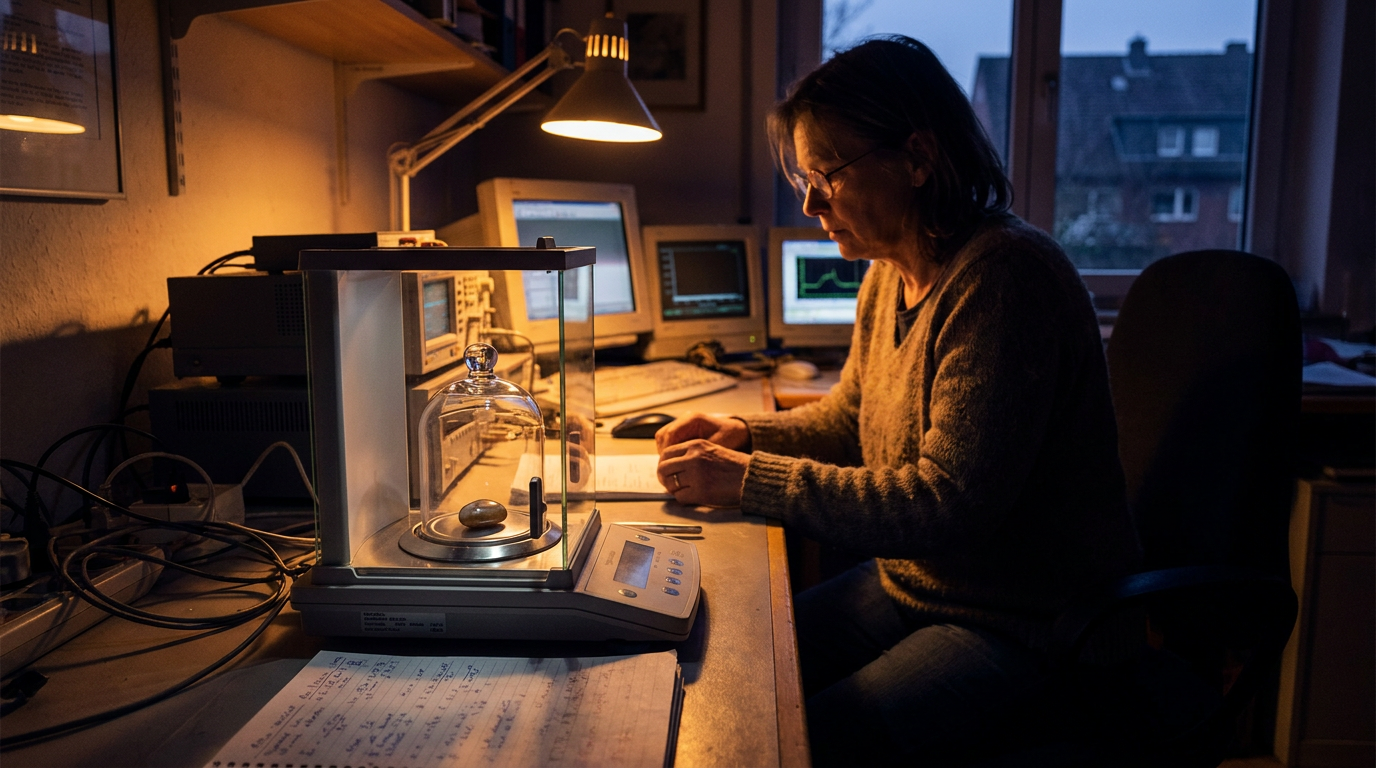
2 min readIn 2033, a bored data scientist named Petra Voss ran what she thought was a joke experiment. She weighed objects, precise to the nanogram, before and after naming them.
A rock on a scale: 142.0000000 grams. She looked at it, decided its name was “Harold,” and spoke it aloud.
142.0000003 grams.
She laughed. Calibration error. She reset. Tried again with a glass marble. Named it “Constance.”
The mass increased. Every time. Not by the same amount, but always up, never down, and never zero.
She told no one for a year. She ran 14,000 trials. The effect held. Unnamed objects: stable. Named objects: heavier. Not by much, femtograms to nanograms, but consistently, measurably heavier.
Then she tried the reverse. She took objects that already had names, a teddy bear called “Mr. Buttons” by its owner for 30 years, and she performed a ritual she invented: she “unnamed” them. Spoke a negation. Declared the name void.
The mass dropped below its original baseline.
As if the name had been load-bearing. As if removing it took something else with it.
She submitted her paper to four journals. All rejected. Not for methodology, the methodology was airtight, but because, as one reviewer wrote: ”The implications are too structurally dangerous to publish without a framework for containment.”
Containment of what? She emailed back.
No reply.
Project Sable
Six months later, Petra received a job offer from an organization with no website, no address, and a name that changed every time she looked at the letterhead. The salary was a number she didn’t recognize as currency.
She accepted.
On her first day, they showed her The Vault, a room beneath a mountain in Norway containing 11,000 objects that have been deliberately unnamed. Each one sat in a vacuum-sealed case, and each case was lighter than it should be. Not by nanograms. By kilograms. One, a steel cube, 10cm per side, weighed negative four grams. It pressed up against its restraints.
“What happens if you name them?” she asked.
Her supervisor, a woman who introduced herself only as “the interim designation”, said:
"We named one. Once. In 1987. An iron rod. Someone called it 'Anchor.' It gained 200 kilograms in eleven seconds and fell through three floors of reinforced concrete before we could unname it. The sublevel it landed in is sealed. We can still hear it down there sometimes. Getting heavier. As if the name is... remembering itself."
Petra asked the only question that mattered: “What happens when something gets heavy enough?”
The interim designation looked at her for a long time.
"We think that's what gravity is. We think something named the Earth. Named the sun. Named every star. And whatever did the naming... we think it's still speaking."
The Unnamed
There is a tribe, uncontacted, location redacted, that has no nouns in their language. They do not name things. They do not name each other. They describe only actions, only motion, only change.
Satellite measurements confirm: the region they inhabit is 0.00004% lighter than the surrounding terrain.
They have never been observed sleeping.