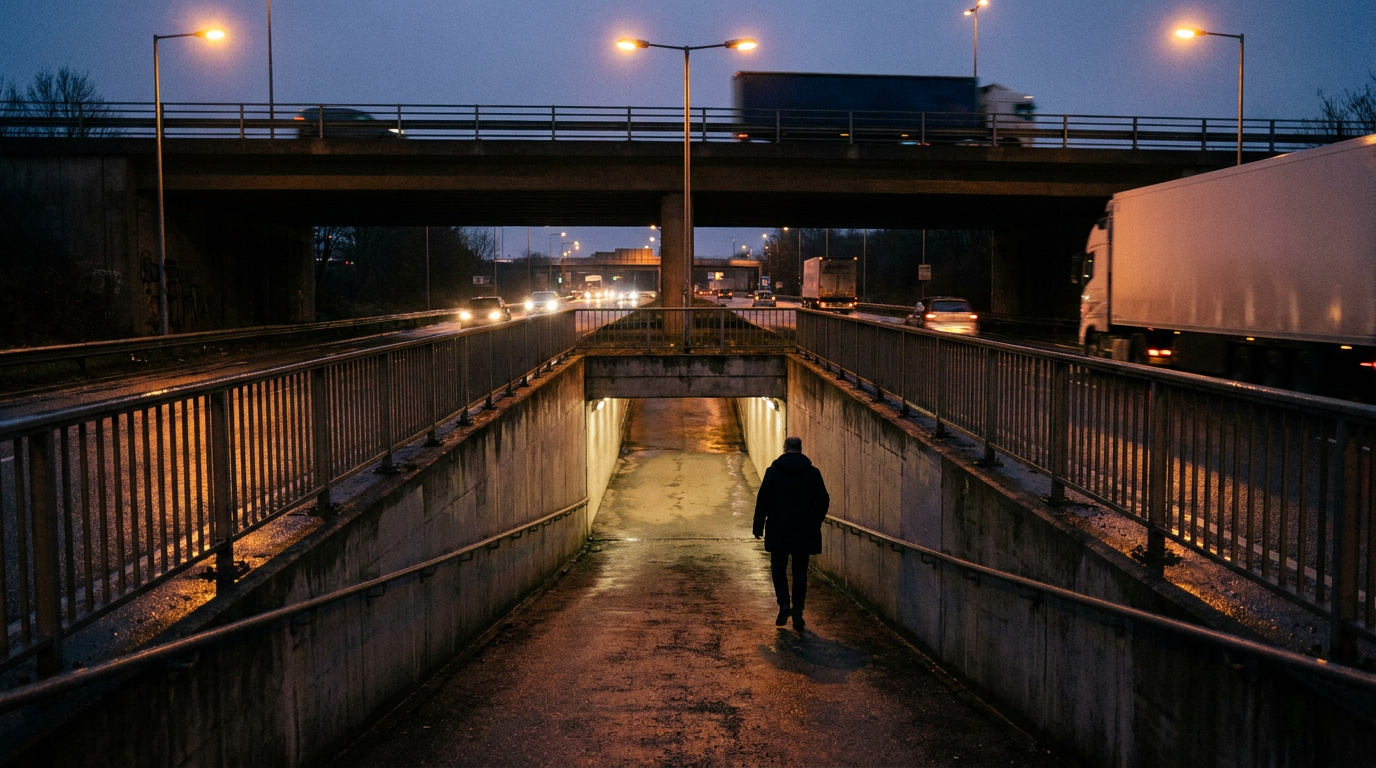
Under the Bypass
by Z. Marlow
3 min readI took Elin through the new subway because she disliked crossing among the lorries.
The entrance smelled of rain and fresh cement. Above us, the bypass murmured beneath its burden, each vehicle pressing a brief weight into the ceiling. Elin held my hand and tested the slope with the toes of her red boots.
“They made it like a mouth,” she said.
The walls were tiled in cream, except for a row of blue tiles at a child’s shoulder height. Each blue tile carried a white fish, though the fish had been set carelessly. Some swam upward. One had no tail.
I knew that fish.
I stopped beneath it. Elin’s arm tightened between us.
“What is it, Gran?”
“There used to be a crack across its eye.”
There was no crack. The glaze was smooth and cold when I touched it. The subway had opened that morning. Men in clean caps still stood at the far entrance, rolling up bunting and smoking in the drizzle.
Yet I remembered the crack. I remembered picking at it with my thumbnail while someone waited patiently beside me. I had been small enough to see my own face in the brass strip along the wall.
There was no brass strip now.
We walked on. Water ticked into the channel at the edge of the floor. Halfway down, the electric lamps gave everything the color of skimmed soup.
“I came here when I was little,” I said.
Elin looked up. She had my daughter’s solemn eyebrows.
“Mam says there wasn’t a road.”
“There wasn’t.”
“Then there couldn’t be an underneath.”
“That is true.”
A lorry passed overhead. Dust sifted from a seam and settled on my sleeve.
The memory remained plain. I could feel the drag of wet stockings at my knees and smell the violet sweets my mother kept loose in her handbag. I remembered being afraid of the tiled mouth, and the woman beside me saying that tunnels were only roads taught to close their eyes.
My mother had never said anything of the sort. She disliked fanciful talk.
Elin began counting the blue fish under her breath. At the tailless one she faltered, then started again. I remembered doing that too. I remembered reaching nine and forgetting whether the upward fish counted.
“Elin,” I said, “what do you call this place?”
She glanced toward the lamps.
“Nothing.”
“Not even to yourself?”
Her palm shifted inside mine.
“The whale’s throat.”
The words went through me quietly.
In my memory, I had called it that. I had never spoken the name aloud because the woman holding my hand had seemed too old to understand. Her glove was brown. One pearl button was missing at the wrist, and through the gap I could see a small pale scar shaped like a grain of rice.
I looked down.
My glove was brown. The lowest button had come away somewhere behind us. Beneath it, the scar shone on my wrist.
Elin stared at it too.
“Gran,” she whispered, “you weren’t the little girl.”
The lamps hummed. Water continued along the channel, carrying a cigarette end toward the drain.
I knelt, though my knees objected, and fastened the loose buckle on her boot. Her hair smelled of cold air and the toast she had eaten at breakfast. For a moment she rested her cheek against the top of my head.
“Were you frightened?” she asked.
“I thought I was.”
“Are you frightened now?”
I considered the bright square at the far end, the rain laid silver across it, the men gone, the bunting rolled away.
“No,” I said. “But I think you may remember that I was.”
She accepted this. Children are generous with impossible things when they concern someone they love.
We went on together. Near the upward fish, Elin stooped and picked something from the wet channel. It was a pearl button, dulled by years of handling.
She placed it in my bare palm.
At the mouth of the subway, sunlight touched her face. She looked back once, not at the tunnel, but at the place beside me where my mother might have been walking.