Weather Below
by Z. Marlow
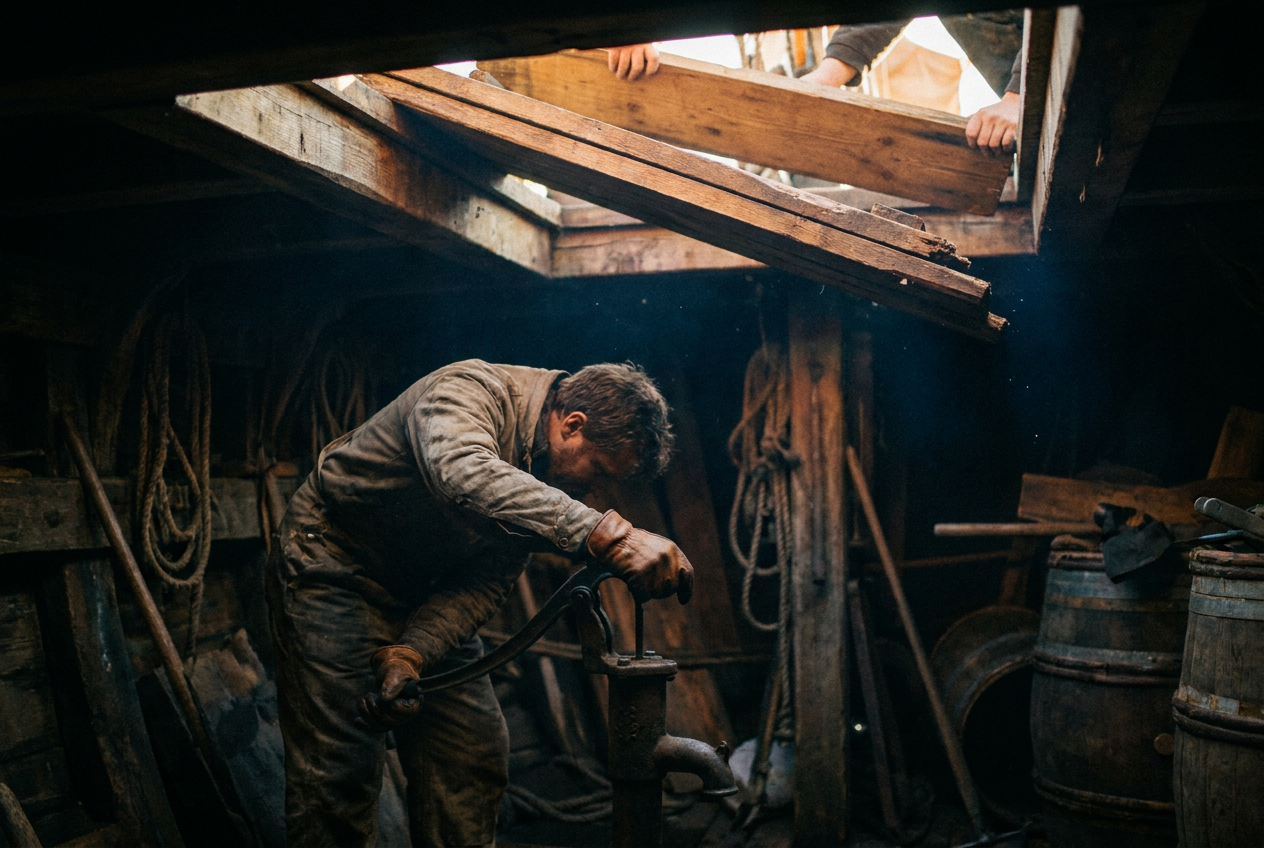
3 min readI was working the pump when Father fitted the hatch boards above us.
The lamp swung from its hook, trimming the cabin with soot. Each roll brought the deck beams close, then sent them away again. Water moved beneath the floorboards with the soft, deliberate sound of someone washing clothes.
We were carrying lamp oil and sacks of barley to the outer islands. I was thirteen, though in remembering that night I sometimes give myself smaller hands. The boat was the Patient Ruth, a broad old coaster that disliked a following sea. Father said she had been built honest, which meant that every weakness announced itself loudly.
The gale found us beyond Candle Shoal.
By dusk the mainsail had split. By dark we had lost the dinghy, half the rail, and our barrel of drinking water. Father lashed the tiller and came below to help me. There was blood in his beard where a block had struck him, but his voice remained ordinary.
“Keep her breathing,” he said.
He meant the pump.
It stood beside the mast, an iron barrel with a wooden handle polished by other hands. On the downstroke it drew from the bilge. On the upstroke it sent the water through a pipe and overboard. The leather valve wheezed like a sleeper with a cold.
We took turns. The cabin smelled of barley dust, lamp smoke, and the deep mineral smell of the sea coming where it had not been invited. Every few minutes Father lifted a floorboard and lowered the lamp. The water was not rising. It was not falling either.
Sometime near midnight, the pump became warm.
I am least certain of this part. Father later denied the warmth, though I remember him snatching his palm from the barrel. It was not hot like iron near a stove. It had the mild heat of a cup held between both hands.
Then the water coming from the spout changed. It ran clear for three strokes. On the fourth, something small clicked against the pipe and fell by my boot.
A white bean.
Father picked it up. The skin was wrinkled from soaking, but the bean itself was cooked through. He pressed it between finger and thumb, and the cabin filled briefly with the smell of onion broth.
Neither of us spoke.
The storm tightened around the hull. Boards flexed. Somewhere above, a loose length of rope struck the deck in a patient rhythm.
Father removed the pin from the pump handle. The barrel should have gone quiet.
Instead, the valve lifted by itself.
From inside the iron came the scrape of a chair across boards. We heard crockery. A spoon touched the rim of a bowl.
Then, below us, a woman said very clearly:
“Hush now. It is only weather on the ceiling.”
A child asked when the heavy footsteps would stop.
Father put his mouth to the pump.
“Soon,” he said.
The handle moved under his hand.
He worked it gently after that, not fast enough to save a leaking boat, but at the pace one rocks a cradle. With each stroke, warm water passed through the pipe. Once there was laughter, far down and muffled. Once a dog barked.
Toward morning the gale loosened. When Father lifted the floorboard again, the bilge was dry.
We reached the islands under a patched sail. He made me promise not to mention the voices, not because people would disbelieve us, he said, but because belief might be a kind of knocking.
That was more than sixty years ago. I may have confused his words with my own.
I still have the bean. It sits in a saucer beside my bed, hard and yellow now. On storm nights it rolls once around the china, though the house is level.
Last autumn, after a week of rain, I woke to hear furniture being moved above my ceiling.
I live on the top floor.