What the Bell Says
by Z. Marlow
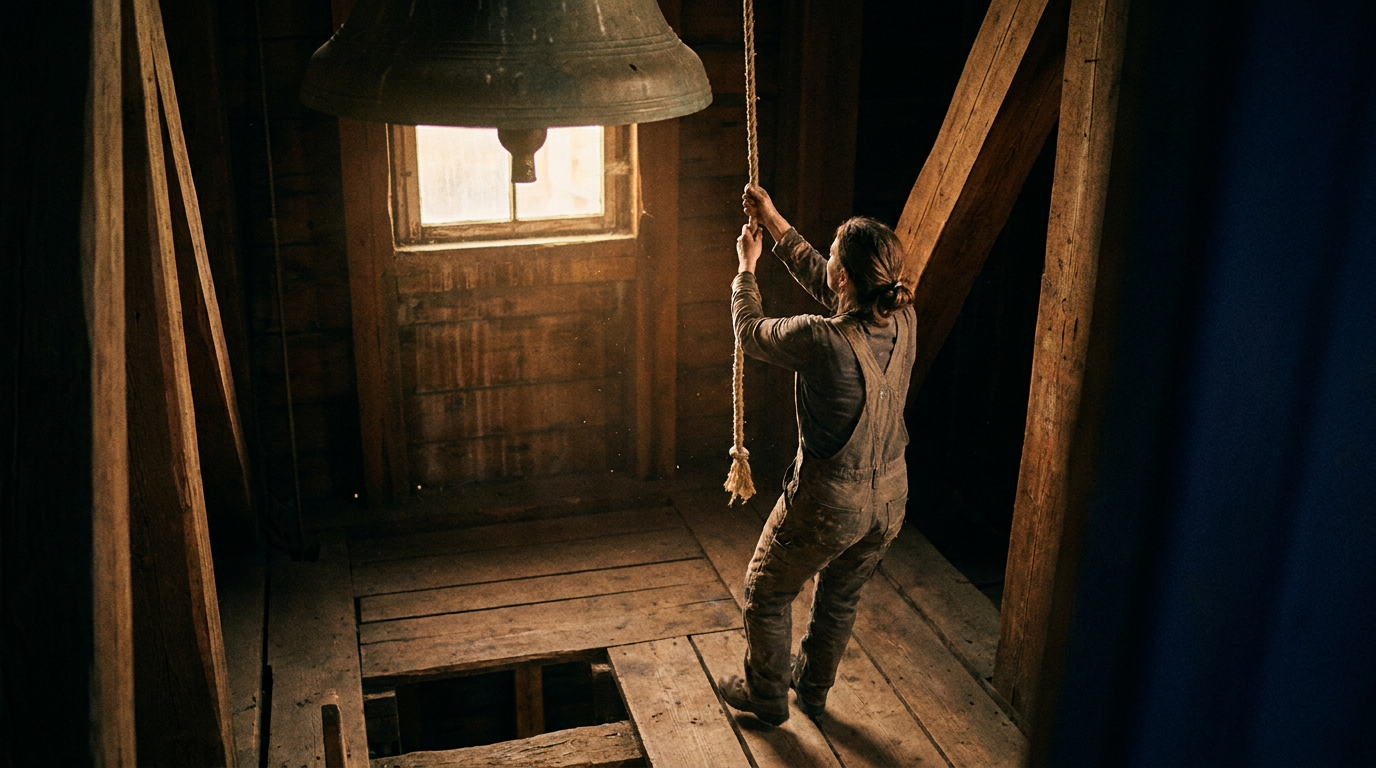
3 min readMara caught the rope as it rose and let it lift her from the boards.
Above her, the curfew bell turned in its frame. Dust loosened from the beams and drifted through the last amber light. Master Pell stood beside her with one wrist wrapped in linen, watching the rope burn a red path through her palms.
“Lean back on the fall,” he said.
“I am leaning.”
“You will be, when it falls.”
The bell had not yet sounded.
Through the tower arches, the city gathered itself for evening. Bakers carried empty trays across the square. A woman shook crumbs from a blue cloth. Roof smoke lay flat in the cold, smelling of apple wood and mutton fat.
The rope rose again. Mara rose with it.
This time the bell spoke.
Not loudly. The great bronze note rolled over the tiles as it always had, but inside it was a smaller sound, dry and precise.
Window.
Across the square, shutters closed.
Mara landed hard. “Did you hear that?”
Master Pell put his good hand over hers before the rope could climb again.
“Hear what?”
The question came too late. She had seen his face.
The bell swung above them. Its mouth opened toward the floor, black with age. Around the inner rim ran the founder’s prayer, letters cast backward so heaven might read them from within. Mara had polished those letters every spring. There had been no word for window.
The rope tugged between their hands.
Below, the lamps along Tanner’s Row went out. A breath later the bell struck.
Dark.
Mara looked over the parapet. People in the square did not hurry. They drew cloaks close and turned toward home, each believing night had come in its proper order.
“Master?”
Pell watched the bell.
“It used to keep better time,” he said.
The rope pulled them both forward. Somewhere beneath the square, bolts slid into place, cellar after cellar. Then came the bronze blow.
Door.
The word was not in Mara’s ears. She felt it behind her teeth, where words waited before being spoken.
Pell wrapped the rope once around his forearm.
“Do not repeat anything,” he said.
“What happens if I do?”
“You already asked me that tomorrow.”
The bell climbed.
For one impossible instant, Mara saw the city at dawn. Frost silvered the chimneys. Pell’s place beside the rope stood empty. Then evening returned, and the bell’s tongue struck.
Master.
Pell bent as if someone had laid a hand on his shoulder.
Mara reached for him. His wrapped wrist was warm. Beneath the linen, blood had begun to show, though the skin had not yet split.
She understood then why bells had tongues.
They were not made to tell people the hour. They told the hour what the world was called.
The rope rose once more.
All across the city, supper spoons paused. Dogs lifted their heads. In the little graveyard beyond the dyers’ wall, pale weeds leaned toward the tower.
The bell opened above Mara.
Inside its mouth, fresh letters shone in the bronze. They were small, no longer backward, and shaped in a hand she knew from labels on winter preserves, birthday ribbons, and the one note kept beneath her mattress.
Her mother had been dead since the thaw.
The word appeared before the sound.
Mara.
Master Pell seized her around the waist. The bell struck, and the city answered.
From every house came her mother’s voice, each one calling from a different room.
Mara did not reply. She held Pell’s injured hand until the voices softened into kettles, chairs, the brushing of brooms. Below, doors opened and shut. Nobody emerged.
The bell slowed.
On its final swing, another word brightened inside the rim. Neither of them knew it. It had too many curves and seemed to continue beyond its last letter.
Pell whispered, “Do not name it.”
Far under the city, something enormous turned over in its sleep.
Then the unknown word sounded, gentle as a spoon laid beside a bowl, and every threshold in the square moved one step nearer.