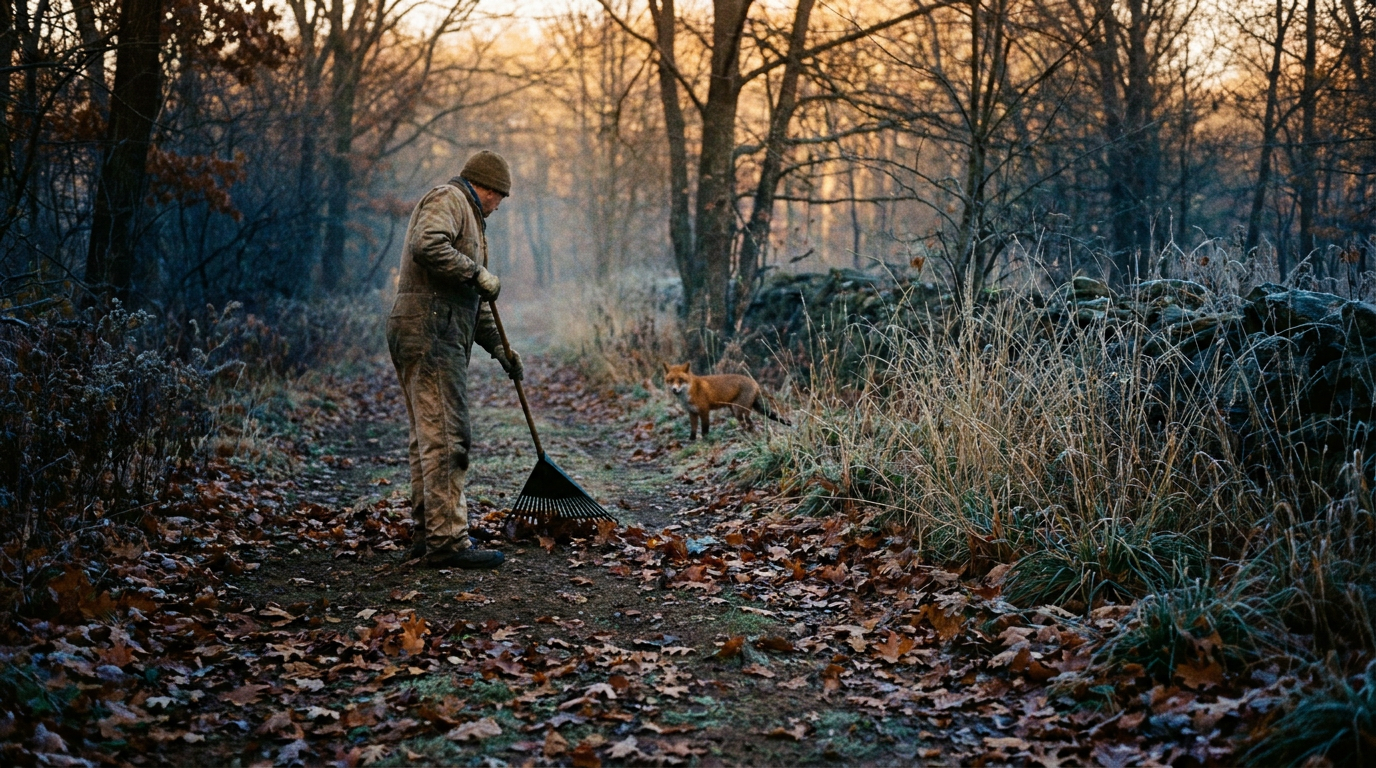
What the Fox Hears
by Z. Marlow
3 min readI clear the leaves from Bracken Row every Thursday, and the fox comes behind me.
She is a small vixen, dark along the spine, with one white forepaw. She waits while I lift the wet plane leaves from each drain, then lowers her muzzle to the iron and listens. Cars pass within a yard of her. She pays them no attention.
People here have always said the foxes count us.
My grandmother told it differently. In her telling, there was only one fox, always the same vixen, who had lived beneath the hill since the first stone channel was laid. On winter nights she visited every gutter in the village and listened at the openings. If all was well, she went back to the hill before dawn. If someone was missing, she walked to the place where they had gone.
This was how the miller’s daughter was found asleep in a snow-filled cart. It was how old Penn came home from the quarry after three days, following paw marks no snow had covered.
My grandmother did not call these miracles. She said the drains joined every house, and anything joined to a house must know something of the people inside.
The old stone channels are mostly gone. Bracken Row has black plastic pipes now, laid when I was a boy. The fox still listens.
Last November, after a night of hard rain, I found her waiting beside the grate outside my father’s bungalow. Leaves covered it to the kerb. When I drew them away, they did not slide down with the water. They lifted slightly, settled, then lifted again.
Like hair above a sleeper’s mouth.
The fox sniffed once and looked at me.
My father had begun forgetting doors that autumn. He forgot the word for kettle, though he still knew when it ought to sing. I had fitted a bell above his back door and a bright brass bolt below the handle.
The bolt was open. The bell lay on the kitchen floor.
His slippers were gone, but his coat still hung by the radiator. On the table, his tea had formed a grey skin.
I went back outside. The fox was already walking.
She stopped at every grate between the bungalow and the lower road. At each one she put her ear close to the iron. Rainwater threaded along the gutter beside us, but it was moving the wrong way. It crept uphill in narrow silver lines, gathering leaves and matchsticks, following the fox.
At the bypass she left the pavement and slipped through the brambles. Beyond them was the culvert, a concrete mouth half hidden by nettles. My father lay below it in the wash of brown water, one leg bent under him. He was cold, but awake.
Before I climbed down, I heard him calling me.
Then I heard it again, from inside the culvert.
It was not an echo. The second call came first.
The fox stood above the pipe with her white paw on the rim. All the little streams in the road had gathered there, trembling toward my father as if the village itself were trying to remember where it had put him.
He recovered. Some mornings he knows me, and some mornings he calls me by my uncle’s name. He remembers the fox perfectly.
“She was not looking for me,” he said once. “She was listening for you.”
Since then I have watched her make her round. She listens at the drains, the water meters, the square covers for the new fibre lines. Sometimes she passes on at once. Sometimes she waits.
This morning she has been sitting outside my house for nearly an hour.