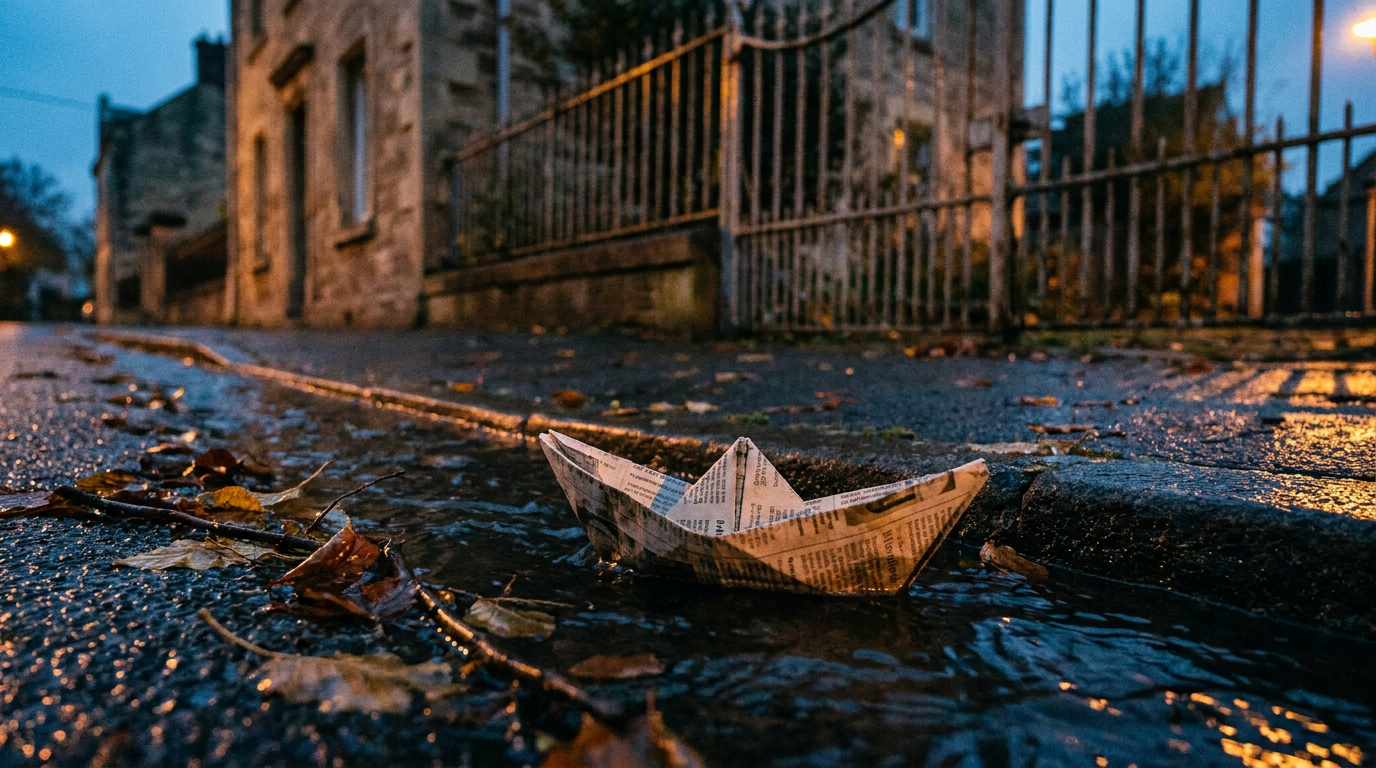
What the Gutter Kept
by Z. Marlow
3 min readI was sailing a paper boat along the gutter when it passed our gate for the second time.
At least, that is how I remember it. Marlin Street sloped toward the river, and after rain the water ran brown and quick beside the kerb. Nothing could have come back uphill. Yet there was my boat, softened at the corners, turning slowly past the privet hedge.
I had made it from one of Mum’s blue envelopes. I knew it by the silver lining and the word Dentist showing on the sail.
This was before my brother was born, although sometimes I remember him watching from his pram. Memory has put him there because it dislikes an empty pavement.
The boat passed our house and went on toward the storm grate at the corner. I followed, dragging a stick through the water. Near the grate, the current deepened. The boat tipped sideways and vanished between the iron bars.
Then it came around again.
It emerged from the gutter above Number Twelve, where there was no opening I could see. It sailed neatly around a crushed pear, passed the red bicycle outside the Coopers’ house, and approached me with the patience of something accustomed to being waited for.
The third time, I knelt beside the grate.
There was a smell of wet stone and old pennies. Water whispered below. I put my fingers through the bars, meaning to catch the boat before it disappeared.
A hand rose from the darkness.
It was an adult hand, pale in the brown water. There was a small crescent scar below the thumb. The fingers took hold of the boat, turned it once, and set it carefully back into the current.
I ran home.
Mum found me behind the pantry door with wet knees. She did not laugh when I told her. She wrapped me in the yellow bath towel and made toast on the long fork over the gas ring. I remember the blue flames, each with a transparent little heart.
“Drains join places,” she said. “That is all.”
I asked what place the hand had joined us to.
She spread butter to the corners.
“Somewhere else in the rain.”
For years I thought this was one of her evasions. Mum had a gentle way of leaving a door open in her answers, so that childhood could pass through without bruising itself.
Marlin Street was resurfaced long after she died. I went back because the house was being sold, or had been sold already. The order changes whenever I think about it.
Rain had polished the new tarmac. The privet was gone, but the storm grate remained at the corner, set lower now, with fresh cement around its edges.
I had a folded letter in my pocket. It was from the solicitor, though I cannot remember what it said. Without considering why, I made it into a boat.
The gutter carried it downhill.
At the grate, it caught against a twig. I knelt and reached through the bars. The iron was colder than I expected. Beneath it, the drain bent sharply away, but not toward the river. A narrow channel ran uphill under the street.
I pushed my hand into the water.
On my palm, just below the thumb, was the crescent scar I had got years before from Mum’s gas ring, while lifting the kettle during her last winter.
Small fingers touched mine through the dark.
I turned the boat once and set it into the hidden current.
Only then did I remember the hand correctly. It had not risen to give the boat back.
The child had been holding on to it.
The water took the letter uphill. Somewhere beyond the bend, a stick tapped along the kerb, bright and irregular. I stayed there until the rain thinned, listening to my own small footsteps approach from a part of the street that had been paved over.
There are no open gutters on Marlin Street now. Still, after heavy rain, paper gathers at the corner grate: receipts, envelopes, the pale folded wings of things sent from houses that are no longer there.