What the Main Remembered
by Z. Marlow
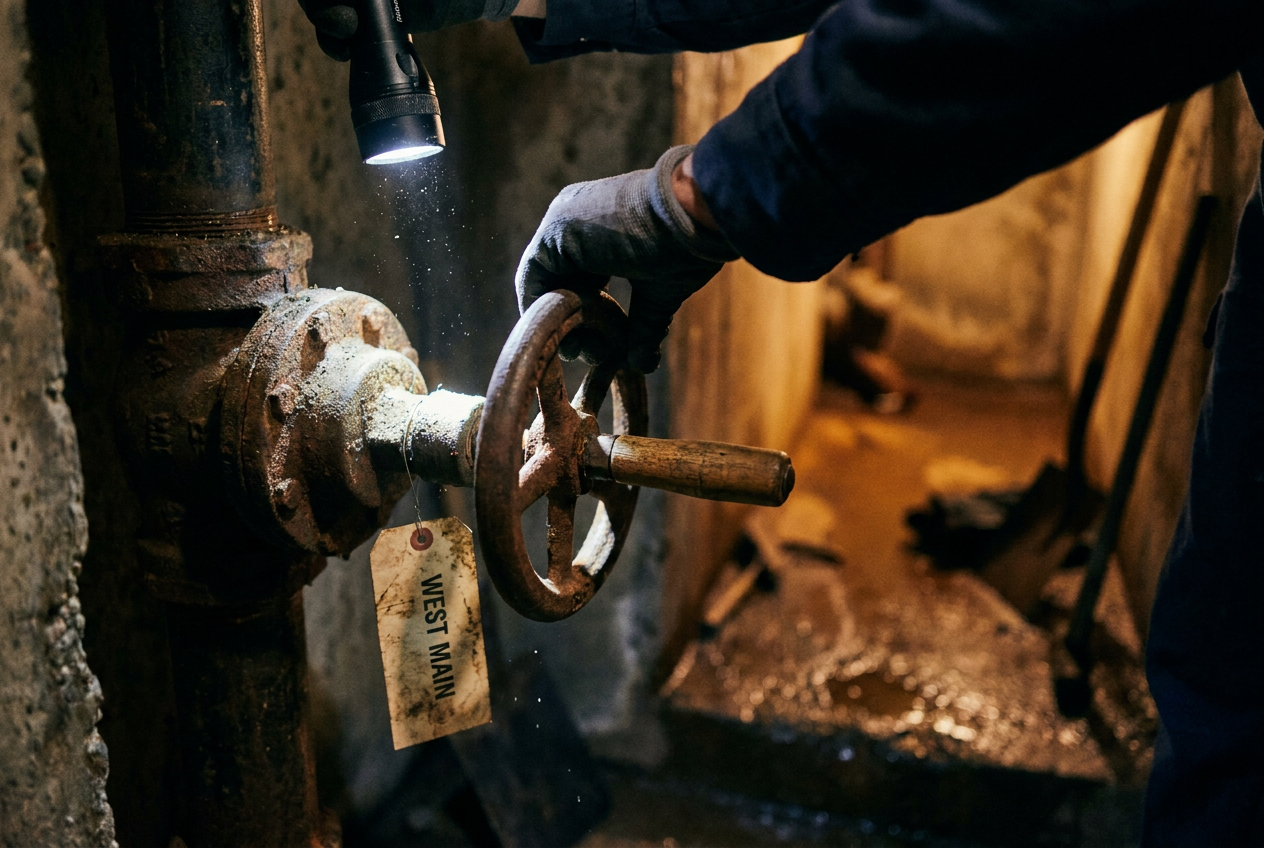
3 min readI turn the wheel until the pipe knocks beneath the road. That is how I know the west main is closed, whatever the men with newer keys may tell you.
You asked about the girl. The pipes come first.
A turncock learns the town by pressure. Hawthorn Row complains in the mornings, when kettles are filled. The tannery pulls hard after dusk. At the almshouses the water moves quietly, though more is taken there than anywhere. Old Senn taught me to feel these things through the iron key.
“Water knows its customers,” he said. “Never let it serve itself.”
I thought this was turncock talk, like saluting a burst main or leaving a cup beside an open trench. Every trade keeps a little foolishness to make its dangers feel domestic.
Each spring we flushed the dead end beyond Tallow Lane. The main stopped under an orchard wall, where no house had stood within memory. We opened the scour valve and let the winter water spill into the ditch.
Usually it came brown, smelling of pennies and roots. Once it brought a wooden spoon. Once, a quantity of white hair.
The year after Senn was buried, something pale folded through the valve.
I shut the flow. Not quickly enough.
There was an arm in the ditch, then a shoulder. The water kept arranging itself. Mud darkened where the eyes should be. Apple blossom stuck along the little ribs.
The old warning returned to me then. I took up my spade.
This is the part you dislike. You must understand that such shapes are soft at first. A boot will do. Senn had shown me one years before, no larger than a rabbit, with an old man’s mouth opening and closing in the runoff. We broke it apart and stood watching until the pieces forgot one another.
It is not killing. Not then.
But the girl in the ditch had my Ada’s left hand. The smallest finger bent inward, just as hers had since birth. She had the mark beneath her chin where the broth scalded her, though that happened later. Or had happened already. There are mornings when I cannot place the orchard on the proper side of the funeral.
I wrapped her in my coat.
At home, I laid her beside the stove and poured warm water between her lips. By evening she had weight. By midnight she was breathing. My wife sat across the room with both hands pressed to her mouth.
Ada was asleep upstairs.
That proves nothing. A main carries water to every basin, every kettle, every child with a cup held in both hands. It learns us from within. I had believed the thing in the ditch was copying Ada.
I know better now.
Ada had been copying it, one drink at a time.
My wife wanted the spade. I would not allow it. We had buried one daughter already, although, as I said, that may have been afterward.
The ditch girl woke before dawn. She looked at me without surprise and asked why we had put her inside a house.
We called her Mercy. She ate little, but drank whenever the pipes muttered. Ada loved her at once. Children have fewer objections to being doubled. They shared a bed, then dresses, then memories. Each accused the other of dreaming the orchard.
You wish me to say which one remains.
I cannot. My wife chose, in the end, and took the other to the river. She came home alone, soaked to the waist. For years afterward she refused water unless it had been boiled.
Mercy, or Ada, is grown now. She lives beyond the west main with children of her own. None resembles her except when wet.
That is why I still close the valve each spring. The town has replaced the orchard with brick houses, but the dead end remains under their kitchens. Sometimes, with my key against the wheel, I feel small hands turning it from below.
Last night there were more than before.