When the Street Opens
by Z. Marlow
3 min readWe opened Market Lane before sunrise, and by breakfast the chairs had begun to arrive.
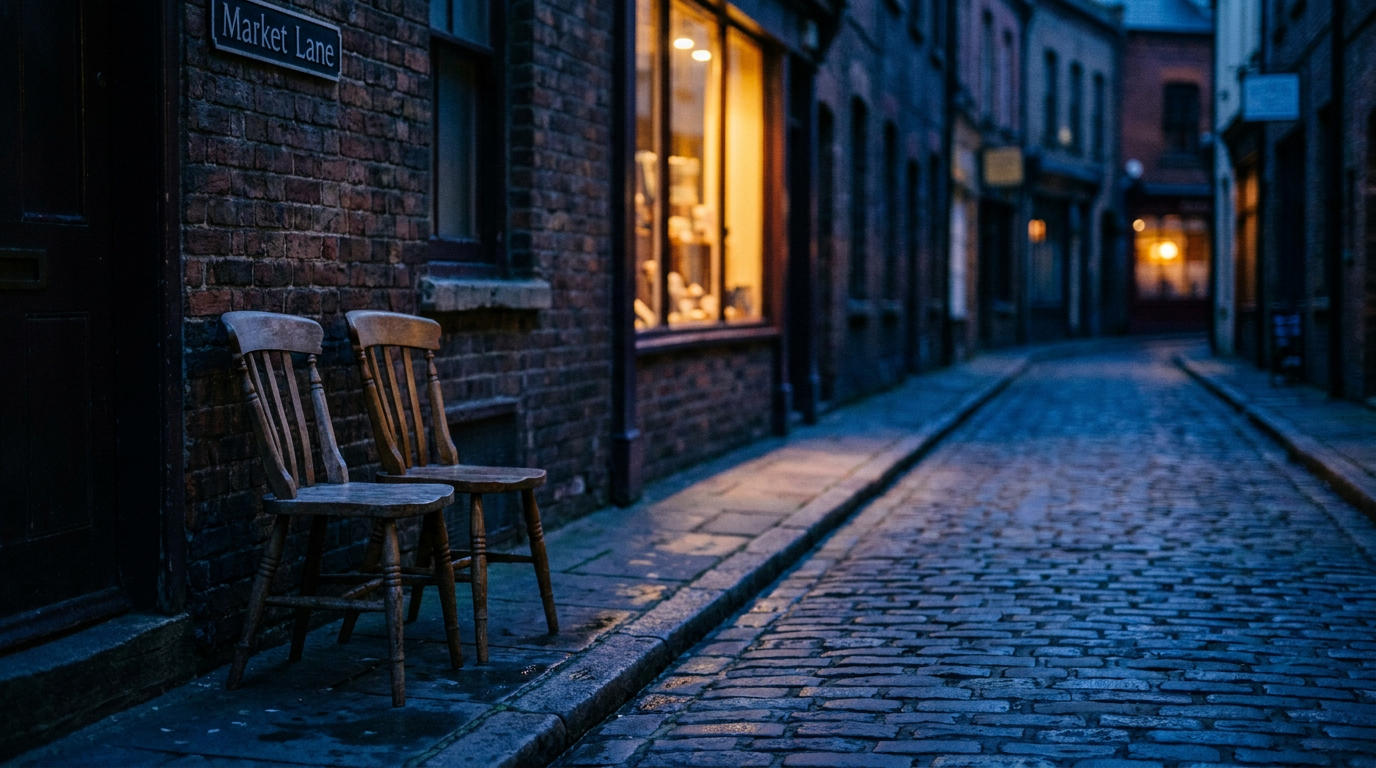
They came from kitchens, sheds and upstairs rooms: spindle-backed chairs, folding stools, an armchair with its stuffing showing through one elbow. The townspeople set them along the barriers and sat facing the trench.
No one spoke above a murmur. Mrs. Vale brought tea for my crew. She had knitted woollen sleeves for the metal cups so our hands would not stick to them in the cold.
This is the custom in Bellwether. Whenever the street is opened, someone must sit beside it until it is closed again. Children are excused after dusk, but many stay. They wrap themselves in blankets and watch the men work.
Ask why, and people tell the story of Old Mara Pell.
Mara lived where the butcher's shop stands now. One winter, roadmen dug outside her house to mend a cracked water pipe. They left the trench unwatched overnight. In the morning, Mara's husband was gone, though his boots remained beside the stove and the door was still bolted.
Mara took a chair into the snow and sat by the trench until spring.
Some say she heard him walking underneath. Some say she heard herself, calling from a great distance. When the roadmen filled the hole, she thanked each of them and went home. After that, whenever a spade struck the road, Mara carried out her chair.
Others copied her. They have been copying her ever since.
I had heard the story as a boy. I never believed it, but I never mocked it either. In a small town, customs outlive their reasons. We still salt the church steps, though the church has been empty for years.
The burst pipe lay deeper than expected. At noon, the excavator bucket struck stone.
Not rubble. These were fitted blocks, dark with damp, laid in a smooth curve beneath the lane. We cleared the soil with hand tools. A gutter appeared, then the iron rim of a drain.
The drain was facing downward.
I lay on a board across the trench and brushed clay from the stones. Their upper faces were rough and unfinished. Their lower faces, visible through a gap near the pipe, had been polished by wheels and weather.
There was a street beneath ours.
Not buried. Not ruined.
In use.
For a little while, none of us moved. From below came the faint clop of hooves, though Bellwether has not kept working horses within my memory. A cart passed under us. Its wheels rattled across the hanging stones, and dust sifted up through the drain.
That was when I understood the chairs.
We had not dug down into another street. We had opened its sky.
Mrs. Vale stood and placed her cup on the pavement. All along the barriers, people did the same. The small sounds ceased: no coughing, no scrape of shoes, no rustle of paper around sandwiches.
Below us, the cart stopped.
A man called something in a voice too muffled to make out. Then came the sound of a chair being dragged over stone.
It settled directly beneath Mrs. Vale.
We repaired the pipe without widening the trench. By evening, the blocks were covered, the soil tamped, the road sealed black and shining. The townspeople took their chairs home one by one.
Mrs. Vale left hers.
It stands beside Market Lane still, chained to the barrier until the new surface has cured. Each morning there is frost on the seat.
Except for one round place in the middle, about the warmth and size of a resting hand.