Where the Road Drinks
by Z. Marlow
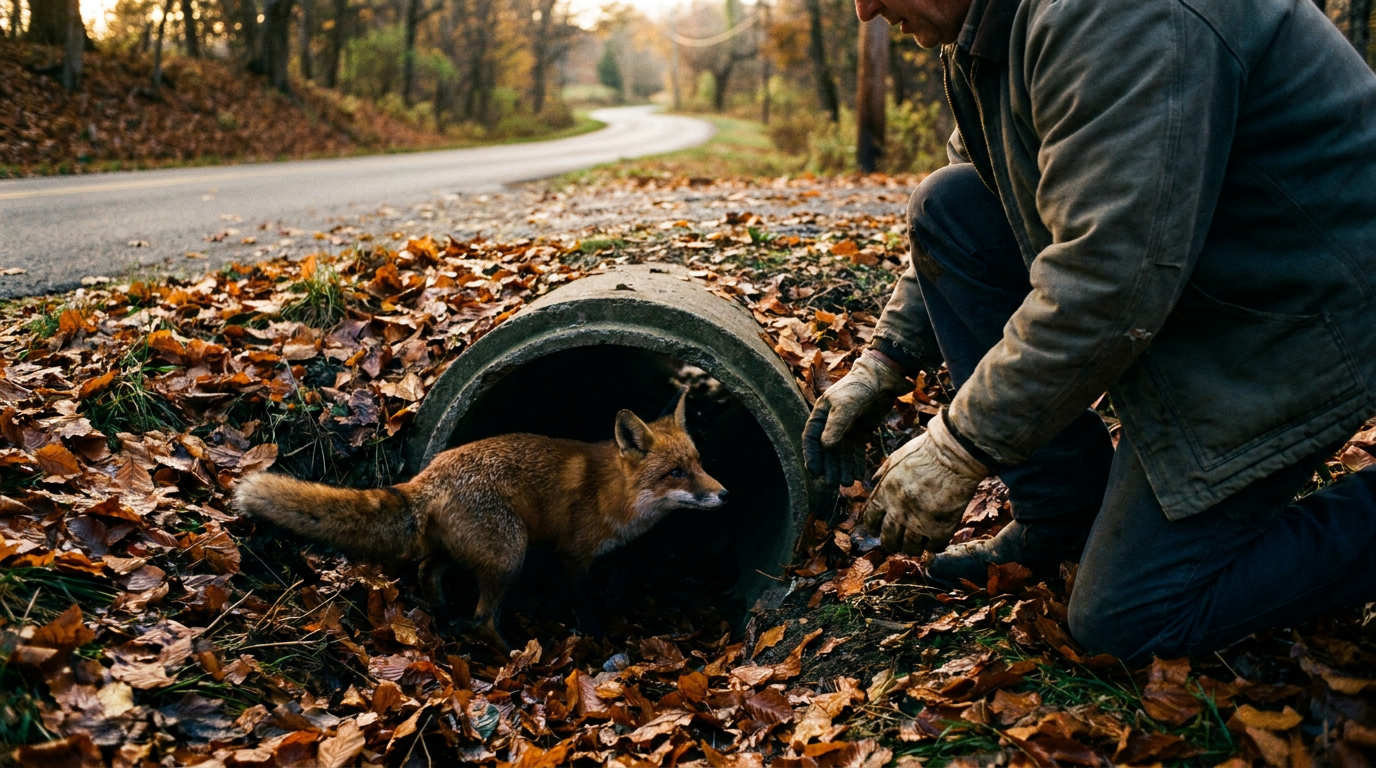
3 min readI was clearing leaves from the culvert when the fox came out.
She stepped between the rusted bars without turning sideways. Her coat was the dark red of wet bricks, and one ear ended in a neat black point. She looked at me, sneezed once, then crossed the lane and vanished into the hedge.
There was no opening on that side.
Old Mara Vale had told me about the fox years before, although in her telling it happened afterward. She was nearly blind by then and spoke of local things as if remembering tomorrow.
“When they laid the lane,” she said, “the men kept finding her paw marks in the mortar. So they left her a way through.”
The lane is older than tarmac but younger than the stream beneath it. It runs from the churchyard to the upper farms, bending for no reason beside a field where nothing has grown within anyone’s memory. Our council sends me twice each autumn to lift branches from the drains. It is quiet work. The iron grates smell of pennies, and the water under them carries pale beech leaves flat against its back.
Mara called the fox Brindle, though no fox of that name appears in parish stories. Brindle knew every road before it was built. She would sit where a bridge must go, sleep where a milestone would stand, and give birth beneath places where travelers would later wait in rain.
People thought she foretold the roads.
Mara said this was vanity.
“A culvert is the piece of the old world the road agreed not to close.”
That morning, after the fox disappeared, I crossed to the hedge. There was only thorn, clay, and a crushed drinks tin shining among the roots. Yet under the lane I could hear claws moving through the pipe.
They went away from me.
Then they came closer.
I returned to the grate and shone my torch between the bars. The culvert should have been straight. I had seen daylight through it every autumn for twelve years.
Now the beam found a bend of fitted stone. Water ran around it and continued somewhere beyond sight. On the mud lay a child’s yellow glove.
My daughter owned a pair like it. Her grandmother had knitted them with crooked thumbs, one longer than the other. That day, both gloves were still in my daughter’s schoolbag. I checked when I collected her.
She lost the left one the following Tuesday.
I did not tell her where I had found it. Children accept too easily what adults have spent years learning not to see. I washed the mud away and set it beside its partner on the radiator. Steam rose from the wool with a smell of rain and burrow earth.
That night my daughter asked whether foxes remember us before we are born.
I asked why.
She said she had dreamed of crawling beneath the lane. Brindle went ahead, her tail brushing the roof. There were openings on either side, each showing a different afternoon. In one, Mara Vale sat beneath an apple tree, young and laughing. In another, I knelt at the grate with my torch.
“And there was one with you much older,” my daughter said. “The fox wouldn’t let me look for long.”
The next autumn, the culvert was straight again. No fitted stones, no bend, no paw marks. Water moved through it toward the lower fields, as water ought.
I still clear the leaves.
Sometimes, when the road is wet, small footprints appear at its edge. They do not cross from hedge to hedge. They begin in the middle of the tarmac and lead down through the black surface, one by one, as if the lane were only shallow water.
My daughter is grown now. She drives that way to work.
Brindle always appears before she does.