Where Warmth Returns
by Z. Marlow
3 min readYou follow Juniper into the boiler cupboard because she has taken your left slipper there again.
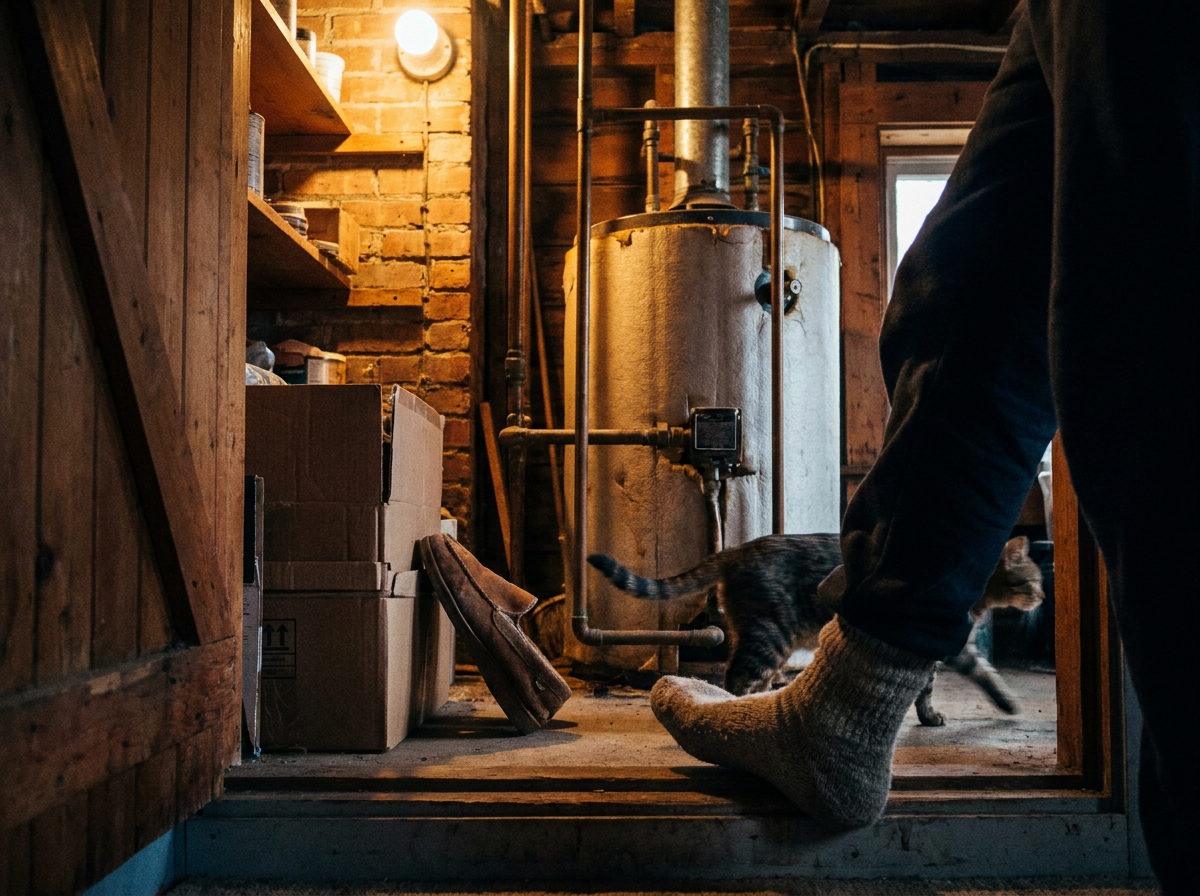
She is slow now. Her hind feet whisper across the linoleum, and she pauses at the threshold as if waiting for someone to open a second door. Inside, the pipes rise through the ceiling, painted the same cream as the walls. One is hot enough to smell faintly of dust.
Juniper sets the slipper beside it.
There are other things behind the boiler: a teaspoon, your wool glove, the photograph of your mother standing knee-deep in the sea. You thought these things lost. Juniper has arranged them in a crescent around the return pipe.
You carry everything upstairs except the slipper. She watches you with the mild disappointment of an old teacher.
This happens before the appointment, though later you will remember it afterward.
The caretaker says the return pipe brings cooled water back from the upper floors. He kneels with one palm against it, listening to the knocks.
“Air in the system,” he says. “Old buildings collect it.”
That night, Juniper sleeps in the cupboard. When you try to lift her, she makes a sound you have never heard from her, not a growl, but a plea spoken too low. You bring down her blanket instead. The red one with the chewed corner.
Near midnight, three taps pass through the pipe.
Juniper answers with her tail.
The following morning, the boiler is cold. The building has gone quiet after rain. Still, the return pipe is warm beneath your hand.
You hear a collar jingling somewhere inside it.
Years ago, when Juniper was small enough to carry under one arm, she vanished in the park. You called until your throat tasted of pennies. At dusk you found her beside a heating grate behind the public baths, nose pressed to the ironwork, tail beating the wet leaves.
You believed she had heard you calling through the underground pipes.
You were right about the pipes.
You were wrong about when.
On the evening before the appointment, Juniper refuses supper. She takes each mouthful from your fingers, carries it downstairs, and places it beside the return pipe. A neat little offering of chicken and rice.
Then she leans her forehead against the metal.
At first there is only the water moving, a dark, domestic murmur. A cupboard door closes far above. Someone laughs. You hear a kettle begin to boil, though no one in the building is awake.
Then your own voice comes through the pipe.
It is flattened by distance, older and tired with weeping. Every word is clear.
“Juniper, if you can hear me, find the warm place. I’ll come after.”
You have not said this.
Juniper turns to look at you. Her cloudy eyes are peaceful. She has spent all winter listening to your grief arrive before you.
That is why she brought your things here.
She thought you were lost.
After the appointment, you return alone.
You do not mean to go downstairs. You find yourself there with her collar in your hand and the red blanket against your face. The cupboard smells of warm iron and the lavender soap used on the stairwell.
You kneel beside the return pipe.
The sentence comes without choosing. Exactly as you heard it.
When you finish, three soft knocks answer from another evening.
In spring, the heating is turned off. You move Juniper’s bowl into the cupboard anyway and fill it each morning. This seems foolish, but grief permits small foolishnesses, and the water is sometimes lower when you come home.
Once, you find wet pawprints leading from the bowl to the cream-colored pipe.
They are too small to be Juniper’s.
Lately, before the radiators warm, you hear a young dog scratching gently inside the walls. You have begun leaving the cupboard door open.