While the Light Waits
by Z. Marlow
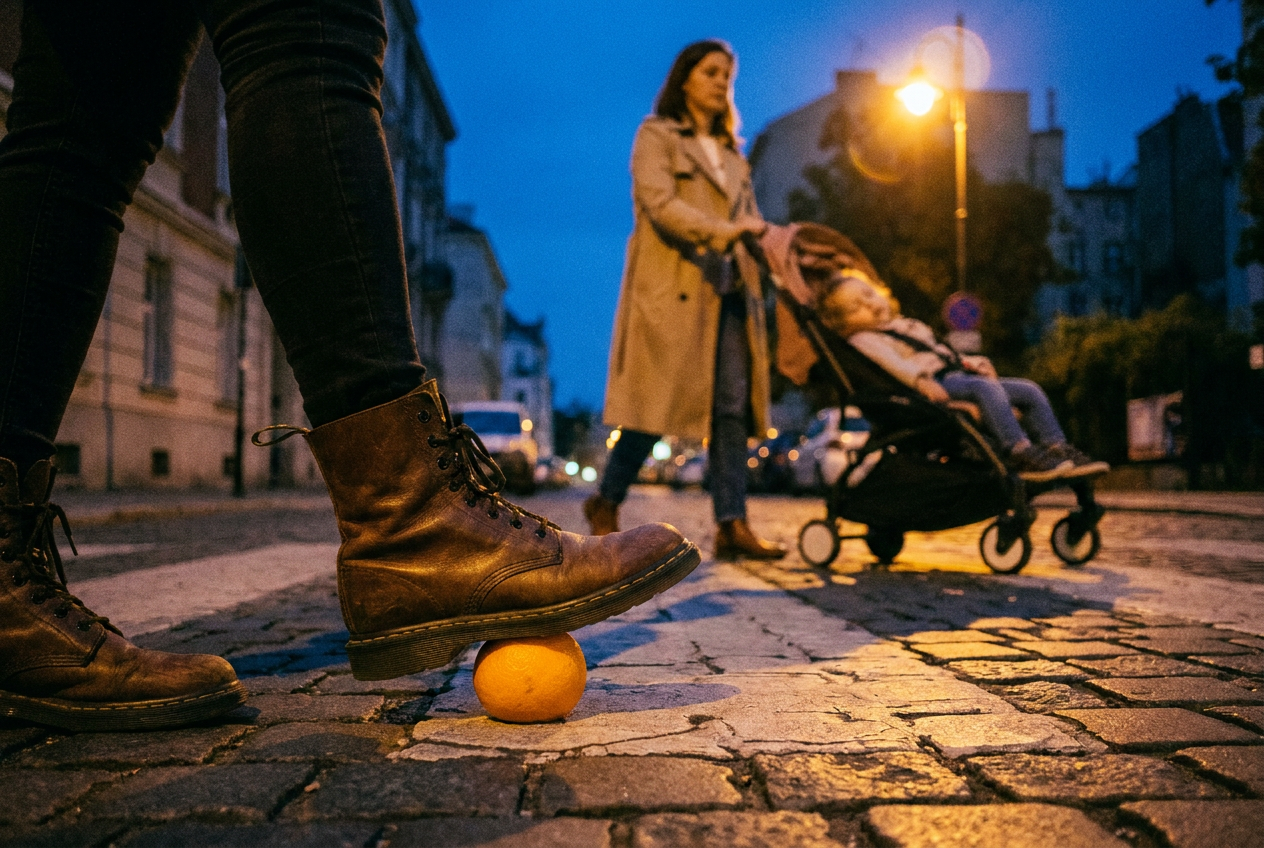
3 min readYou drop an orange at the crossing, and it rolls neatly beneath the shoe of a woman with a sleeping child.
She returns it without waking him. By then the green figure has gone, so you both remain on the kerb, holding your shopping while the traffic passes. The orange smells faintly of pavement dust.
“Always the way,” she says.
You press the button again.
There is a small cone underneath the yellow box. You have used this crossing for years without noticing it. The cone turns when the green figure appears, for people who cannot see the light. You discover it because your thumb is occupied with the orange and you reach beneath the box with two fingers.
The cone is already turning.
The traffic still has green. A delivery van passes, followed by a bus whose windows are filmed with rain. The woman beside you says nothing. When the signal changes, the cone stops.
That is the first discourtesy.
You show Jo the next evening. Jo says it is probably loose wiring, because Jo believes loose wiring accounts for most of creation.
“Thunderstorms,” Jo says. “Migrating birds. Your aunt’s Christmas lights.”
You stand at the crossing after supper, taking turns beneath the button. The cone does not move early. Instead, something presses lightly against your fingertip.
You look beneath the box. There is only the black cone, ridged like a small mechanical acorn.
“Gum,” Jo says.
“It moved.”
“Ambitious gum.”
Then Jo puts a finger there and becomes quiet. After a moment, Jo pulls away.
“What?”
“Nothing. Static.”
The green figure appears. You cross.
After that, you test the cone whenever you pass. Most days it behaves. Sometimes, while the red figure shines, you feel other fingers resting against yours.
A broad thumb. A child’s sticky knuckle. Once, unmistakably, a woollen mitten.
The contacts last only until the light changes. You begin tapping greetings. Most fingers do not answer, but some do. Two taps become hello. Three mean the weather is foul. A rapid drumming means you are late and blame the crossing.
Jo contributes a rude pattern that requires both hands.
It is funny for a while.
A man from the roads department opens the box one morning. He smells of peppermint and wet canvas. You ask whether the cone can retain pressure somehow.
“It can retain rainwater,” he says. “And wasps.”
He replaces a spring. The fingers continue.
In April, Jo dies while rinsing two cups at the kitchen sink. There is no useful warning. One cup breaks; the other remains upright beneath the running tap.
For several months you avoid the crossing. You go the long way past the pharmacy, where the pavement tilts and rain gathers in the cracks. The orange woman passes you once, her child now walking beside her. Neither recognises you.
In November, carrying nothing, you return.
The red figure is lit. You place your fingers beneath the box.
At first there is only the cold cone. Then someone touches you with two fingers and taps Jo’s rude pattern.
You answer with two taps for hello.
The fingers reply.
You press twice, pause, then once, a pattern you have never used. The answer comes twice, pause, then once.
They are not an echo. Somewhere on an ordinary evening, Jo has felt you become a ghost.
The light changes. Cars stop. The cone turns beneath your hand, but neither of you lets go.
Behind you, someone clears their throat. A cyclist rings his bell. The green figure begins to blink.
Jo’s fingers withdraw at last.
You cross slowly. Halfway over, you remember that first evening, Jo’s face under the amber streetlamp, the quick removal of a hand.
Static, Jo said.
On the opposite kerb, a little girl is reaching beneath the other button while her father watches the traffic. She smiles at something you cannot feel yet.
You wait until she looks up.
Then you raise your hand.